 MMXXVI
Parcevals saga ok Valvens þáttr: the young Parceval, the question he did not ask and Valven's adventures in the Norse version of Chrétien
The Parcevals saga and Valvens þáttr are the Norse version of Chrétien de Troyes's Perceval, with a separate tale about Valven's adventures. See the plot, the relation to Erex saga and Ívens saga, the abrupt ending and what is debated about King Hákon's commission.
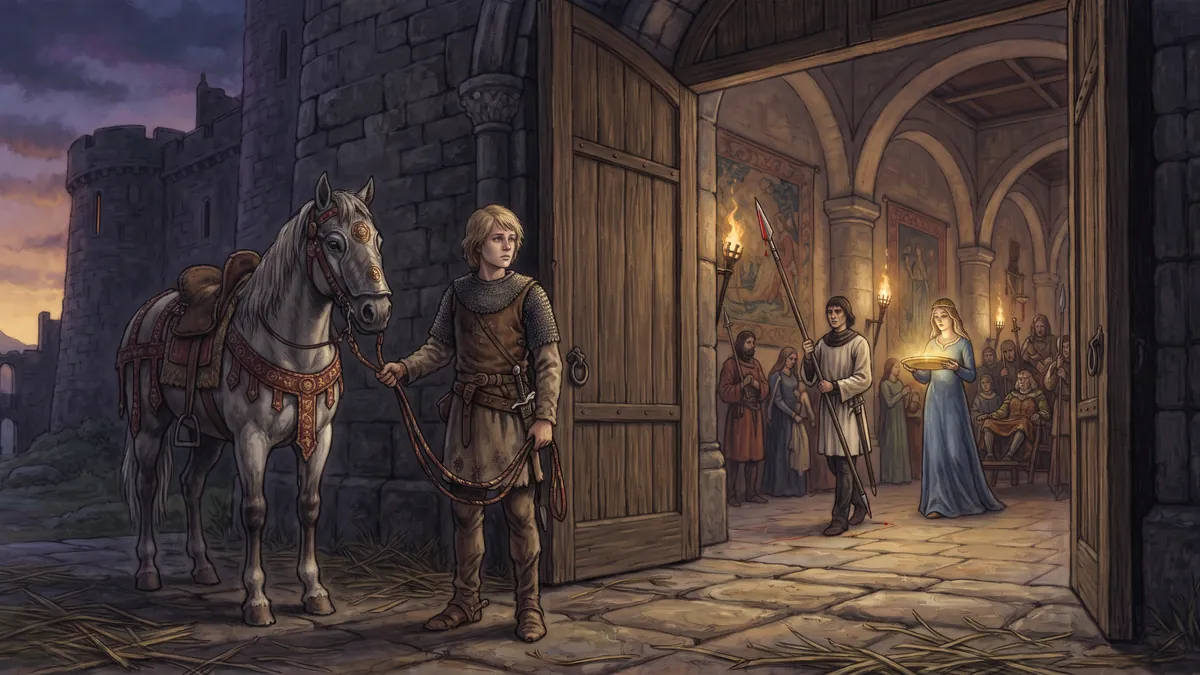
The Parcevals saga ok Valvens þáttr is the Norse version of Chrétien de Troyes’s Perceval, or Le Conte du Graal. It belongs to the group of chivalric sagas usually associated with King Hákon Hákonarson of Norway. According to Geraldine Barnes, Erex saga was probably written alongside Ívens saga and Parcevals saga, and Parcevals saga may also have been commissioned by the king, though that is only a hypothesis.
The young Parceval
Chrétien’s romance begins with a boy raised in the forest by his widowed mother, who keeps him away from chivalry. Parceval meets knights, decides to become one and goes to King Artús’s court. He learns the craft, wins the lady he loves and, in a castle, sees a strange procession: a bleeding lance, a precious dish, a wounded king. He stays silent, without asking what it means. In the morning, the castle is empty.
The question
That question not asked is the centre of the romance. In Chrétien, Parceval’s silence will cost dearly, and he spends the rest of the work trying to understand what he lost. The Norse saga translates the story, but ends abruptly. According to scholarly analysis, Parceval never asks the question about the king’s suffering, and yet lives happily. In Wolfram von Eschenbach, the question is essential.
The Valvens þáttr
The Valvens þáttr is a separate narrative strand, centred on the adventures of Valven, the Gawain of Arthurian legend, which Chrétien interleaves with Parceval’s. The saga presents them together. Like Ívens saga, it uses repeated structures to link passages similar in theme, and its author attempted end rhyme, although the text is in prose.
An open debate
Date, authorship and link with the court remain under discussion. Ívens saga and Parcevals saga belong to Hallberg’s so-called “Tristram group,” but Blaisdell doubted the grouping, and it is not known whether the author was Norwegian or Icelandic. Studies treat the author as someone who made a work, not as a mere translator.
Why it matters
Chrétien’s Perceval was left unfinished. The Norse saga carries the story into another language and leaves it with an abrupt ending, preserving in Norse one of the most discussed texts of medieval literature.
To run through the forest to the castle, gathering the golden dishes, play Parceval’s forest.
Sources.
- Marianne E. Kalinke and P. M. Mitchell, Bibliography of Old Norse-Icelandic Romances (Cornell University Press, 1985)
- Geraldine Barnes, entry on Erex saga and the chivalric sagas, in Medieval Scandinavia: An Encyclopedia (Garland, 1993)
- Academic theses and articles on the transmission of Chrétien de Troyes's romances to Old Norse literature (Durham and other universities)