 MMXXVI
Home of the gods
Asgard (Old Norse Ásgarðr, “the enclosure of the Æsir”) is the dwelling of the main gods of the Norse pantheon. According to the Prose Edda, it was built in the middle of the world by the sons of Bor (Odin, Vili and Vé), after they killed the giant Ymir and shaped the earth from his body.
Asgard lies high above and is joined to Midgard, the world of humans, by the bridge Bifröst, the rainbow. The bridge is watched by Heimdall, the gods’ guardian, who always keeps the horn Gjallarhorn at his side.
The halls of the gods
In the poem Grímnismál, Odin lists the dwellings of the gods. Breidablik is the home of Baldr; Fólkvangr is the field where Freyja receives half of the warriors killed in battle; Valhalla (Valhöll) is Odin’s great hall, where the valkyries bring the chosen warriors, the einherjar, who train and feast there until the last battle.
From his high seat, Hliðskjálf, Odin could see all the worlds.
The wall and the eight-legged horse
A builder offered to raise a wall around Asgard. The gods gave him one winter and agreed the price: Freyja, the Sun and the Moon, if the wall was finished on the first day of summer. At Loki’s urging they let him use his stallion Svaðilfari, who hauled stones with astonishing strength. A few days before the deadline, Loki turned himself into a mare and lured the stallion away. The wall was not finished. The builder was a giant, and Thor killed him with the hammer Mjölnir.
From this adventure came Sleipnir, Odin’s eight-legged horse, the child of Loki and Svaðilfari.
The root among the gods
One of the three roots of Yggdrasil, the great tree that holds up the worlds, reaches the Æsir. Beneath it lies the well of Urðr, where the Norns water the tree and where the gods meet every day to hold court. At the end of time, in Ragnarök, Bifröst breaks under the riders of Muspelheim and Asgard falls. But the Völuspá ends with a new green earth rising from the waters.
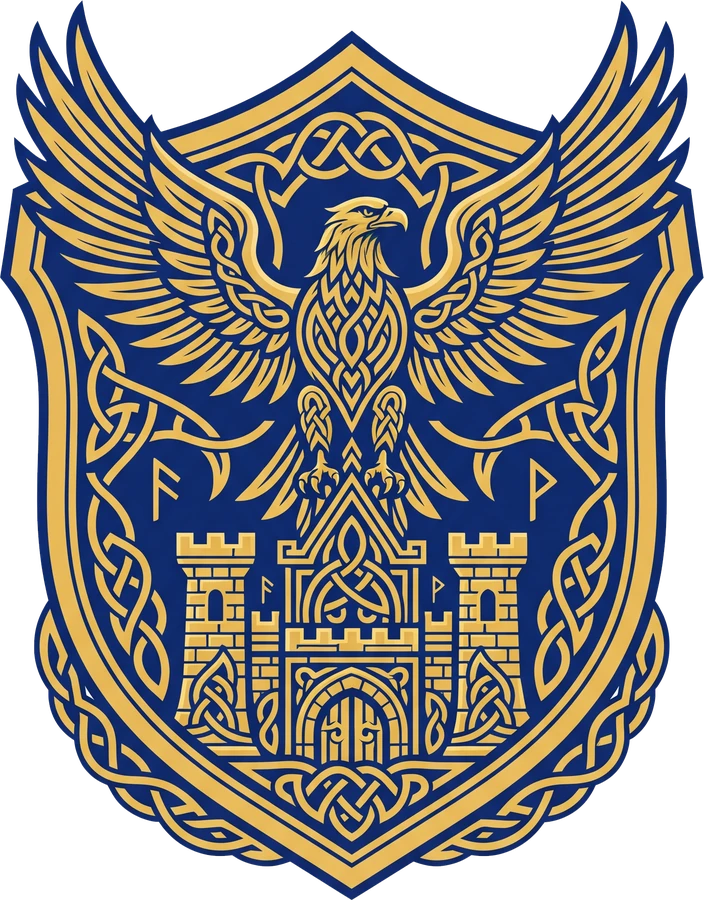
About the crest: the golden eagle above the fortress is an artistic reading. In the sources, an eagle sits at the top of Yggdrasil, with the hawk Veðrfölnir between its eyes (Gylfaginning). The interlaced knots recall Viking decorative art.