 MMXXVI
Reykdæla saga: Áskell goði, the gravel bank of Leyningsbakki and the farm that now holds a power station
Reykdæla saga tells how Áskell, chieftain of Hvammr, on the bank of the river Laxá, feels he will be killed and chooses the bank of Leyningsbakki to be buried; the place still exists, near a hydroelectric power station.
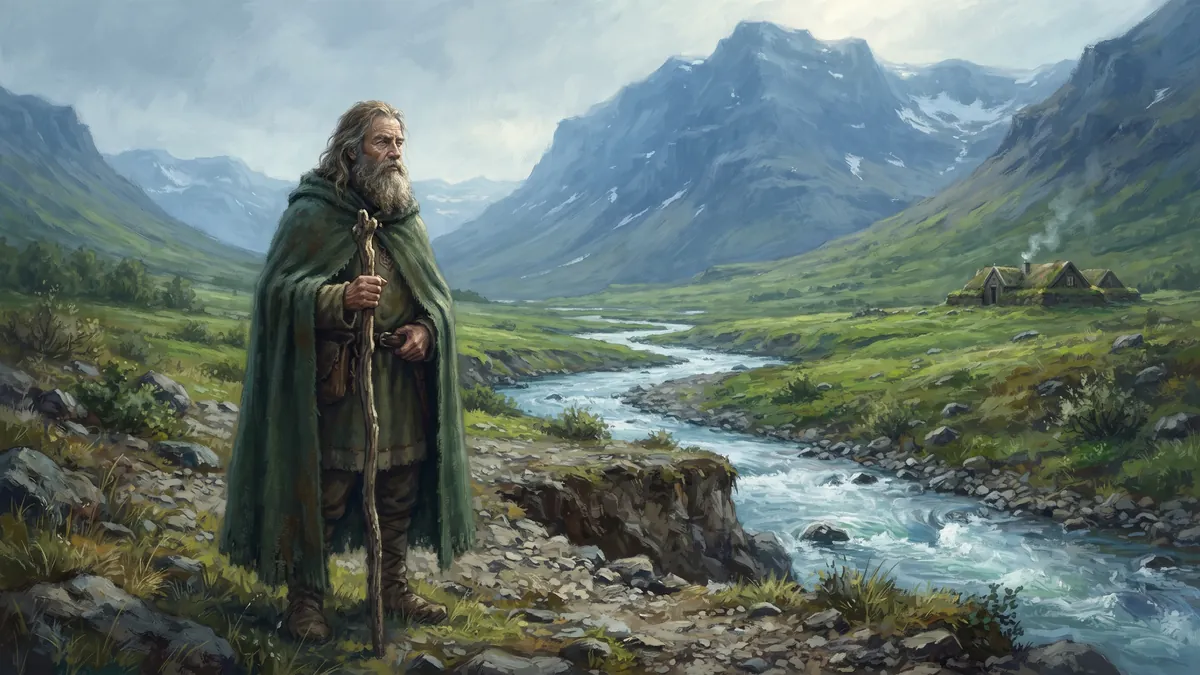
Reykdæla saga is an Icelandic saga about the valley of Reykjadalur, in the north of Iceland, and about the family of a chieftain, Áskell, and of his son, Víga-Skúta. It covers the period between 970 and 1000.
The chieftain of Hvammr
Áskell is a goði at Hvammr, by the river Laxá. The saga describes him as a good man who tries to act ethically. Caught up in a local dispute, he thinks he will soon be killed.
The bank
Áskell goes to Leyningsbakki, admires the land and tells his people he wants to be buried there. At each visit he receives a wound, and the wounds accumulate until he dies. The killer, says the saga, hid under a riverbank before attacking him. Before dying, Áskell struggles to return to Reykjadalur, and is buried as he wished.
The place today
Leyningsbakki, “the bank of hiding”, would be a gravel bank on Áskell’s farm. The river has eroded part of the nearby hills, but the place is still there, downstream from Hvammr, which now holds the Laxárstöðvar hydroelectric power station.
The text
The saga was written between 1200 and 1280, and the oldest manuscript dates from between 1390 and 1410. Scholars debate the meaning of “landsleg”, a word most understand as the natural beauty of the land.
In short
It is a saga in which the landscape plays the part of a character. To run along the banks of the Laxá collecting what matters, play The banks of the Laxá.
Sources.
- Reference work in English, article "Reykdæla saga ok Víga-Skútu"
- Icelandic Roots, "A brief look inside Reykdæla saga"
- Waage (2012), "Norsk Geografisk Tidsskrift", on "land" and "landsleg"