 MMXXVI
Sága and Sökkvabekkr: the goddess who drinks with Odin from golden cups and the doubts about who she is
Sága is a goddess named in Grímnismál, in the Prose Edda and in a line of Helgakviða Hundingsbana I. See what the sources say about the place where she lives, the golden cup, the possible meaning of the name and why many scholars link her to Frigg.
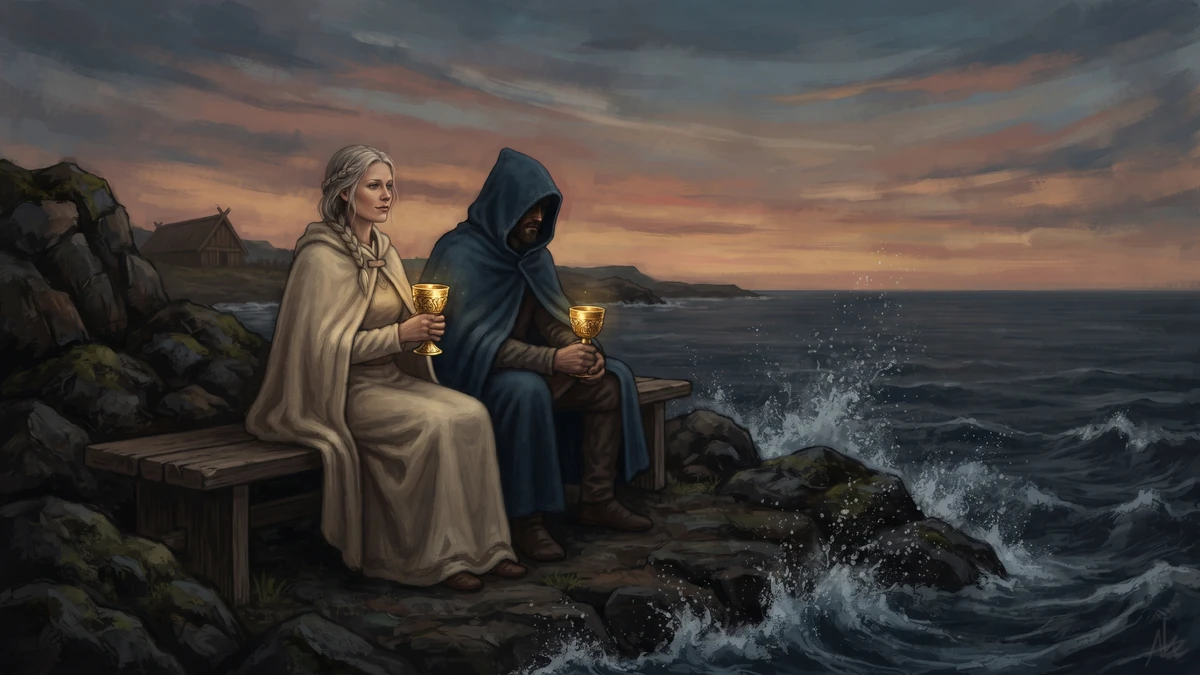
Sága is one of the goddesses of whom the sources say little. What exists fits in a few lines: a place, a cup and a name that intrigues scholars.
Grímnismál: the daily drink
In Grímnismál, Odin, disguised as Grímnir, tells young Agnarr where each god lives. Sökkvabekkr is the fourth place on the list. In Benjamin Thorpe’s translation, “o’er which the gelid waves resound”, Odin and Sága drink there, “joyful each day”, from golden beakers. In Bellows’s translation, they drink “in gladness from cups of gold”.
Prose Edda
In Gylfaginning, ch. 35, High describes the ásynjur. After Frigg and Fensalir, he says: “Second is Saga. She dwells in Sokkvabekk, and that is a big place.” In Faulkes’s translation, this is the only time Sökkvabekkr appears in the Prose Edda. In Skáldskaparmál, ch. 75, Sága appears in a list of 27 ásynjur, with no further information.
A line in another poem
In Helgakviða Hundingsbana I, Sinfjötli mentions “nes Ságu”, “Sága’s headland”. Translators vary between cape, headland and ness, and part of the stanza may be lost.
The name
The name is usually linked to the verb sjá, “to see”, which would make Sága a “seeress”. Rudolf Simek points to vowel problems in this derivation and thinks a link to saga and segja, “to say, to tell”, more likely, though he sees problems there too. For Jacob Grimm, Sága could be nothing but our “saw”, the tale, personified and deified.
Is she Frigg?
Frigg is called a seeress in Lokasenna, which reinforces the idea. John Lindow writes that the similarity between Sökkvabekkr and Fensalir and the fact that Odin drinks with Sága led most scholars to understand her as another name for Frigg. Stephan Grundy suggests that Sága and Sökkvabekkr may be variants of Frigg and Fensalir, used to fit the alliterative verse. Britt-Mari Näsström argues that Frigg is Sága and that the names suggest a goddess tied to water. Simek, for his part, sees her as one of the ásynjur of vague outline, together with Hlín, Sjöfn, Snotra, Vár and Vör.
In short
Sága is a goddess the sources show in a single gesture: drinking with Odin from a golden cup, in a place of cold waters. Whether she is another goddess or another name for Frigg, the sources do not say.
To practise telling apart what each source states from what is debated, play Sága: what each source says.
Sources.
- English Wikipedia, article "Sága and Sökkvabekkr", with the passages of Grímnismál, Gylfaginning and Skáldskaparmál and the studies by Simek, Lindow, Grundy, Näsström and Grimm