 MMXXVI
Sigríðr stórráða: the queen of the great undertakings, the gilded brass ring and what each source says
Sigríðr stórráða, "Sigrid the Haughty", appears in Heimskringla as the queen who had two suitors burned and who rejected Olaf Tryggvason after a quarrel over a ring. See the scene, the other sources and the debate on whether she existed.
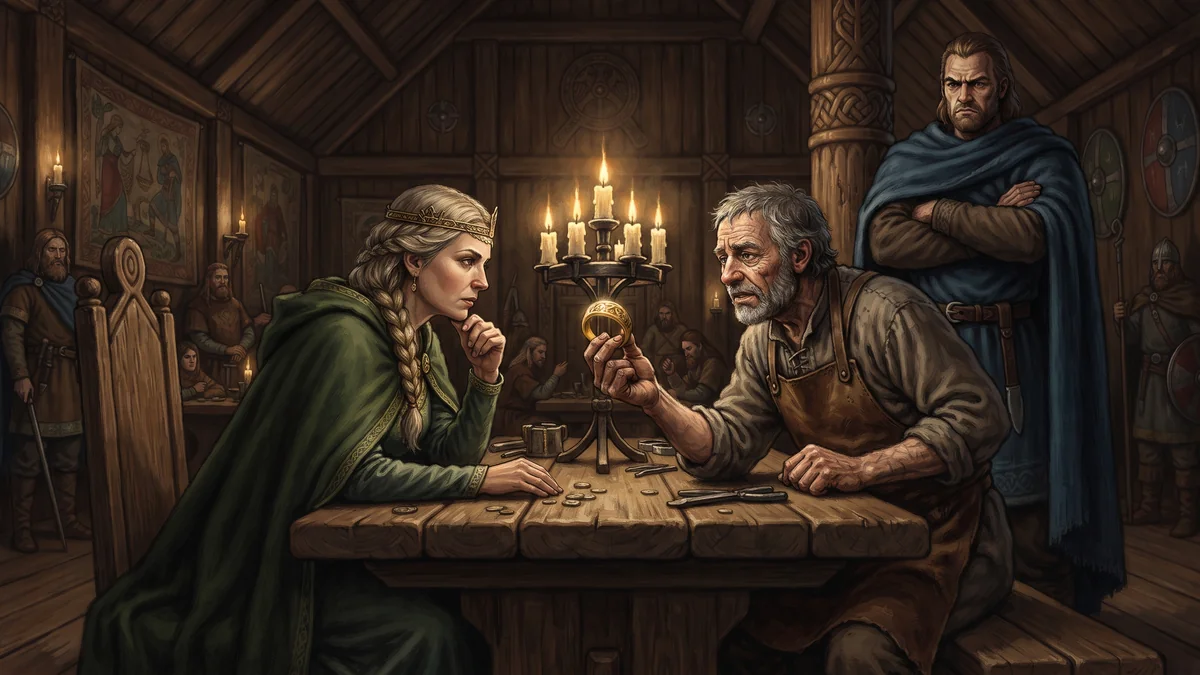
Sigríðr stórráða, “Sigrid of the Great Undertakings”, or “the Haughty”, is one of the most-cited queens of the sagas. Almost everything told of her comes from one source, Snorri Sturluson’s Heimskringla, and for that very reason it is hard to know what is real.
The two suitors
According to Snorri, Harald Grenske, Sigríðr’s foster-brother, took offence when she compared her wealth in Sweden with his in Norway. He later asked for her hand. She refused, reminding him that he already had a wife, Åsta. He rode to her home with many men and found there Vissavaldr, a king from Garðaríki, who also wanted her. The two were lodged together and drink was served in abundance. That night, Sigríðr had the house set on fire and anyone who tried to escape killed, to deter other suitors. Hence, says Snorri, the nickname.
The ring
Olaf Tryggvason asked for her hand after an exchange of messages, and she accepted. He sent a gold ring, but Sigríðr’s goldsmiths found it was gilded brass, and she began to doubt him. When they met, Olaf required her to convert to Christianity. She refused to abandon her faith and said he could believe as he liked. Olaf struck her with a glove, and she warned that it could cost him his life. Snorri links the feud that followed, between her and Sweyn’s sister Tyri, to the battle of Svolder, where Olaf died.
Other sources
In Yngvars saga víðförla (twelfth century), Eric the Victorious marries Sigríðr and separates from her over her difficult temper; they have a son, Olof the Swede. Saxo says that Eric’s widow, “Syritha”, married Sweyn Forkbeard after rejecting Olaf Tryggvason. The contemporary chronicler Thietmar of Merseburg speaks of a daughter of Mieszko I who married Sweyn, but does not give her name. Adam of Bremen, a century later, speaks of a Polish princess who was the wife of Eric and then of Sweyn.
Did she exist?
Gwyn Jones called her “non-existent”. Birgit Sawyer and others treat her as a composite literary figure. Some historians identify her with the unnamed Polish princess, reconstructed as Świętosława, but the hypothesis is highly disputed, because it depends on reconciling Norse and continental sources that contradict each other.
In short
The Sigríðr of the sagas is a strong character with hard words, and the ring episode shows what the tradition found important: honour, faith and the warning that a gift can be less than it seems. What lies behind her, no source guarantees.
To train the goldsmith’s eye, play Sigríðr’s rings.
Sources.
- English Wikipedia, article "Sigrid the Haughty", with the passages of Heimskringla (Haralds saga gráfeldar, Óláfs saga Tryggvasonar, Separate Saga of St. Olaf, Magnúss saga ins góða), Yngvars saga víðförla, Hervarar saga, Saxo Grammaticus, Thietmar of Merseburg and Adam of Bremen