 MMXXVI
Sigrún and Helgi: the valkyrie who married the hero and the meeting in the burial mound
In the poems Helgakviða Hundingsbana I and II of the Poetic Edda, the valkyrie Sigrún chooses the hero Helgi and fights for him, and later meets him one last night inside the mound where he was buried. See the plot, what the manuscript says and what scholars note.
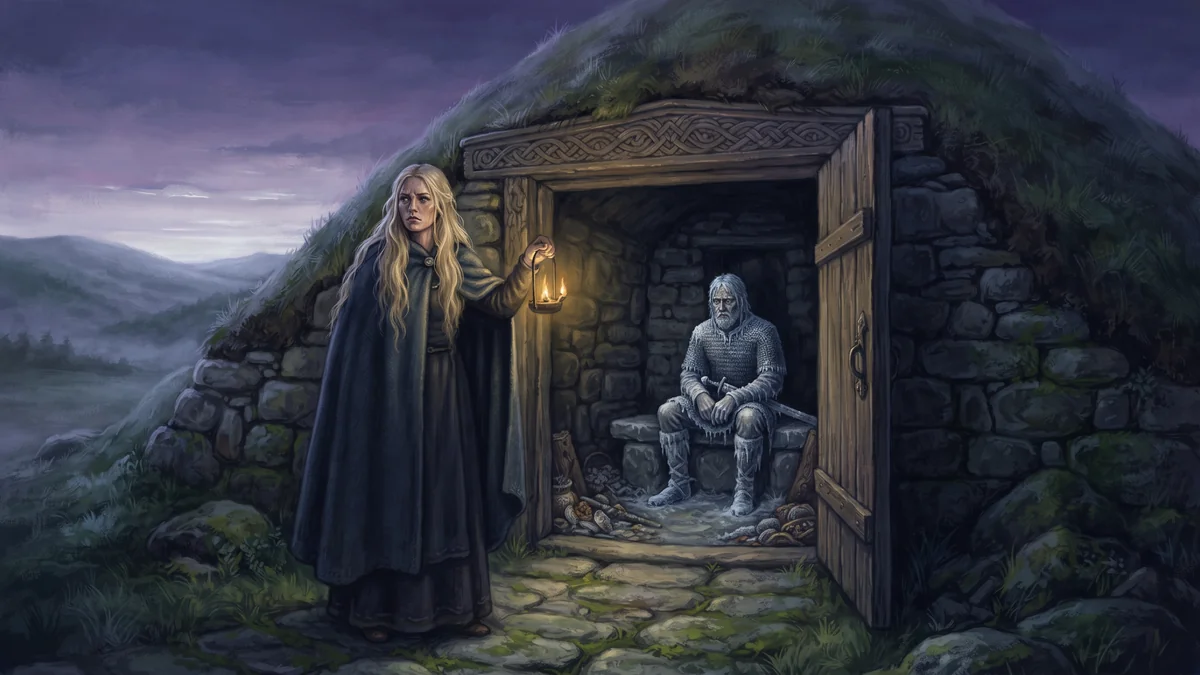
The Poetic Edda keeps two poems about Helgi Hundingsbane, “Hunding’s slayer”. In them appears Sigrún, daughter of King Högni, one of the few valkyries with a complete love story, with a wedding, grief and an ending that passes from one life to another.
The first poem: the choice
Helgakviða Hundingsbana I begins at Brálund with the birth of Helgi, son of Sigmund and Borghild. The norns come to the house and shape his destiny as a hero. At fifteen he kills Hunding. Hunding’s sons demand the price of the killing and the return of the booty, Helgi refuses, and the war ends with the death of all of them.
Then Helgi meets the valkyrie Sigrún. She says her father, Högni, has betrothed her to Höðbroddr, son of King Granmarr, a man she considers unworthy. Helgi promises to face him and gathers a large fleet. Before the battle of Frekastein, there is a duel of insults between Helgi’s half-brother Sinfjötli and Höðbroddr’s brother Guðmundr. Helgi wins and gains Sigrún as his bride.
The second poem: the death and the mound
In Helgakviða Hundingsbana II, Sigrún presents herself as the new life of Sváfa. After the wedding, her brother Dagr, who had been spared in exchange for loyalty to Helgi, sacrifices to Odin and receives a spear from him. With it he kills Helgi at Fjöturlundr and takes the news to his sister. Sigrún curses him: may he live as an outlaw, wandering like a wolf.
Helgi is buried in a mound. In Valhalla, Odin asks him to rule the einherjar with him. A maidservant tells Sigrún she saw Helgi ride with a retinue into the mound. Sigrún goes there and finds him covered with frost and blood. He explains that her tears fall cold and wet on him. She makes a bed in the mound and they spend the night together, but Helgi must return to Valhalla before dawn. Sigrún waits, in vain, for him to come back, and dies young of sorrow.
What the manuscript and scholars say
Both poems survive only in the Codex Regius, around 1270. Henry Adams Bellows considered the second poem a patchwork of several pieces that do not fit well together. Stanzas 28 to 37 and 39 to 50, however, are usually seen among the finest in Old Norse poetry. The text suggests that Sigrún and Helgi are reborn: in the next life she is the valkyrie Kára and he is Helgi Haddingjaskati. There is also debate about where the poem is set, between Denmark and Sweden, and about Helgi’s genealogy, attributed to three clans.
In short
It is a story of choice and loss: a valkyrie who decides which side to take, a hero who does not escape fate and a meeting after death that leaves the two, and the poetry, closer rather than farther apart.
To help raise Helgi’s mound, play Helgi’s mound.
Sources.
- Poetic Edda, Helgakviða Hundingsbana I and II (Codex Regius manuscript, around 1270; English translation by Henry Adams Bellows)
- English Wikipedia, articles "Helgakviða Hundingsbana I" and "Helgakviða Hundingsbana II"