 MMXXVI
Sigurd the Mighty, Earl of Orkney: the head hung from the saddle and the tooth that killed him
According to the Orkneyinga saga, Earl Sigurd Eysteinsson defeated Máel Brigte, hung the head from his saddle and died of the infection caused by a tooth that scratched his leg.
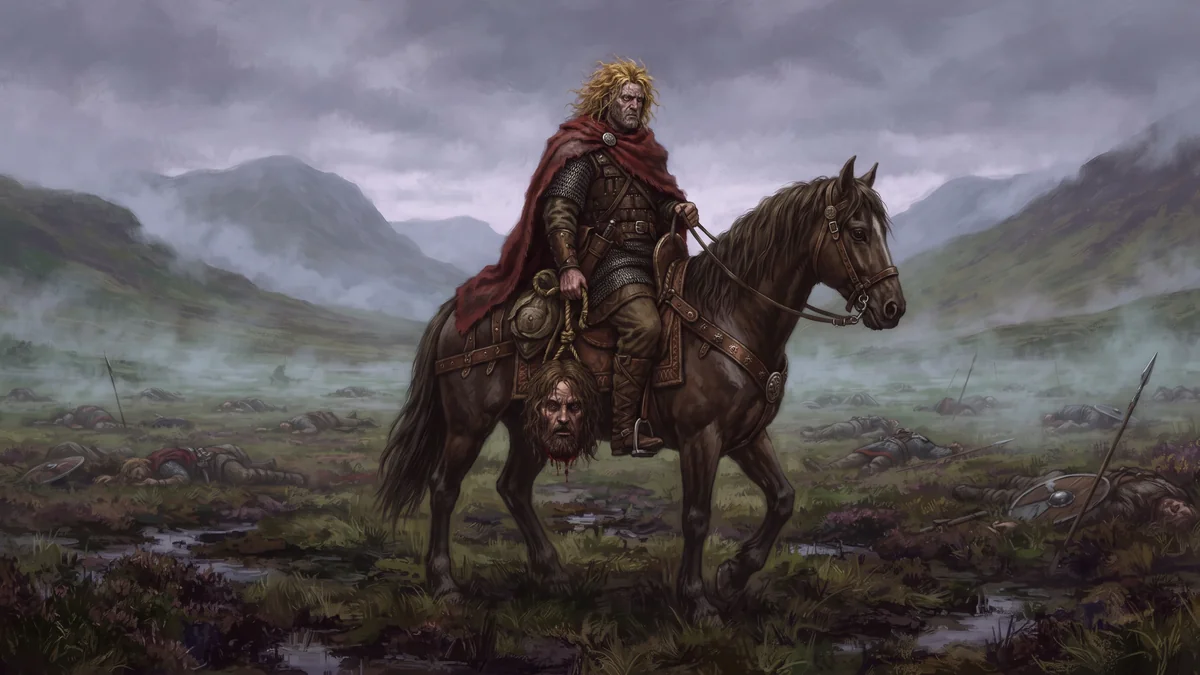
Sigurd Eysteinsson, “Sigurd the Mighty”, was the second Earl of Orkney, from about 875 to 892. He was a son of Eystein Glumra and received the title from his brother, Rognvald Eysteinsson. The story of his death is one of the most remembered in the sagas of the isles.
How he became earl
After Ivar, Rognvald’s son, was killed in Harald Fairhair’s campaign against the Viking pirates, Harald gave the islands and the title of earl to Rognvald. Rognvald passed them to Sigurd, who had served among Harald’s forecastlemen.
The conquest in Scotland
Allied with Thorstein the Red, Sigurd took Caithness and Sutherland. His advance reached at least as far as Ekkjalsbakki, which some sources place in Moray but which was probably farther north, along the River Oykel. The conquests earned him his epithet.
The duel with Máel Brigte
According to the Orkneyinga saga, Sigurd challenged Máel Brigte, “the Buck-Toothed”, to a battle of forty men on each side, but brought eighty. Máel Brigte was defeated and beheaded.
The death
Sigurd tied the head to his saddle as a trophy. One of the protruding teeth scratched his leg, the wound became infected and he died. The source notes that the detail of the tooth varies between versions, and that the most specific one comes from the saga.
The grave and the heirs
He was buried in a mound, the Sigurðarhaugr, “Sigurd’s mound”. The most probable site is Sidera, or Cyderhall, near Dornoch, but some say it was at Burghead, in Moray. His son Guttorm succeeded him and died within a few months. Rognvald then installed his son Hallad, who resigned in disgrace. The title finally went to Einarr, Rognvald’s youngest son, whose mother was a slave.
What is certain and what is not
The two main sources are the Heimskringla and the Orkneyinga saga. The Historia Norwegiae confirms the conquest of the islands, but without details. The location of Ekkjalsbakki is disputed, and that of the grave is uncertain. The duel and the death come from saga material and are tradition, not firm facts.
In short
It is a story of a victory that ends in a wound. To parry the duel’s blows with the shield, play The duel with Máel Brigte.
Sources.
- Reference work in English, article "Sigurd Eysteinsson"
- Orkneyinga saga
- Heimskringla, by Snorri Sturluson