 MMXXVI
Sjøorm: the sea serpent of Norway, the fishermen's reports, Egede's description and Bishop Pontoppidan
Norwegian fishermen had spoken for centuries of a giant sea serpent, the sjøorm. In 1734 the missionary Hans Egede described a monster off Greenland, and Bishop Erik Pontoppidan gathered the subject in his natural history of Norway.
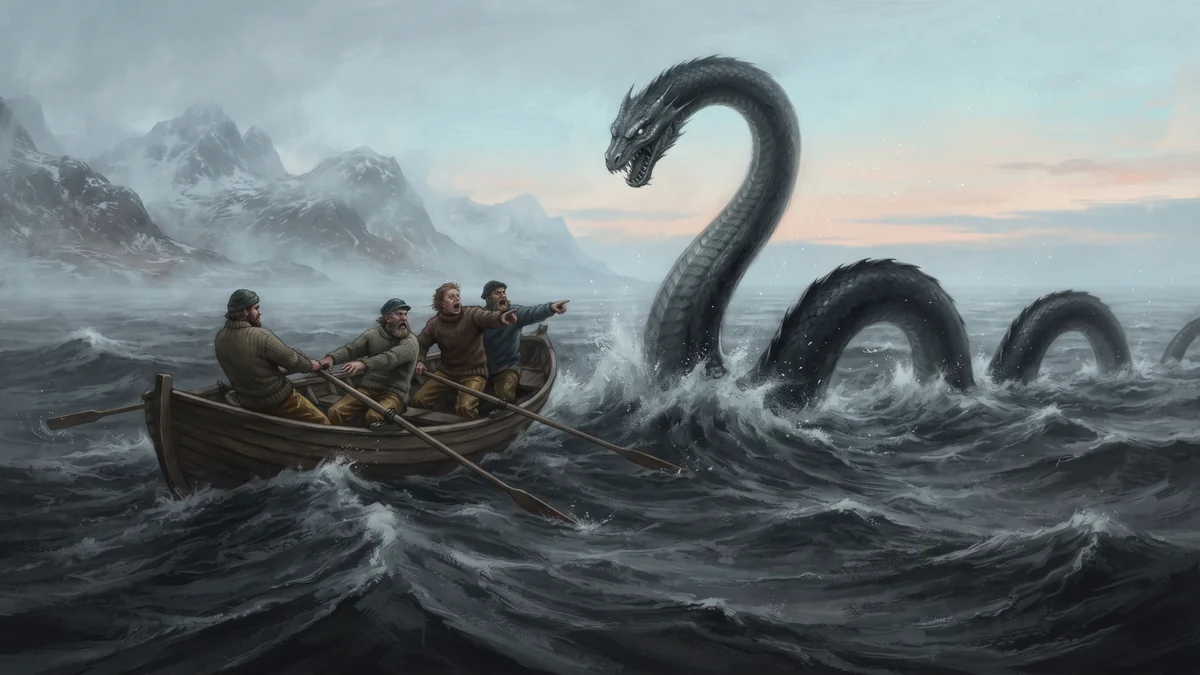
Long before photography, the fishermen of Norway already told stories of a long creature that appeared in calms, with its head above the water and its body in arches. They called it the sjøorm, “sea serpent”. Those who lived from the sea knew there was something out there too big to be an ordinary fish, and the tradition passed from boat to boat.
The North on the maps
In 1555 the Swedish clergyman Olaus Magnus published the History of the Northern Peoples, with the famous Carta Marina. His drawings show sea serpents attacking ships. Historians see in them a mixture of sailors’ reports and imagination, but it was one of the first times the monster was given an image for the rest of Europe.
Hans Egede, 1734
The Dano-Norwegian missionary Hans Egede, who worked in Greenland, wrote in his diary in July 1734 that from the ship he saw an enormous monster rise from the sea. He described a tall head, a long snout, a body covered in scales and a back part like a serpent’s. It is one of the most cited accounts in the history of sea serpents.
Bishop Pontoppidan
Erik Pontoppidan, bishop of Bergen, included the sjøorm in his natural history of Norway, published in 1752 and 1753. He collected reports from fishermen and sailors, and did not hide that he believed them. The work helped spread the idea across Europe and, later, the world.
What scientists say
For modern researchers, the stories may come from real animals, such as the oarfish, which can be very long, or from whales, squid and even seaweed and drifting logs seen from afar. There is no proof of an unknown giant sea serpent, but there is a strong tradition, which is still told.
To help the rowers keep the rhythm and escape the serpent, play The rhythm of the oars.
Sources.
- Olaus Magnus, History of the Northern Peoples, 1555
- Erik Pontoppidan, Det første Forsøg paa Norges naturlige Historie, 1752–1753
- Studies of Norway's sea folklore and the history of sea serpents