 MMXXVI
Skarphéðinn, Njáll's eldest son: the axe Rimmugýgr, the leap from ice to ice on the Markarfljót and the tongue that cost allies
In Njáls saga, Skarphéðinn is the eldest son of Njáll and Bergþóra: a feared fighter with a sharp tongue, who crosses a frozen river from ice ledge to ice ledge and ends up dragging his family toward ruin.
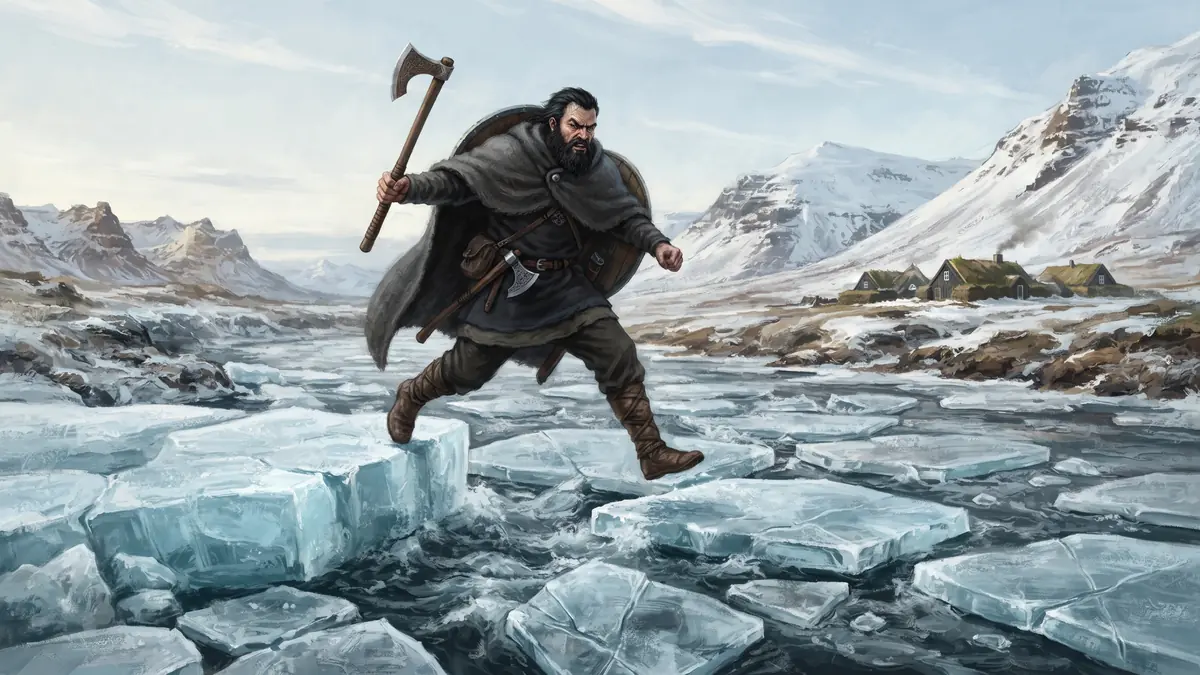
Skarphéðinn Njálsson is, together with his father, the best-remembered character of Njáls saga, written in Iceland between 1270 and 1290. He was the eldest son of Njáll Þorgeirsson and Bergþóra, and grew up at Bergþórshvoll, in the Rangárvallasýsla district of southern Iceland. In a few words, the saga presents him as big, strong, a good fighter, quick of tongue and hard of temper.
A man hard to ignore
His look alone was alarming: a threatening face that often showed a rage he struggled to hold in. Njáll is the wise, conciliatory man of the district. Skarphéðinn is the opposite: the son who answers with a weapon or with irony. His foster father, Þórður Leysingjason, was killed, and the saga says that as he lay dying he predicted Skarphéðinn would avenge him. That is how the young man entered the chain of revenges the saga tells.
The leap over the ice
The most famous scene takes place in winter, on the Markarfljót river, covered in ice. Njáll’s sons and Kári set an ambush for Þráinn Sigfússon and his men, and the ice forms a bridge between the two groups. Skarphéðinn pulls ahead of his brothers, leaps from one ice ledge to the next and slides over the ice until he reaches Þráinn, who was just about to put on his helmet. The blow of the axe Rimmugýgr, a name usually translated as “battle-hag” or “battle-troll”, is fatal. In all, the attackers kill four men that day, among them one named Hrappur.
The reputation that weighs
Then comes the deed the saga itself treats as the gravest. Höskuldr Þráinsson, Þráinn’s son, was the goði of Hvítanes, well liked by all, and Njáll had taken him in as a foster son. Skarphéðinn kills him while Höskuldr was sowing his own field. Nearly everyone condemned it, and Skarphéðinn himself admits it gave him a bad name. At the Althing, the country’s assembly, his brothers plead for help, and he, grimly fatalistic, insults many who might have backed them; in one of the clashes an insult of his adds fuel to the fire. Little by little the family is left isolated.
The axe in the beam
When the enemies set fire to Bergþórshvoll, Skarphéðinn drove his axe into a beam of the house. One reading is that he wanted to keep the edge of the blade sharp. Many scholars see the saga as a critique of a rigid ideal of honour and manliness, in which insult and revenge feed each other, and Skarphéðinn is its strongest portrait.
To run across the ice, pick up the axes and dodge the cracks of black water, play The ice of the Markarfljót.
Sources.
- Njáls saga (*Brennu-Njáls saga*), Icelandic saga composed between 1270 and 1290, ch. 92 onward
- Modern summaries and commentary on Njáls saga, covering the Markarfljót episode and the character of Skarphéðinn