 MMXXVI
Skofnung, the sword of King Hrólf Kraki that came out of a grave and ended at sea
In the Icelandic sagas, Skofnung is King Hrólf Kraki's sword, taken from a burial mound. It has rules of use, a stone that heals the wounds it makes, and a fate that runs through a duel, a shipwreck and a grave at Roskilde.
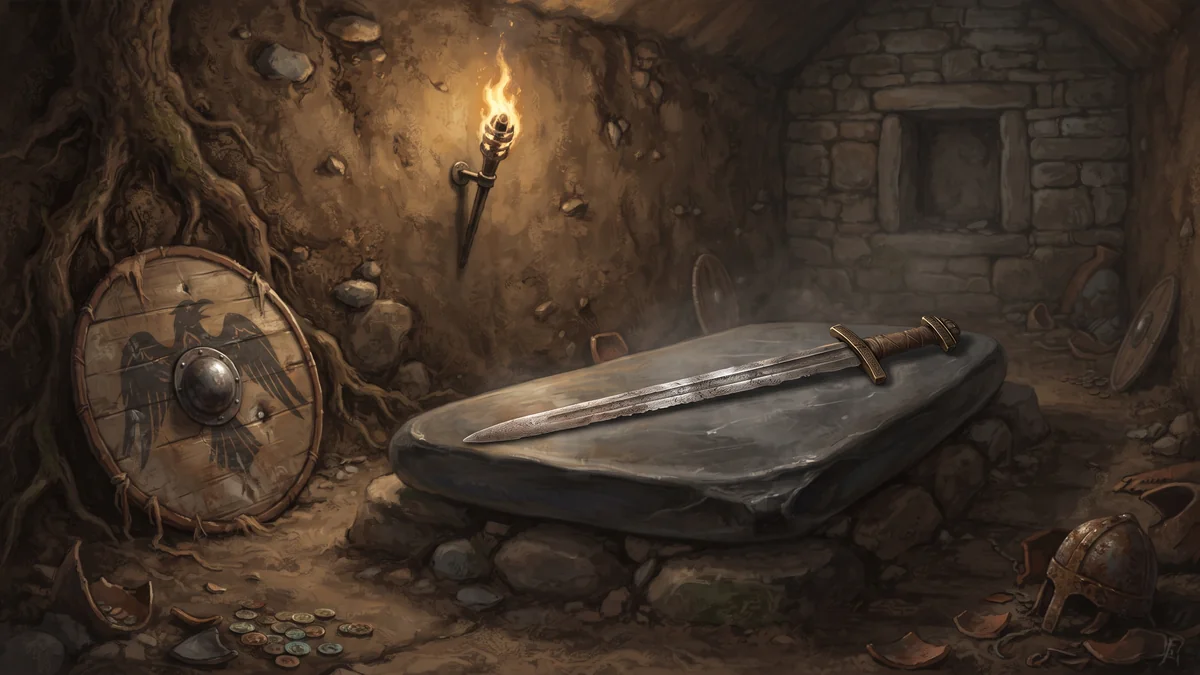
Skofnung is the sword of the legendary Danish king Hrólf Kraki. The Hrólfs saga kraka calls it the best of all the swords that have been carried in northern lands. What makes the story good, though, is what the Icelandic sagas tell afterwards: the sword came out of a grave and passed from hand to hand, with rules that almost nobody respected.
From the grave to the saga
According to Wikipedia, Skeggi of Miðfjörðr was chosen by lot to break into a burial mound and recovered Skofnung. In the Laxdœla saga the sword belongs to his son Eiðr of Áss, and the saga says it had been taken from Hrólf Kraki’s mound. Scholars compare the episode to others in which a hero enters a grave and leaves with a weapon, such as Grettir in another saga.
The sword’s rules
Eiðr tells the conditions to Þorkell Eyjólfsson in chapter 57: the sword must not be drawn unless a fight is imminent, the sun must never shine on the hilt, and it must not be drawn if a woman is nearby. Whoever is wounded by it keeps the wound open unless it is rubbed with the Skofnung stone, which Eiðr hands over with the sword.
Kormák’s duel
In Kormáks saga, Kormák borrows the sword from Skeggi for a duel with Bersi, who carries the sword Hviting. Skeggi gives him detailed instructions, among them to keep the pommel away from the sun. Kormák ignores them and loses the duel.
The end of the sword
In the Laxdœla saga, Þorkell borrows the sword to kill the outlaw Grímr, but the two become friends and Þorkell never returns it. His ship capsizes and everyone drowns, but the sword sticks in the timbers and washes ashore. His son Gellir comes to carry it.
Gellir dies in Denmark, on his way back from a pilgrimage to Rome, and is buried at Roskilde. The saga says the sword was with him and that it was not recovered afterwards. That it was buried with him is an inference, not a sentence of the saga.
In short
Skofnung gathers what the sagas like to tell about weapons: a funerary origin, rules that cannot be broken and an ending without witnesses. To practise defending in a duel, play Kormák’s duel.
Sources.
- Laxdœla saga (13th century), chapters on Eiðr, Þorkell Eyjólfsson and Gellir
- Kormáks saga, chapters 9 and 10, on the duel with Bersi
- Hrólfs saga kraka (14th century), which calls Skofnung the best of the swords of the North
- English Wikipedia, article "Skofnung", with the references to Oakeshott (1991) and Whetter and McDonald (2006)