 MMXXVI
Skule Bårdsson: Norway's first duke, the father-in-law who became King Håkon's rival, the acclamation at the Øyrating in 1239 and the death among the flames of Elgeseter priory
Skule Bårdsson was born around 1189, became an earl and, in 1237, Norway's first duke. In 1239 he was proclaimed king at the Øyrating, in Trøndelag, and on 24 May 1240 he died at Elgeseter.
Skule Bårdsson was born around 1189 and was a half-brother of King Inge Bårdsson. In Inge’s last years, the king made him an earl (jarl). When the king died, in 1217, Håkon, aged 13, was chosen king over Skule’s candidate. The two shared power, and most of the real power stayed in Skule’s hands.
The king’s father-in-law
To reconcile the rivals, Skule’s daughter Margrete married Håkon in 1225. That made King Håkon Skule’s son-in-law, but the tension only grew. In 1237 Skule received the title of duke (hertug), the first in Norway.
The proclamation
In 1239 his supporters proclaimed him king at the Øyrating, the traditional assembly of Trøndelag. The party that backed him became known as the Vårbelger. Civil war broke out again. Skule won a battle at Låka, in Nannestad, but lost at Oslo and had to fall back.
Elgeseter
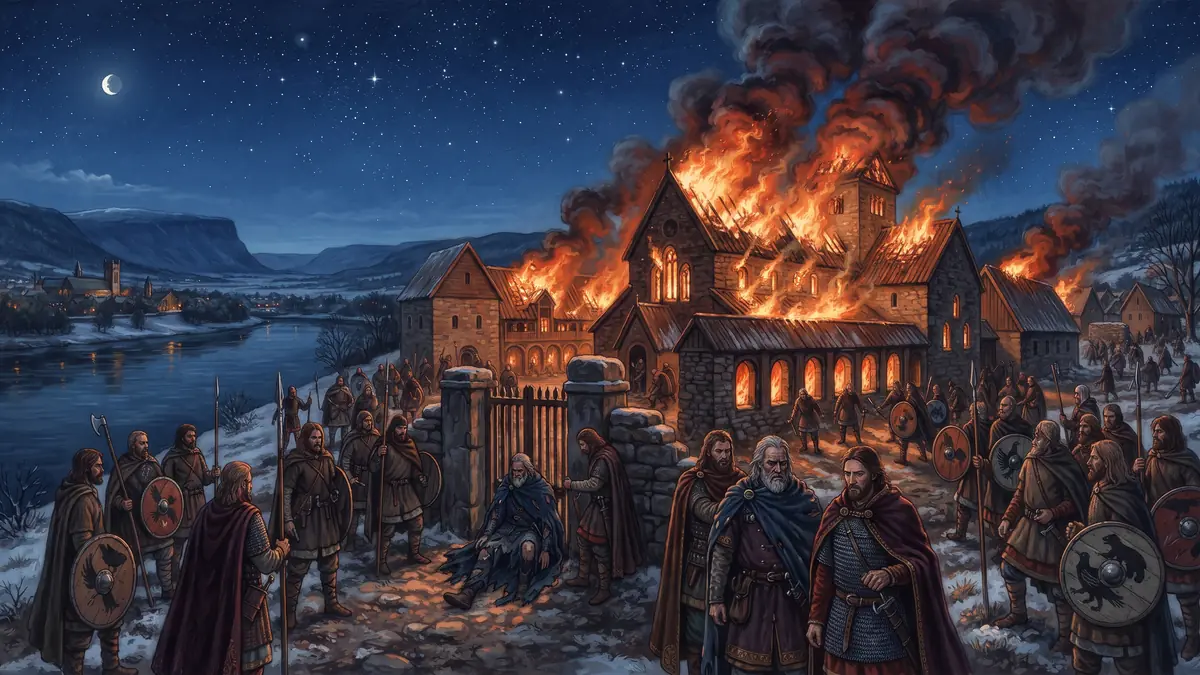
After the defeat, Skule sought refuge in Elgeseter priory, in Nidaros. On 24 May 1240, Håkon’s men burned the place and killed him. The duke’s death ended the era of Norway’s civil wars.
Who backed him
Snorri Sturluson was an ally of Skule. The two great parties of the civil wars were eventually merged into two, the Baglers and the Birkebeiners. The sources that cover this period include the Heimskringla, the Fagrskinna, the Morkinskinna and Orkneyinga saga. The reign of Håkon IV is told in Håkon Håkonssons saga, written in the 13th century by the Icelander Sturla Þórðarson, which explains why the version that reached us is that of the winning side.
What remains
Skule climbed almost every step: earl, duke, the king’s father-in-law and, briefly, a proclaimed king. He was the last great name of Norway’s civil wars.
To gather the banners of the Øyrating and leave aside the enemy torches, play The banners of the Øyrating.
Sources.
- Heimskringla, Fagrskinna, Morkinskinna and Orkneyinga saga, which cover the political history of Norway in the 12th and 13th centuries
- Håkon Håkonssons saga, written in the 13th century, the main account of the period of Håkon IV and Skule
- Studies of Norwegian political history on the civil wars and the so-called era of the Birkebeiners and the Baglers