 MMXXVI
Sleipnir: Odin's eight-legged horse and his strange origin
Sleipnir is Odin's horse, the son of Loki and the stallion Svaðilfari. See what Snorri, the Grímnismál, the Hyndluljóð and the Tjängvide stone say about him.
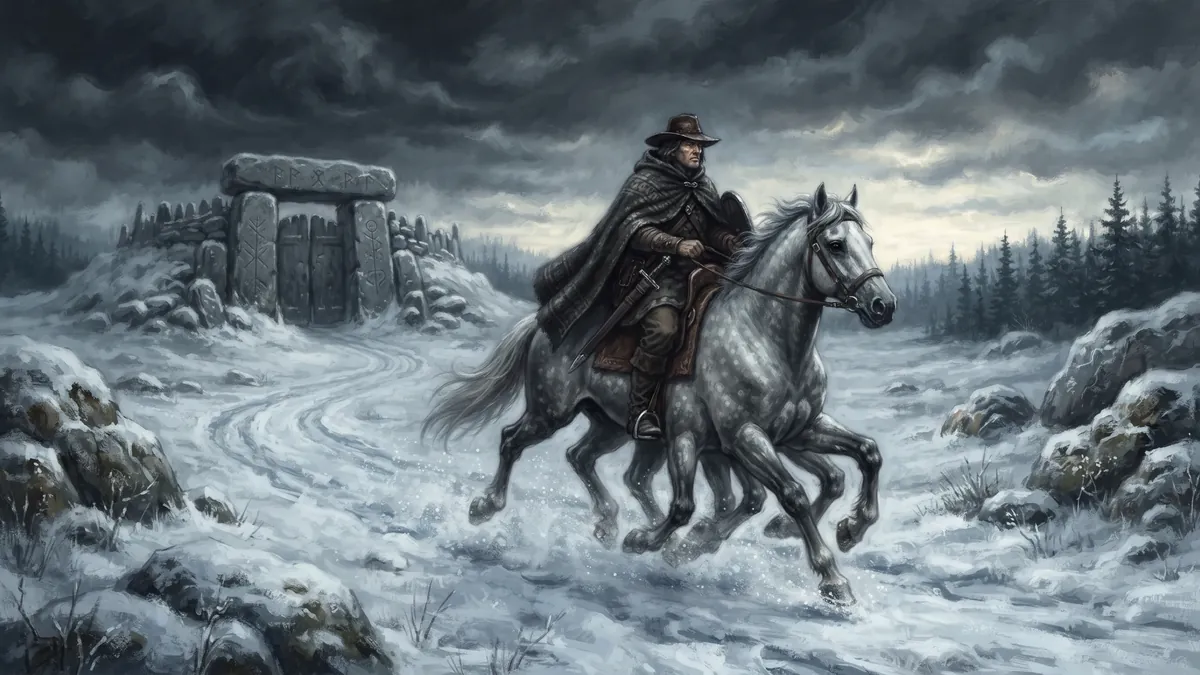
Odin has a grey horse with eight legs, and almost everything known about it fits in a few sources. Its name is Sleipnir. He appears in the Poetic Edda, in the Prose Edda and on a painted stone from Gotland. His origin is the strangest part of the story.
The horse and the wall
In the Gylfaginning, Snorri Sturluson tells how a builder offered the gods to raise a wall around Asgard in three winters. In return he wanted the sun, the moon and the hand of Freyja. The gods agreed on one condition: the wall had to be finished by the first day of summer. The builder had only the help of his stallion Svaðilfari, who hauled stones of a size that amazed the gods. When only a few days were left, the gods grew afraid and blamed Loki.
Loki took the shape of a mare and lured Svaðilfari away. The builder, who was a giant, did not finish the wall in time and Thor killed him. Some time later Loki gave birth to a grey foal with eight legs. That was Sleipnir, “the best of all horses”, according to Snorri, and Loki gave him to Odin. The Hyndluljóð confirms the parentage in few words: Loki fathered the wolf on Angrboða, and Sleipnir he bore to Svaðilfari.
What Sleipnir does
The Grímnismál says Sleipnir is the best of horses, just as Yggdrasil is the best of trees and Bifröst the best of bridges. Odin rides him on journeys between the worlds. In the Baldrs draumar, Odin rides Sleipnir to Hel to question a seeress about Baldr’s dreams. In the Gylfaginning, after Baldr’s death, the god Hermóðr borrows the horse and rides nine nights to the realm of Hel. At the gate, Sleipnir leaps over it.
The Tjängvide stone
In 1844 a painted stone was found at Tjängvide, in Gotland, showing a rider on an eight-legged horse before a figure who receives him. It is now in the Swedish Museum of National Antiquities and is usually dated to about 700 to 900. Many scholars link it to Odin and Sleipnir, but the stone carries no name, and that link is an interpretation.
What is hypothesis
Why eight legs? The written sources do not explain. Some scholars propose that the eight legs recall the four men who carry a coffin, which would fit the horse’s role on the road to Hel. It is a theory. No Norse text says it.
In short
Sleipnir is born of a change of shape: Loki, as a mare, and the stallion Svaðilfari. He stays with Odin, carries him between the worlds and carries Hermóðr to Hel. The Tjängvide stone shows a similar horse, and the link to Sleipnir is a modern reading.
To race Sleipnir down a road full of obstacles, play Sleipnir’s road.
Sources.
- Snorri Sturluson, Prose Edda (Gylfaginning, chapters 15, 41, 42 and 49)
- Poetic Edda: Grímnismál, Baldrs draumar and Hyndluljóð
- Tjängvide image stone (G 110), Gotland, in the Swedish Museum of National Antiquities
- English Wikipedia, article "Sleipnir", consulted to check the passages and the scholars' theories