 MMXXVI
Sólarljóð: the poem of the dead father who tells his son what he saw in heaven and in hell
Sólarljóð, "Song of the Sun", is an Icelandic poem of around 1200, with 82 stanzas, in which an already dead father speaks to his son and reveals who he is only in the last stanzas.
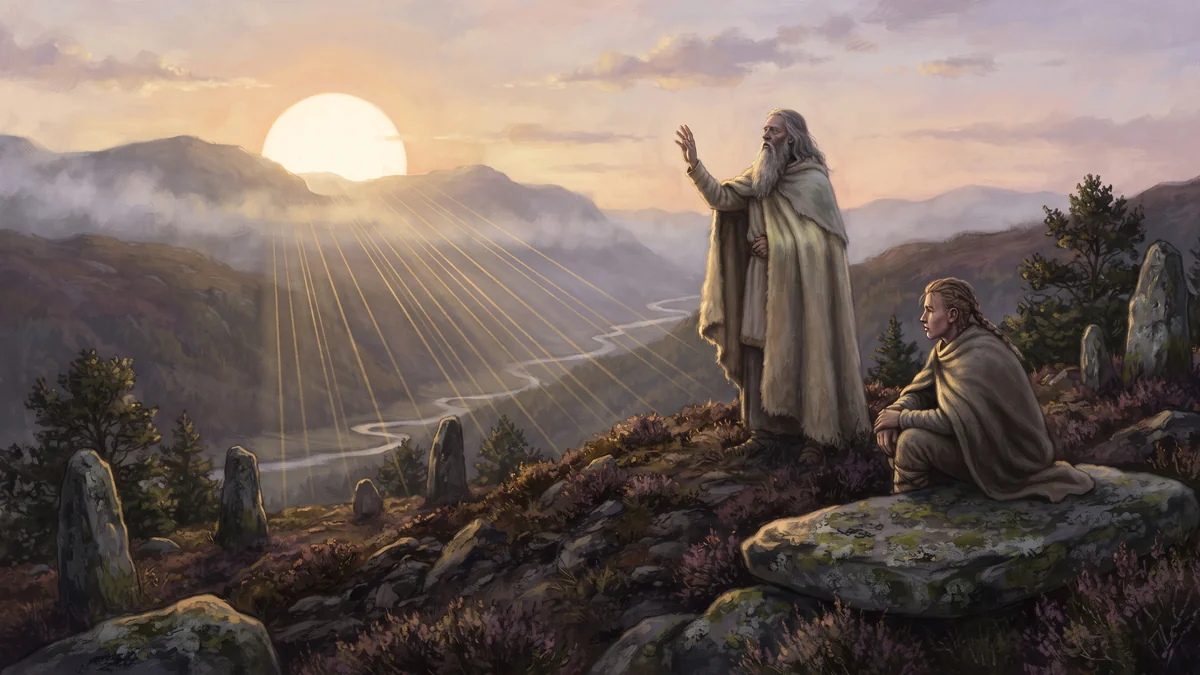
Sólarljóð, “the Song of the Sun”, is a poem written in Iceland around 1200, in the ljóðaháttr metre of the Poetic Edda poems. The content, however, comes from Christian visionary literature.
Who speaks
The poem is anonymous, but some manuscripts attribute it to Sæmund. It has 82 stanzas, and some manuscripts carry a stanza 83, though few do. The speaker is a father who has already died and addresses his son from the afterlife. He reveals his own identity only in the last stanzas.
The parts of the poem
According to Gro Steinsland’s division:
- Stanzas 1 to 24: examples of the lives, deaths and fates of anonymous people.
- Stanzas 25 to 32: advice similar to that of the Hávamál.
- Stanzas 33 to 38: a “psychological biography” of the narrator.
- Stanzas 39 to 45: the “sun stanzas” that give the poem its name.
- Stanzas 46 to 56: the narrator in a limbo between life and death.
- Stanzas 57 to 80: hell and heaven, often compared to Dante’s Divine Comedy.
- Stanzas 81 and 82: an address to the son and the hope of resurrection.
Pagan or Christian?
There are references to Norse mythology in the poem, but it shows no sign of syncretism and has a firmly Christian outlook. Fredrik Paasche argues that the material from the pagan age is used to convey a worldview that is not pagan. Peter Hallberg has also discussed the poem’s heritage and structure.
In short
Sólarljóð uses the form of the poems about the gods to speak of what comes after death. To catch the rays of the sun stanzas, play The rays of Sólarljóð.
Sources.
- English Wikipedia, article "Sólarljóð"
- Gro Steinsland, division of the poem cited by Wikipedia
- Fredrik Paasche and Peter Hallberg, scholars cited by Wikipedia