 MMXXVI
Strengleikar: the twenty-one Breton lais in Old Norse, translated at King Hákon's court in the thirteenth century
The Strengleikar are a Norwegian collection of twenty-one lais in French verse, many of them by Marie de France, rendered in Norse prose for King Hákon. See the Uppsala manuscript, the list of titles, what changes from the French and what was lost.
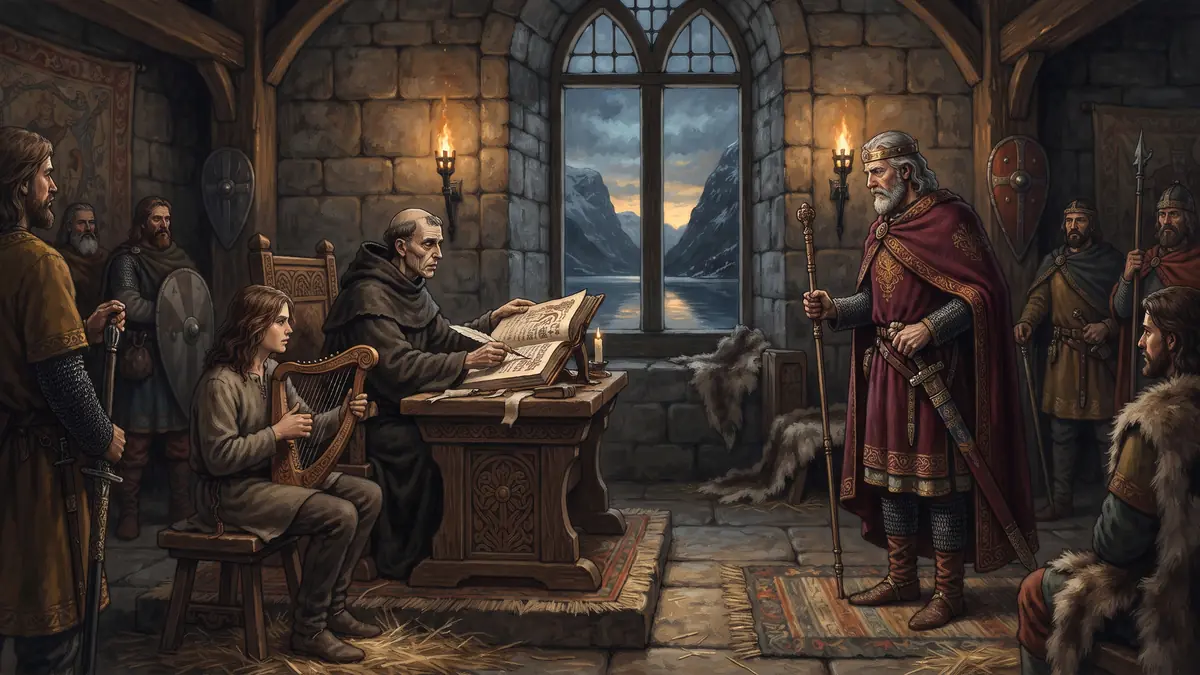
The Strengleikar are one of the most curious works of the court of Hákon Hákonarson, king of Norway from 1217 to 1263. The title points to stringed instruments, and the collection gathers lais, the short narrative poems in French that were usually sung to musical accompaniment. The Norse texts, however, are in prose. The work is anonymous. The translation has been attributed to Brother Robert, but there may have been several translators.
The manuscript
The main text is in the codex De la Gardie 4-7, in the Carolina Library in Uppsala, on folios 17va to 43vb. It is dated 1250 to 1270 and is defective. Four leaves that were once part of it, with Grelents saga, are now in Copenhagen, in the manuscript AM 666 b 4°. There are also late copies: Gvimars saga, from 1737, in Reykjavík (Lbs 840 4°), and excerpts from the late seventeenth century in Stockholm.
The list
The collection has twenty-one texts, plus a prologue, the Forræða. Among them are:
- Bisclaretz ljóð (from French Bisclavret);
- Guiamars ljóð (Guigemar);
- Januals ljóð (Lanval);
- Geitarlauf (Chevrefoil);
- Jonet (Yonec), Laustik (Laüstic), Milun, Equitan, Eskja (Le Fresne) and Chetovel (Chaitivel);
- Tveggja elskanda ljóð (Les Deux Amants);
- Grelent, Tidorel, Desire and Douns ljóð.
Some titles have no identified source, such as Guruns ljóð and Ricar hinn gamli. The Strandar ljóð is described as a lost work by a “Red Lady of Brittany,” made for William the Conqueror.
Faithful to the French, with one exception
Unlike many medieval translations, the Strengleikar follow the sense of the French originals closely. The major exception is Milun, abridged to about half its original length. Eliduc, which closes Marie’s collection, does not appear in the Scandinavian manuscripts, though a weasel-healing motif in Völsunga saga suggests the story may have been known in Iceland in some form.
Why they matter
The Breton lais were the gateway to the Arthurian and courtly world. By rendering twenty-one of them for Hákon’s court, the translators brought to Norway stories of werewolves, fairies and lovers kept apart, and these joined Tristrams saga and the other chivalric sagas. One of the stories, Bisclaretz ljóð, later circulated in Iceland.
To take each sentence to the right lai, play Each phrase in its lai.
Sources.
- Robert Cook and Mats Malm (eds. and trans.), Strengleikar: An Old Norse Translation of Twenty-One Old French Lais (Uppsala, 2006)
- Marianne E. Kalinke and P. M. Mitchell, Bibliography of Old Norse-Icelandic Romances (Cornell University Press, 1985)
- Uppsala University Library (Carolina Rediviva), description of the manuscript De la Gardie 4-7