 MMXXVI
Stúfs þáttr: the blind poet Stúfr and King Haraldr Sigurðarson, the thirty stanzas recited in a farmhouse and the invitation to Nidaros
In the Morkinskinna, the blind Icelandic poet Stúfr lodges at a Norwegian farm when King Haraldr arrives unannounced. He recites poems, asks for favours and is accepted at court. Meet this short tale from around 1220.
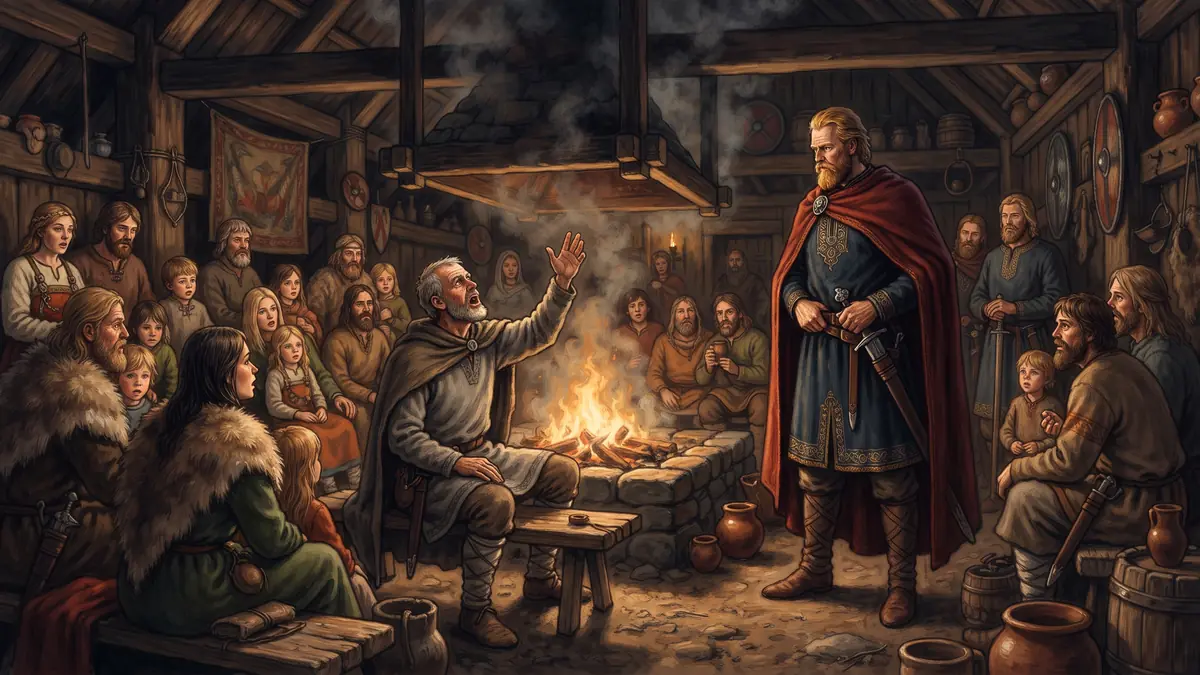
Among the short tales of medieval Icelandic literature, the Stúfs þáttr has a charm of its own. A þáttr is a brief episode that fits inside a larger saga. This one was preserved in the Morkinskinna, a compilation about Norwegian kings written around 1220. The main manuscript, GKS 1009 fol., dates from about 1275. The protagonist is a blind poet who arrives at the court of King Haraldr Sigurðarson, the future Harald Hardrada.
The blind poet
Stúfr Þórðarson was Icelandic and blind. He was the son of Þórðr Kattr, raised by Snorri goði, the chieftain of Helgafell. Stúfr’s grandmother on Þórðr’s side was Guðrún Ósvífrsdóttir. According to the story, he went to Norway and lodged at the house of a farmer in the uplands when King Haraldr arrived without warning.
The farmer apologised for not receiving the king as he deserved. The king replied that it was only a passing visit. The conversation turns on Stúfr’s name, which comes from “Kattr”, and the king jokes about the name of his father, Þórðr Kattr. Stúfr accepts the tone and answers in kind.
The stanzas
When the king asks what he can do, Stúfr says he knows verses. He recites a flokkr, a short poem, and then another. The king counts that there have been thirty stanzas. Stúfr replies that he knows as many drápur, long poems, as flokkar. He also says his great-grandfather was the skald Glúmr Geirason, which ties him to a line of court poets.
The requests
After the verses, Stúfr makes three requests. First, a letter with the king’s seal, to claim an inheritance in the east. Second, permission to compose a poem about the king, which would become the Stúfsdrápa, which Danish tradition called the “arvedrape”. Third, to be accepted as a hirðmaðr, a man of the court guard. The king grants it: he tells Stúfr to come to Nidaros, and there he is well received.
What the text shows
The story is a portrait of how poetry served as currency for entering the court. A poet without possessions, but with memory and verse, could win protection and inheritance. How much of this really happened is unknown, since the text is much later than the eleventh century.
What stands out most in the text is the tone. The king jokes about the name of the poet’s father, and the poet, though blind and without possessions, answers in kind, without shrinking. The dialogue shows a court in which wit and presence of mind counted as much as the verses, and in which an unexpected visitor could win a place through conversation.
To recite the stanzas to the king in the right rhythm, play Stúfr’s stanzas.
Sources.
- Morkinskinna, chapter on Stúfr enn blindi (work composed around 1220; manuscript GKS 1009 fol., about 1275)
- Carl Christian Rafn (ed.), Danish translation of Stúfs þáttr
- Store norske leksikon, entries on skalds and skaldic poetry