 MMXXVI
Sturlaugs saga starfsama: Sturlaugr the Industrious, the fair Ása, the aurochs horn and the voyage to the land of Bjarmaland
Sturlaugs saga starfsama, an Icelandic legendary saga, tells how Sturlaugr the Industrious won the fair Ása, sought an aurochs horn as far as Bjarmaland and took a Russian city for his sworn brother. See what the text says and what remains uncertain.
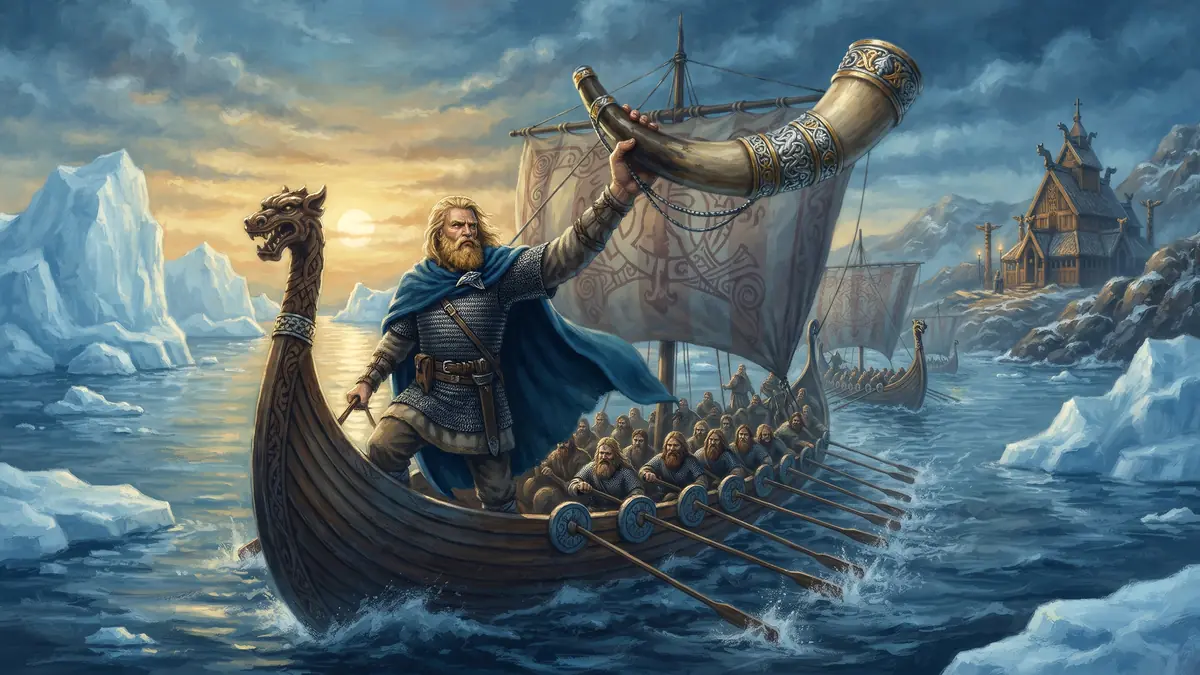
The Sturlaugs saga starfsama, “the saga of Sturlaugr the Industrious”, is one of the fourteenth-century fornaldarsögur and the “prehistory” of the Göngu-Hrólfs saga, since the hero is the father of Göngu-Hrólfr. It is a long adventure, with duels, mysterious women and a quest to the North. The text was even printed in a seventeenth-century edition.
The suitor who did nothing
Sturlaugr is the son of Ingólfr, of Naumudalr, tall, handsome and good at games. He grows up with foster companions. At his father’s urging, he goes to ask for the hand of Ása the Fair, daughter of Earl Hringr, of Kaupangr. She refuses him, since he has done nothing to win fame. The companions go raiding in the East with ten ships and return.
After the queen’s death, King Haraldr, of Þrándheimr, asks for Ása, and Hringr, with no choice, agrees. Then Kolr krappi appears, violent, who demands Ása and challenges Haraldr to a duel. Haraldr asks the old Hemingr to fight in his place, and Kolr kills him at the Gautelfr. Haraldr turns to Sturlaugr, who agrees to fight on condition that the king return the betrothal. Sturlaugr marries Ása, and sixty men accompany him.
The duels and the name Industrious
Ása sends her husband to Véfreyja, her foster-mother, who gives him a sword, a cloak and Svipuðr as a companion. Sturlaugr kills Kolr, and Hrólfr nefja’s club ends the fight. Framarr, Kolr’s half-brother, challenges him. Before the duel, the companions fight each other: Hrólfr beats a blue berserker, Þórðr kills Hrafn the Tall, Frosti kills Jökull. Sturlaugr wounds Framarr, and Véfreyja takes him away to heal. The two swear brotherhood.
Haraldr burns Hringr’s hall, but Sturlaugr arrives and forces a reconciliation. The king asks for the úrarhorn, an aurochs horn he lost, and gives Sturlaugr the nickname “the Industrious”.
The quest for the horn
Véfreyja sends Sturlaugr to her sister, Járngerðr, who directs him to Snælaug, in Hundingjaland. The fleet sails north. Each of the chiefs meets a supernatural woman; Torfa and Hildr vanish into the sea, and Sturlaugr kills Hornnefja. In Hundingjaland, the king imprisons the men in a rock, and Sturlaugr’s spear grows until it opens a way out. In Bjarmaland, they enter the temple of Þórr; Hrólfr nefja dies, and Sturlaugr takes the horn, while a giantess priestess is killed.
Back home, Sturlaugr strikes Haraldr in the face with the horn and breaks his teeth. He serves King Ingifreyr, of Sweden, for twelve years. Then he raids Bjarmaland and kills King Röndólfr, and attacks Hundingjaland and kills King Hundólfr.
The origins of the horn and Garðaríki
At Yule, Sturlaugr vows to discover the origin of the horn, Framarr vows to win Ingibjörg, and Sighvatr promises to help. Frosti goes to Finnmörk disguised as “Gestr” and wins Mjöll, who explains: Haraldr hunted a beast in Bjarmaland, a woman, Goðríðr, helped him, and the horn grew from the beast. Mjöll and Frosti die in a fire, as Véfreyja had foreseen.
Framarr goes to Aldeigjuborg, in Garðaríki, to woo Ingigerðr, but she refuses him. Sturlaugr sends three hundred ships: King Ingvarr and Snækollr fall, and Sturlaugr takes the city. He gives Aldeigjuborg to Framarr, who marries Ingigerðr. Sturlaugr and Ása have two sons, Heinrekr and Ingólfr, and he dies in peace, old, in the reign of Friðfróði.
What is uncertain
The scholar Knut Liestøl thought the saga influenced the Ormars rímur, probably through a lost prose Ormars saga. Dates, names of peoples and the three hundred ships belong to the adventure tradition, not to a historical record.
To row the fleet in the right rhythm to Bjarmaland, play To Bjarmaland.
Sources.
- Sturlaugs saga starfsama, Icelandic legendary saga (fornaldarsaga), seventeenth-century printed edition and in Guðni Jónsson and Bjarni Vilhjálmsson (eds.), Fornaldarsögur Norðurlanda (Reykjavík, 1943–1944)
- Icelandic text of the Netútgáfan (snerpa.is), Sturlaugs saga starfsama
- Katarzyna Anna Kapitan and Philip Lavender, "The Prose Summary as Antiquarian Tool and Literary Springboard: An Edition and Translation of Ormars þáttr Framarsonar", Opuscula 20 (2022)