 MMXXVI
Styrbjarnar þáttr Svíakappa: the young Swede who burned his own ships at Fyrisvellir and the herd with brushwood driven against his army
The Styrbjarnar þáttr Svíakappa tells how Björn, nephew of King Eiríkr of Sweden, banished and nicknamed Styrbjörn, "the Strong", returns with a fleet from Jómsborg, burns his ships at Fyrisvellir and loses the battle to a cattle trick and a hooded stranger. See the plot.
The Styrbjarnar þáttr Svíakappa is a tale of ambition and defeat. Its hero is a young Swede who, without the kingdom he thinks he deserves, returns with a foreign army and loses everything in a single day.
The boy on the mound
Eiríkr and Ólafr rule Sweden, sons of Björn the Old. Ólafr marries Ingibjörg, daughter of Jarl Þrándr Sula, and has a son, Björn. Ólafr is poisoned at Uppsala, and Eiríkr raises the boy. At twelve, Björn sits on his father’s mound and refuses to dine with the king, saying the kingdom is his. Eiríkr says he will receive the inheritance at sixteen.
Björn quarrels with Aki, one of Eiríkr’s men, and kills him at the hall door. He refuses to pay compensation, and the king pays it. At the assembly, the farmers give to another the land that would have been Björn’s, and the crowd throws turf and stones at him and his uncle Ulfr. Eiríkr sends him away for three years with sixty well-equipped ships.
Styrbjörn
Björn kills the newly chosen king of Sweden and raids lands in the east. In three years he takes Jómsborg, in Wendland, and Eiríkr calls him Styrbjörn, for his hardness and stubbornness. In Denmark, he makes a deal: he will marry Thyri, daughter of Haraldr Gormsson, and receive a hundred ships and help in three battles. After one wedding night, he returns to Jómsborg, gathers a great fleet and takes King Haraldr and the Danes with him to Sweden.
Fyrisvellir
At Uppsala, the adviser Þorgnýr, lawspeaker of Tiundaland and the wisest man in Sweden, advises Eiríkr to reform laws and arms and to block the sea route. Styrbjörn clears a path through the forest Myrkviðr, reaches the plain of Fyrisvellir and burns his ships, so that his men cannot retreat.
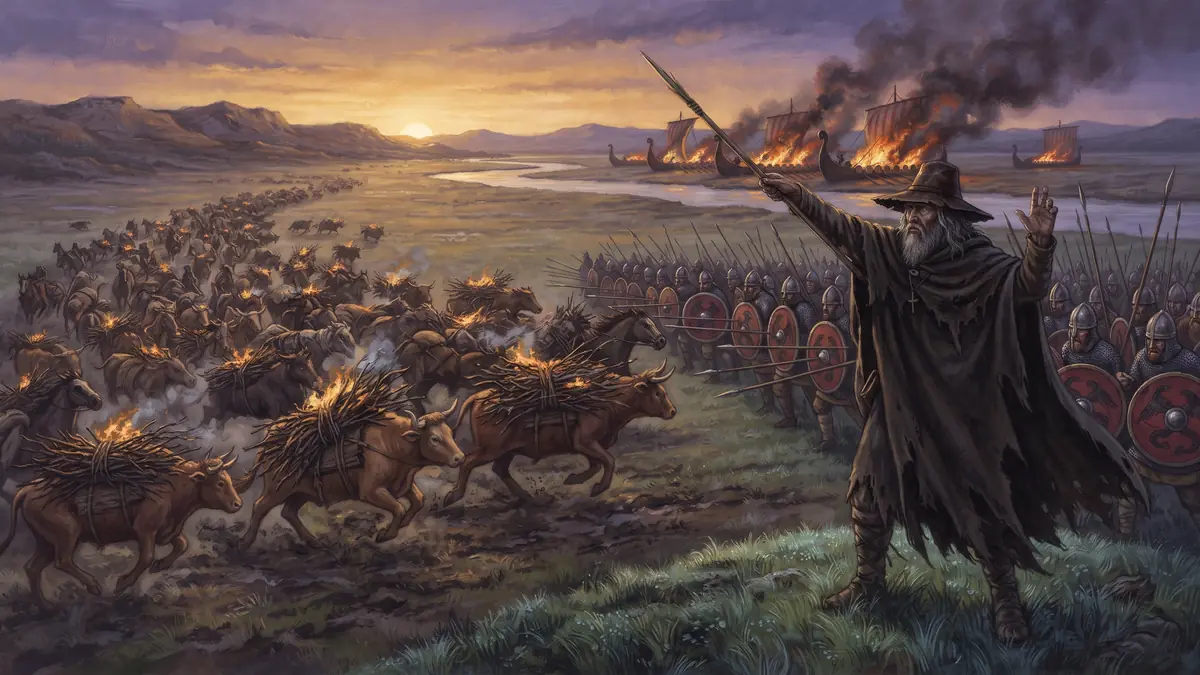
Þorgnýr has oxen, horses and other draught animals gathered, brushwood and bundles tied to them, and driven against the enemy, with slaves and common folk behind. On the first day, Styrbjörn’s army suffers greatly. On the second, they fight in formation, without advantage. At night, Styrbjörn sacrifices to Þórr, and Eiríkr makes offerings to Óðinn and promises to die ten years later in exchange for victory.
A tall hooded man gives Eiríkr a reed spear and tells him to throw it over Styrbjörn’s army. When he throws it, a cloud blinds Styrbjörn’s men, and a landslide falls on them. King Haraldr sees it all and flees. Styrbjörn tells his men to plant the standards and not to run, and falls with the whole force.
The poet
Eiríkr, standing on the bridge at Uppsala, asks for a poet and promises a reward. Þorvaldr Hjallason composes verses in exchange for a ring and never composes anything else.
What remains uncertain
The tale brings together a dream of a kingdom, an alliance with the Danes and a battle decided by a supernatural intervention. The text carries legendary details, such as the reed spear and the landslide, that cannot be taken as history. The date of composition is not secure.
To dodge the herd driven against the army, play Fyrisvellir.
Sources.
- Styrbjarnar þáttr Svíakappa, Old Norse text available at heimskringla.no
- Ármann Jakobsson, "The life and death of the medieval Icelandic short story", Journal of English and Germanic Philology 112:3 (2013)