 MMXXVI
Sutton Hoo: the 27-metre ship buried in Suffolk, the helmet like those of Vendel and Valsgärde, 37 gold coins and the occupant whose body was never found
In May 1939, Basil Brown and Edith Pretty opened Mound 1 at Sutton Hoo, in Suffolk, and found a ship 27 metres long. The burial, from about 620, is one of the best-known finds of Anglo-Saxon England.
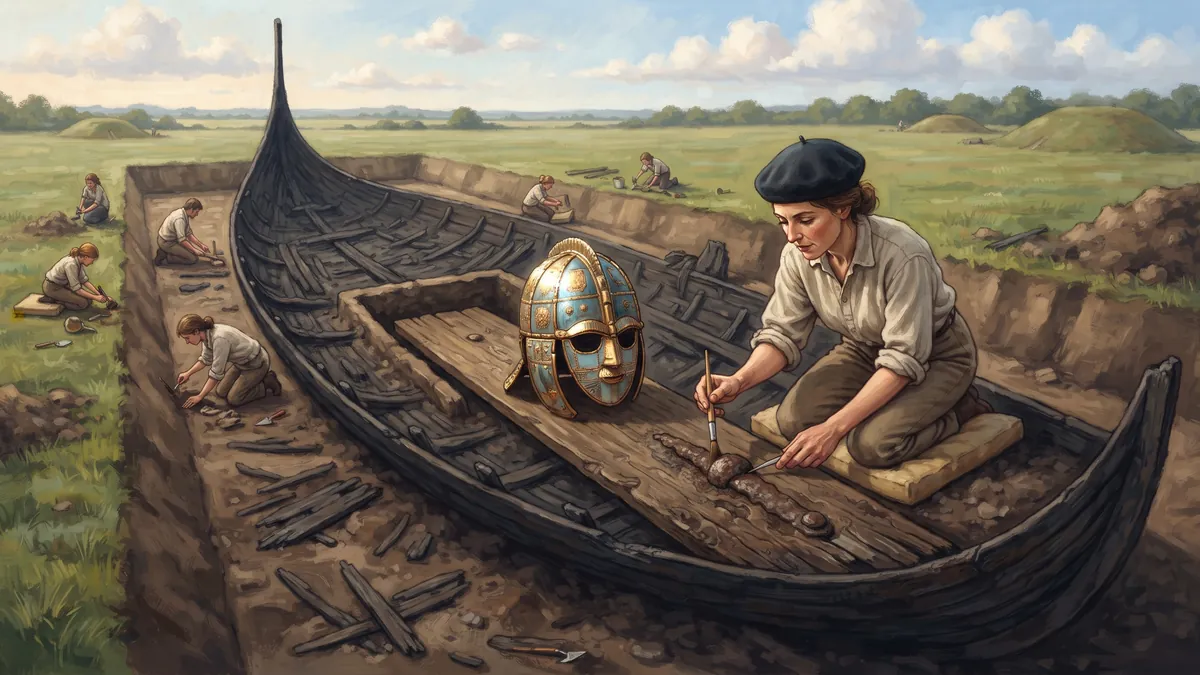
Sutton Hoo, in Suffolk, in eastern England, is a cemetery of about 20 mounds used roughly from 575 to 625. In 1938, a landowner, Edith Pretty, hired a self-taught archaeologist, Basil Brown. In May 1939 he began digging Mound 1 and, on the third day, his team found the first ship rivet.
The ship
The ship was about 27 m long and 4.4 m wide amidships, with nine overlapping planks on each side and 26 ribs. The oar rests suggest room for up to 40 rowers. The burial has been dated to about the third decade of the 7th century, and the 620s are the most likely.
The treasure
The chamber held 37 gold coins from various Frankish mints, plus three blanks and two ingots. There was also a large round shield, a sword with a gold and garnet pommel, a nest of ten silver bowls, two spoons inscribed PAULOS and SAULOS, a lyre, a gold buckle with a hidden compartment and a purse lid with garnet work. The helmet is compared with those of Vendel and Valsgärde, in Sweden, but was made with better craftsmanship than the Swedish ones. Edith Pretty gave the treasure to the nation, and the principal pieces are in the British Museum.
Who was buried?
The body was never found, so the occupant is unknown. The favourite candidate is Rædwald, king of East Anglia, traditionally dated to about 624. Gareth Williams’s study of the coins narrowed the date to 610-635, which makes Sigeberht, who died in 637, less likely; Eorpwald, who died around 627 or 628, remains possible. Wear on the sword hilt suggests its owner was left-handed. In 2025, Helen Gittos proposed that the body was a local elite soldier who had served the Byzantine Empire.
Other mounds
Mound 2, from 1938, yielded rivets and a disturbed chamber, from a small boat. Mound 17 was re-excavated in the 1980s and held a young man buried with a horse and weapons. In 1860, two bushels of iron bolts, presumably rivets, were reported from an opened mound.
Today
The £5 million visitor centre was opened in March 2002 by Seamus Heaney. Since 2021 work has been under way on a full-size replica of the ship, planned for 2026.
To tap the rivets and leave the stones, as Basil Brown did on the third day, play The rivets of Sutton Hoo.
Sources.
- Basil Brown's excavations (1938-1939) at Sutton Hoo and later reports, now in the British Museum
- Numismatic studies by Gareth Williams on the Merovingian coins of the burial, which point to the period 610 to 635
- Comparative studies with the Vendel and Valsgärde helmets in Sweden