 MMXXVI
The battle of Runzival: the eighth branch of the Karlamagnús saga and the death of Roland, which became a ballad in Norway
The eighth branch of the Karlamagnús saga tells in Old Norse the defeat of Charlemagne's rearguard at Runzival, Ganelon's treason and the death of Roland. See the plot, the relation to the Oxford manuscript of the Song of Roland and the Norwegian ballad Roland og Magnus kongen.
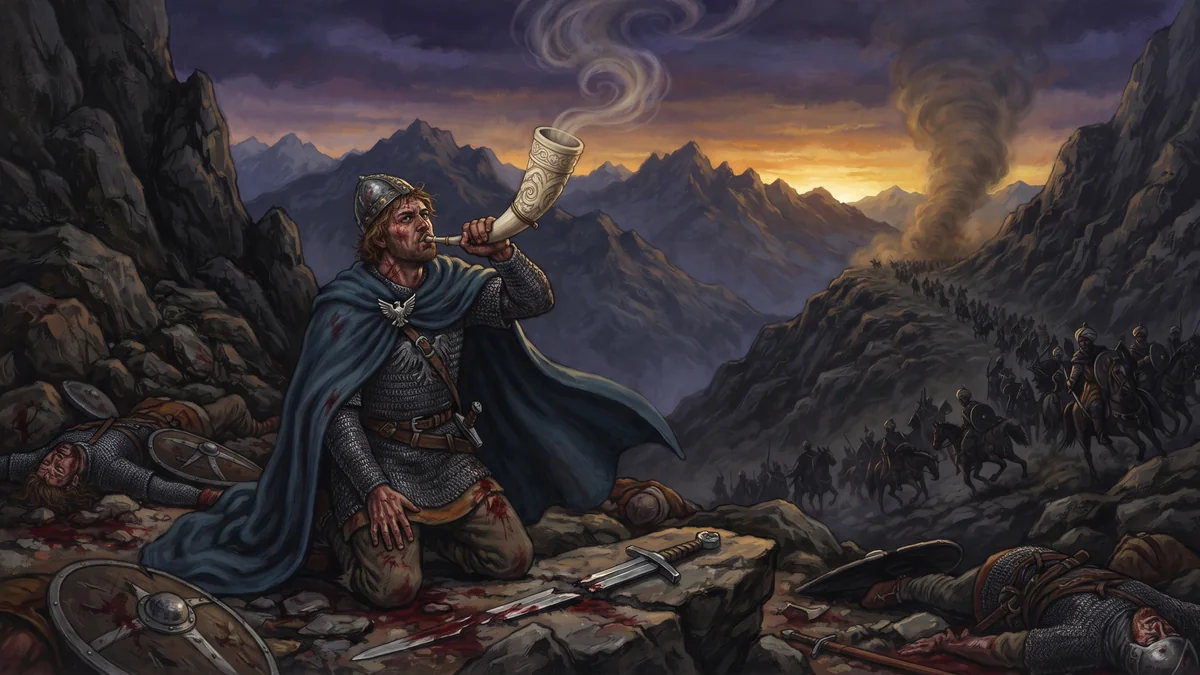
The eighth branch of the Karlamagnús saga is the Norse version of the Song of Roland, the French epic poem about the defeat of Charlemagne’s rearguard in the Pyrenees. The branch is textually close to the Oxford manuscript of the poem, with a few notable differences. In Norse it appears under the title “the battle of Runzival,” and it was the basis of the Norwegian ballad Roland og Magnus kongen.
The treason
The plot that follows is that of the Song of Roland, which the branch follows closely. After years of war in Spain, Charlemagne prepares to return to France. The Saracen king Marsile offers peace. Who will carry the emperor’s answer? Ganelon is chosen, and he resents Roland, his stepson, who proposed him. Ganelon agrees with the enemy on an ambush of the army’s rearguard, to be commanded by Roland.
The blast of the horn
When the Saracens fall on the rearguard, Olivier, Roland’s friend, asks him to sound the horn to call Charles back. Roland refuses out of pride. The battle is fierce, and the Christians are killed one by one. Only at the end does Roland sound the horn, and the sound is heard from afar. He is wounded and wants to keep his sword from falling into enemy hands. His death is the central scene of the poem.
The vengeance
Charles returns, defeats the Saracens and avenges the dead. Ganelon is tried and punished for treason. In the French tradition, the punishment is death by quartering.
The Norwegian ballad
The ballad Roland og Magnus kongen shows that the matter circulated beyond the written text. Its title already carries a Norse form of the emperor’s name, Magnus, taken from Latin Carolus Magnus, which also gave the saga its name Karlamagnús.
Why it matters
In late thirteenth-century Norway, the story of Roland arrived as part of a great compilation about Charlemagne, made from French sources, the same path of translation that brought other works such as the Tristrams saga. It did not stay only in the manuscript: the Norwegian ballad shows that the theme also passed into the song tradition.
To withstand the charge of the Saracen warriors on your shield, play The rearguard at Runzival.
Sources.
- Constance B. Hieatt (trans.), Karlamagnús saga: The Saga of Charlemagne and His Heroes, vol. 3 (Pontifical Institute of Mediaeval Studies, Toronto, 1980)
- Marianne E. Kalinke and P. M. Mitchell, Bibliography of Old Norse-Icelandic Romances (Cornell University Press, 1985)
- Entry on the Norwegian ballad Roland og Magnus kongen, in collections of medieval Scandinavian ballads