 MMXXVI
The Battle of Saucourt in 881: Louis III and Carloman II against the Vikings and the Ludwigslied, the Old High German song that celebrated the victory
On 3 August 881, two Frankish kings defeated a Viking army at Saucourt. The victory became a poem in Old High German, the Ludwigslied, kept in a codex in Valenciennes. See what is known.
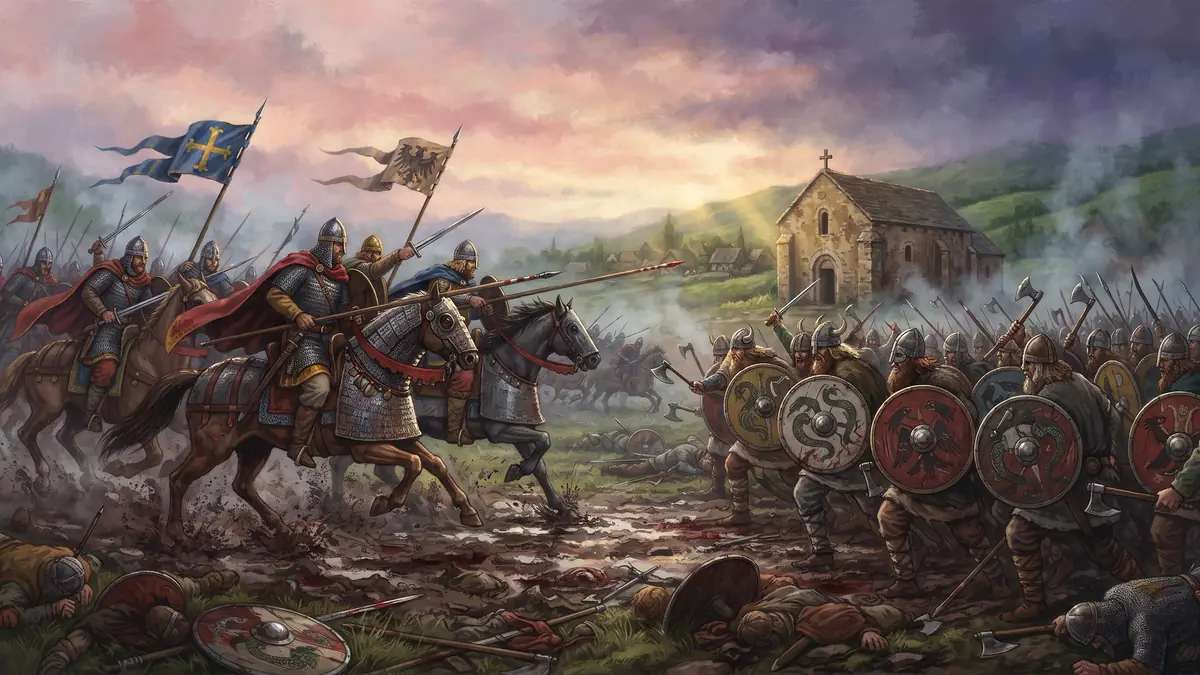
Among the records of the fight against the Vikings in Carolingian Europe, the Battle of Saucourt, on 3 August 881, is one of those that earned a poem. The text, the Ludwigslied, is in Old High German and celebrates King Louis III. It is one of the rare historical songs in that language.
The context
In the preceding years, the Vikings had settled at Kortrijk and raided towns such as Arras and Cambrai. They had also sacked the region of Amiens and Corbie. In 879, with the death of Louis II the Stammerer, the West Frankish kingdom passed to his sons, Louis III and Carloman II. It was they who faced the Norse at Saucourt, in Vimeu, in Picardy.
The battle
According to the Annals of Fulda, the Franks won and about nine thousand Vikings were killed. The figure is probably exaggerated, as is common in chronicles of the time. What can be said with more confidence is that it was a rare victory against the Norse. Louis III died the following year, in 882.
The poem
The Ludwigslied has 59 rhyming couplets, in the Rhine Franconian dialect. It is in codex 150 of the Valenciennes Library, on folios 141v–143r, beside the Sequence of Saint Eulalia, in Old French. The manuscript was rediscovered in 1672, the poem was identified in 1837 by Hoffmann von Fallersleben and received its present name from Jacob Grimm, in 1856.
In the poem, God sends the Northmen to test the Franks. The young Louis, fatherless, is called back and rallies the Franks. The author is unknown.
What remains
The interesting thing is the point of view. The poem is not by a chronicler but by someone who wanted to give the battle a religious and political meaning, presenting the Viking attack as a trial and the victory as divine favour.
The Valenciennes codex keeps side by side the Ludwigslied, in Old High German, and the Sequence of Saint Eulalia, in Old French. Many scholars consider it precious for exactly that reason: two short texts, in different languages, copied together, show how the languages of the old Carolingian empire were already drifting apart.
The annals and the poem, moreover, do not say the same thing. The annals record a number of dead; the poem sings of the king. It is best to read them together, one as a record and the other as praise, knowing that neither claims to be a neutral description of the battle.
To parry the Norse blows like a Frankish horseman, play The blows of Saucourt.
Sources.
- Annales Fuldenses (Annals of Fulda), entry for the year 881
- Ludwigslied, codex 150 of the Valenciennes Library (ff. 141v–143r)
- Entry on the Ludwigslied and the battle of Saucourt-en-Vimeu, in reference works on Old High German literature