 MMXXVI
The Björketorp stone: four metres tall, 7th-century runes and a curse on whoever breaks the monument
In Blekinge, in southern Sweden, the Björketorp stone is 4.2 metres tall, stands between two uninscribed menhirs and carries in Proto-Norse a curse on whoever destroys it. What it was for is still debated.
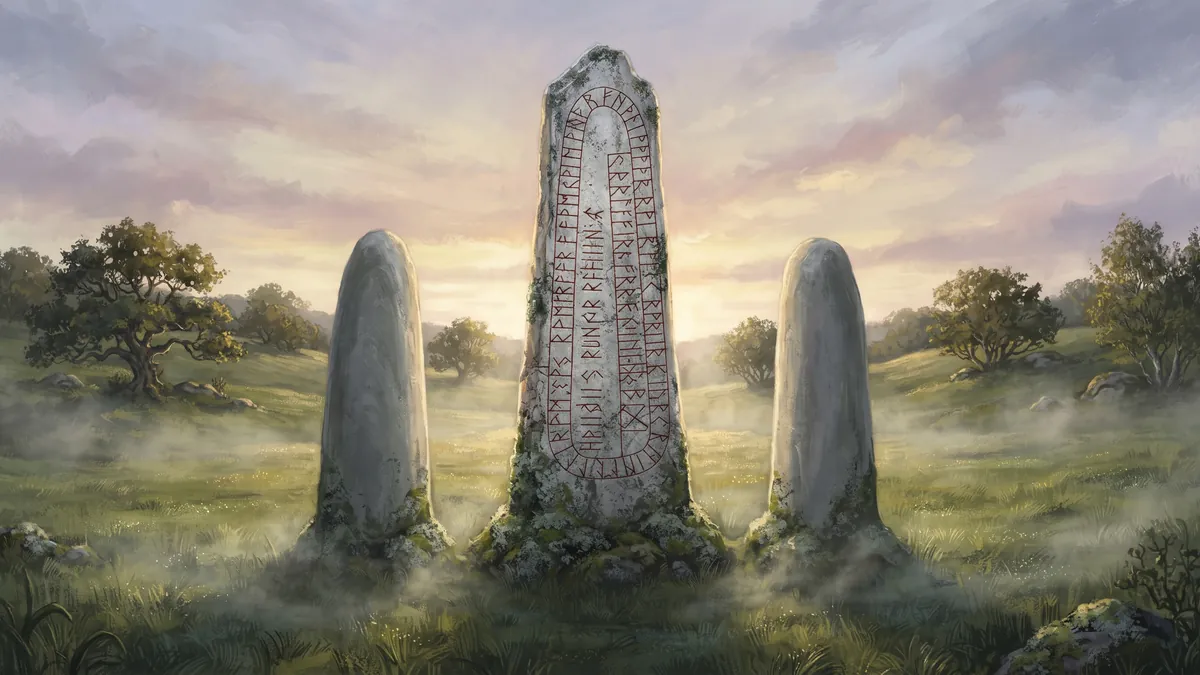
The Björketorp runestone stands in Blekinge, in southern Sweden, and is one of the tallest in the world: it is 4.2 metres high. It is not alone. Beside it rise two tall menhirs with no inscription. Most scholars date the runes to the 7th century, though the possible range runs from 500 to 700. What makes them special is the text: a curse.
What is written
The language is Proto-Norse, and there is writing on two sides. A partial transliteration reads: Haidz runo runu, falh’k hedra ginnarunaz. Argiu hermalausz … weladauþe, saz þat brytz. Uþarba spa. The usual translation is that the speaker, a master of runes, conceals runes of power here; whoever breaks this monument is doomed to endless maleficence and an insidious death. The last line ends with a prophecy of destruction. The shorter side is usually read as a prediction of ruin; the meaning of the other side is still debated.
An alphabet halfway along the road
The runes are an intermediate form between the Elder and the Younger Futhark. The rune for a, for example, has the shape that would later be that of h in the Younger alphabet, and the rune for k looks like a Y. The Blekinge stones were not carved by the same hand. The one at Björketorp is longer, more formal and less archaic than the one at Stentoften, and reflects a regional tradition of the 7th century.
Relatives in the region
Björketorp names no names. But it uses the same rune forms and gives the same message as the Stentoften stone, and so it is linked to the inscriptions of Stentoften, Istaby and Gummarp, which, by the names they mention, belong to the same clan. It stands some tens of kilometres from them.
What was the curse for?
There are several hypotheses. It may protect a grave, but excavations in 1914 found nothing by the stone or in the stone circle. It may be a cenotaph, a memorial far from the body. It may have been a shrine to Odin or a fertility site. Or a boundary marker between Swedes and Danes. Whichever it was, the message is that of a person who wants to be read and respected by whoever passes.
To tap the right runes and leave the pickaxes alone, play The runes of Björketorp.
Sources.
- The Björketorp inscription (Blekinge, Sweden), in Proto-Norse, 6th or 7th century, with those of Stentoften, Istaby and Gummarp in the same region
- Studies of the Blekinge runestones and of the transitional alphabet between the Elder and the Younger Futhark