 MMXXVI
The Eggja stone: the longest inscription in Elder Futhark, found face-down over a grave
Found in 1917 in Norway, the Eggja stone has some 200 runes, the longest known text in Elder Futhark, and the figure of a horse. Nobody has a translation accepted by all, but the subject is the protection of a grave.
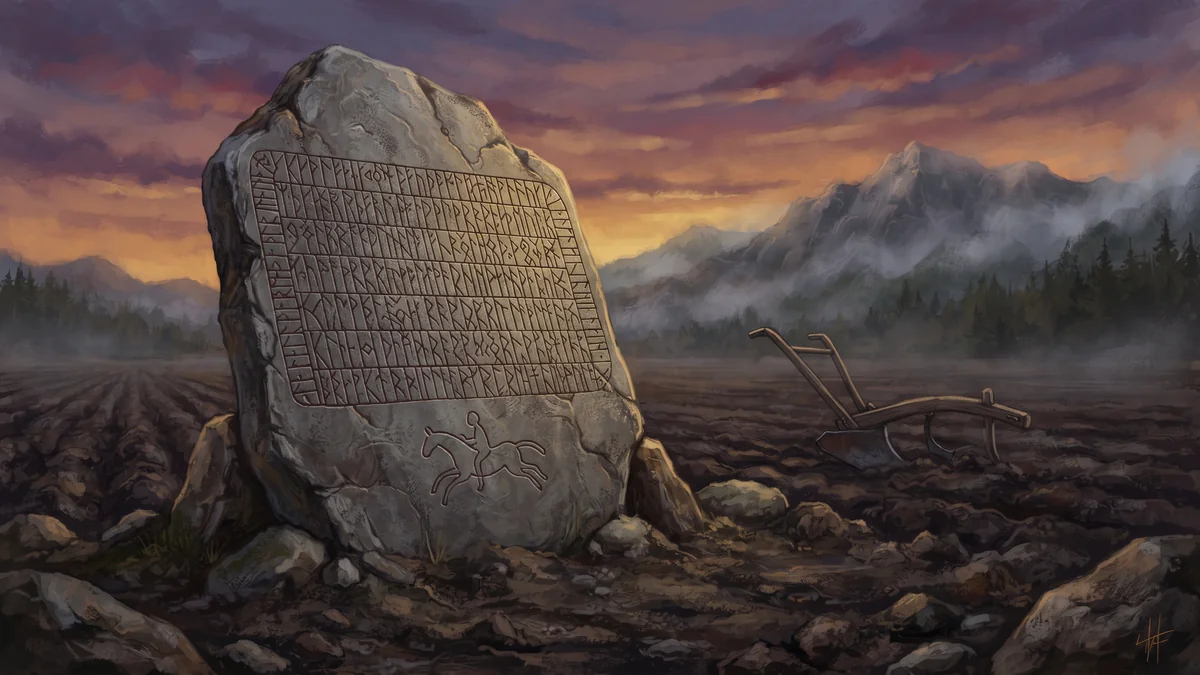
The Eggja stone, also called Eggjum, was ploughed up in 1917 on the Eggja farm in Sogndal, Norway. It lay with its carved face down over a man’s grave dated to about 650 to 700. It has some 200 runes, the longest known text in Elder Futhark, and is now in the Bergen Museum.
What it is
It is a flat slab, with runes that already show transitional forms towards the Younger Futhark. Among the carvings there is a horse, which seems unconnected to the text. Like the Kylver stone, it was found face down over a burial.
The text and the disagreement
The text is stylized and partly metrical, and deals with the protection of the grave and a funerary rite. The translation, however, varies widely, and only small parts have an accepted reading. Some characters are uncertain, and Grønvik’s transcription of 1985 is disputed in places such as fokl, read by others as foki.
Two readings
For Krause and Jankuhn (1966), the first panel says the stone has not been touched by the sun or cut with iron (or a knife), and that it must not be uncovered during the waning moon or moved. In the second, a man sprinkles the stone with blood, and the text asks which “army-god” came to the land. That figure would be a guide of the dead, an early form of Odin. The third panel deals with protection against wrongdoers.
Grønvik reads a shipwreck in bad weather, a question about who carried the dead, and the answer that a divine creature, like a fish, leads him to a land of shining meadows. The text, for him, also says it was made at night and not with steel, and warns necromancers and people who disturb the mind not to desecrate the grave.
Galdr
Some scholars propose that the second panel is a stanza in galdralag, the metre of incantations. Wikipedia notes the similarity with the Merseburg Incantations, and says the two sources may be rare examples of pre-Christian galdr.
In short
The Eggja stone is a case in which the certainty comes from the stone, and the doubt from the text. To carve runes in the right rhythm, play The runes of the Eggja stone.
Sources.
- English Wikipedia, article "Eggja stone" (discovery, dating, readings by Krause and Jankuhn, 1966, and by Ottar Grønvik, 1985)
- Rundata, inscription N KJ101