 MMXXVI
The Faroese chain dance: a ballad sung hand in hand, two steps left and one back, with no instrument at all
In the Faroe Islands, the national dance is a circle of people holding hands and singing old ballads, the kvæði. The skipari leads the song, and the only sound besides the voices is feet stamping the floor.
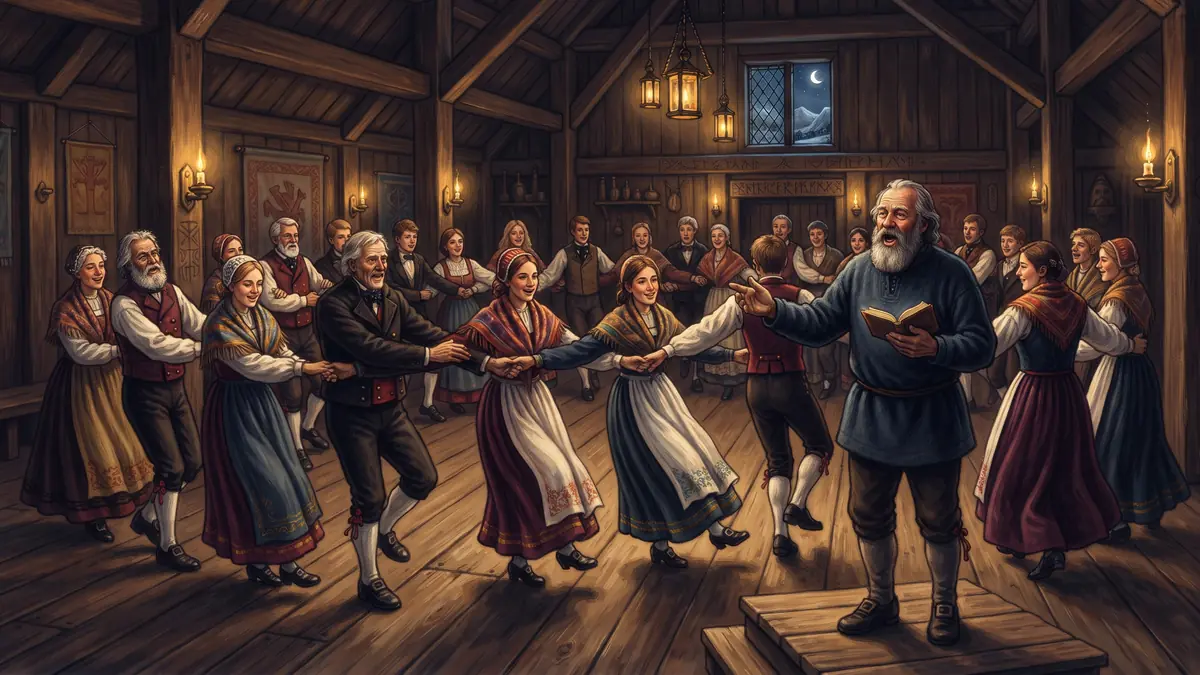
In the Faroe Islands, the national dance is a ring. People form a circle, holding hands, and sing old ballads called kvæði. Each person’s right hand passes a little over the neighbour’s left, and the feet make two steps to the left and one back.
Who sings and who answers
The one who leads the song is the skipari, the leader. He sings the verses, and everyone else joins in the refrain. There are no instruments. The only sound besides the voices is the stamping of feet on the floor, which keeps the beat. The ballads carry, from generation to generation, verses about the kings and heroes of the past.
Three ways to dance
The most common variant is the stígingarstev, with a six-step pattern per bar. There are also the trokingarstev and the bandadansur, the ribbon dance. The dance is not just a show: anyone can join the ring, and latecomers simply add themselves to the circle.
A season for dancing
The season runs roughly from September or October until Lent. On the bright summer nights, nobody dances. The exception is Ólavsøka, the national festival of 29 July, when dancing begins after midnight, after the singing, and goes on into the small hours. There are 15 associations gathered in the Sláið Ring, among them the Dansifelagið í Havn, founded in 1952.
Who kept the ballads
One of the main written collections is Hammershaimb’s Færøsk Anthologi, from 1891. Before books, they lived in memory, passed from one generation to the next inside the ring itself.
To catch the right rhythm and follow the skipari’s song, play The steps of the ring.
Sources.
- Hammershaimb, Færøsk Anthologi (1891), with the Faroese ballads
- Descriptions of the Faroese chain dance and dance calendar, and of the associations gathered in Sláið Ring