 MMXXVI
The Finnsburg Fragment: Hnæf and the sixty warriors who held the doors of the hall for five days
Only a piece of about 50 lines survives of the Anglo-Saxon poem, copied in 1705 from a leaf that was later lost. In it, Hnæf and his men defend the doors against a night attack.
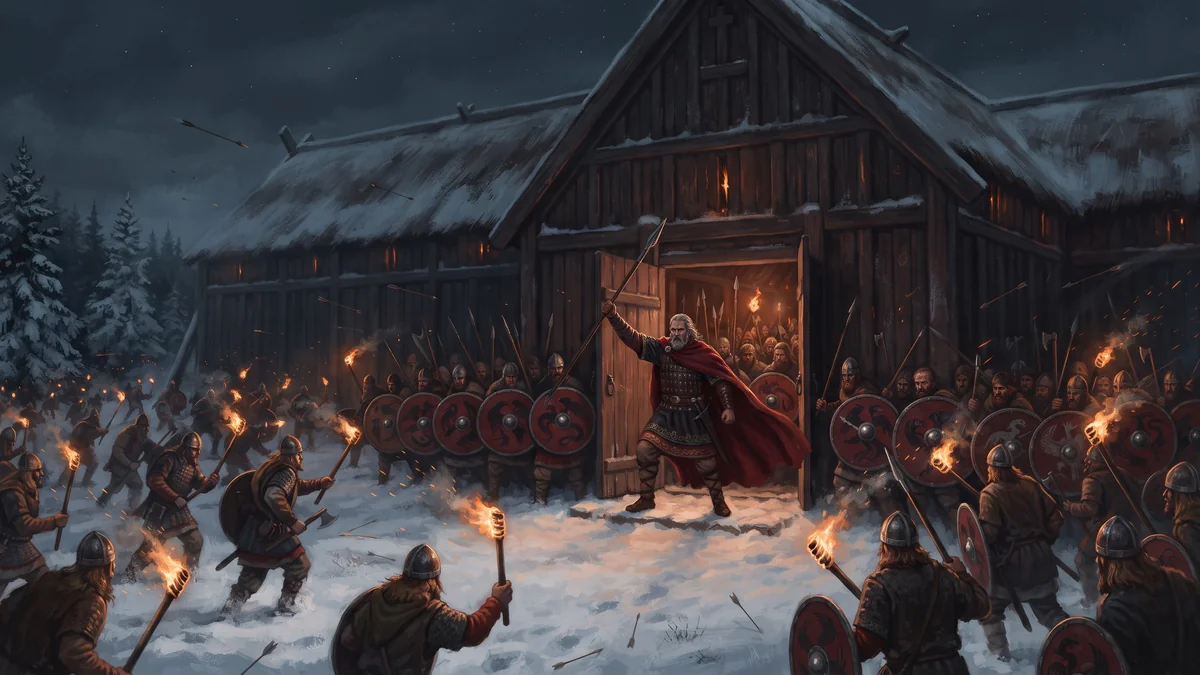
The Finnsburg Fragment (also spelled Finnsburh) is a short surviving part of an Old English heroic poem in alliterative verse. According to the sources, it concerns a fight in which Hnæf and his sixty retainers are besieged in “Finn’s fort” and try to hold off their attackers.
A copy of a lost leaf
The fragment survives only in a copy made in the late 17th century by the scholar George Hickes, who published it in 1705. The original leaf, almost certainly Lambeth Library MS 487 in London, has been lost. The same volume by Hickes contains the first reference to the sole manuscript of Beowulf.
What the piece tells
It is about 50 lines long and does not name the tribes. The text opens with Hnæf saying that what he sees outside is not the dawn in the east, nor a dragon in flight, nor burning gables: it is the torches of the attackers. Hnæf and his men hold the doors for five days, and none of them falls. Then a wounded warrior turns to speak to his chief, and the fragment ends. It is not known which side he was on, nor the cause of the fight, nor the outcome. Hengest appears only once, in line 17.
The other version, in Beowulf
Beowulf (lines 1068–1158) tells the same episode in about 90 lines, sung by Hrothgar’s scop at a feast. There the fight is called Fres-wæl, “the Frisian slaughter”. Hildeburh, Hnæf’s sister, married to Finn to seal peace between Danes and Frisians, loses her brother and her son, who share a pyre. Hengest makes a pact with Finn and spends the winter there, but in the end kills Finn in his own hall and takes Hildeburh back to her people.
What is still debated
Scholars disagree about who was fighting: Klaeber saw Danes and Frisians, and J. R. R. Tolkien proposed Jutes on both sides, in Finn and Hengest, edited by Alan Bliss in 1983. The fragment has no Christian references, and the burning of Hnæf is clearly pagan.
To hold the door of the hall and parry every blow with your shield, play The door of Finnsburg.
Sources.
- Reference work in English, article "Fight at Finnsburg"