 MMXXVI
The Franks Casket: the whale-bone box of about 700 with Weland, the Magi and runes in Old English
Carved in Northumbria in the early 8th century, the casket shows the smith Weland beside the Magi, as well as Romulus and Remus and the taking of Jerusalem. One of its sides is in Florence.
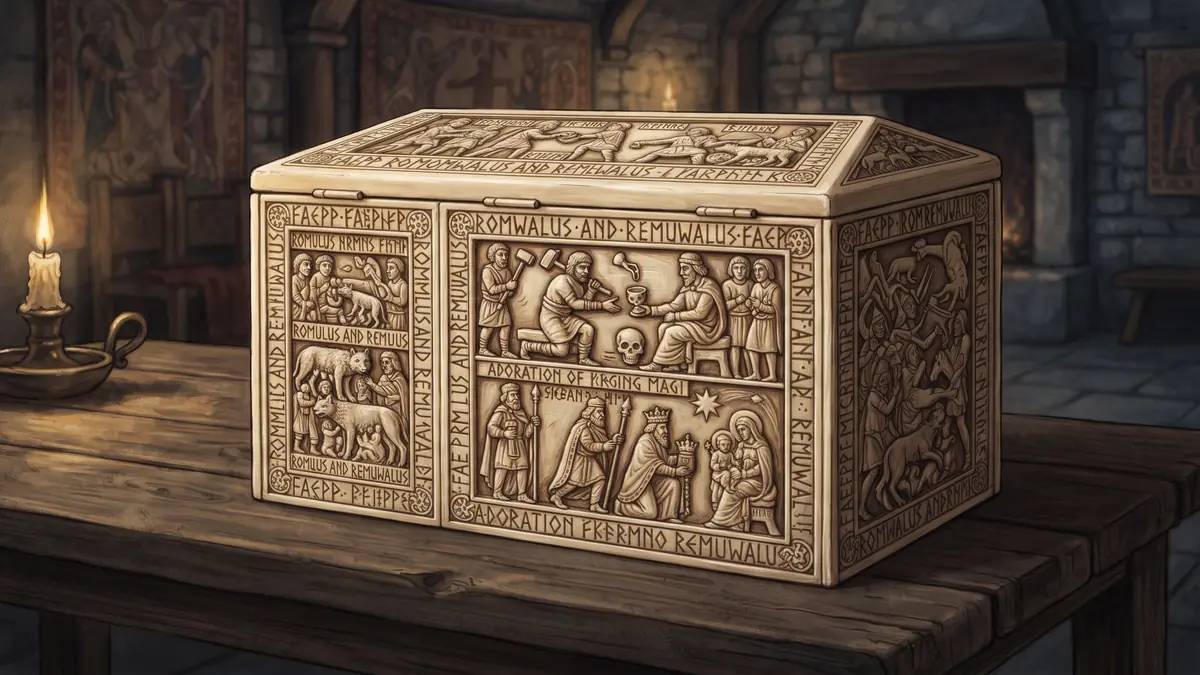
The Franks Casket, or Auzon Casket, is a small chest of whale bone from the early 8th century, now in the British Museum. According to the sources, scholars generally place its origin in Northumbria. It measures 22.9 cm long, 19 cm wide and 10.9 cm high, and its surfaces are covered with scenes carved with a knife, along with runic inscriptions.
From Brioude to London
Before the mid-19th century the history of the casket was unknown. It was later traced to the church of Saint-Julien in Brioude, France, and may have been looted during the Revolution. It then passed to a family in Auzon, who used it as a sewing box after trading away the silver fittings. Sir Augustus Wollaston Franks bought the parts in 1857 and gave them to the British Museum in 1867. The right side, found later, was sold to the Bargello Museum in Florence, where it was identified in 1890. London displays a cast of it.
The front: Weland and the Magi
On the left of the front appears Weland the Smith, enslaved by King Niðhad, who has cut his hamstrings. The scene shows the killing of Niðhad’s sons and the wings Weland makes to escape. On the right is the Adoration of the Magi, the casket’s only clearly Christian image. The inscription around it is an alliterative riddle about the material itself: the whale bone, cast up by the flood on a cliff.
The other faces
The left side shows Romulus and Remus nursed by the she-wolf, with runes saying she fed them in Rome, far from their native land. The lid shows an archer defending a fortress, labelled “Ægili”, usually read as Egil, Weland’s brother. Runes and Latin mix on the back, with Titus’s capture of Jerusalem. The right side is the most disputed: a grieving horse, a burial mound, a woman and a creature with a horse’s head. Elis Wadstein linked it to Sigurd and his horse Grani, but no reading has won general agreement.
What was it for?
The casket looks like a monastic work, perhaps a gift for a secular, maybe royal, recipient, and may have held a book, such as a psalter.
To stack the bone plates of the casket with care, without the tower collapsing, play The plates of the casket.
Sources.
- Reference work in English, article "Franks Casket"