 MMXXVI
The giant Finn and Lund Cathedral: the legend of Saint Lars, the name found in the lullaby and the stone giant hugging the crypt column
According to the Lund legend, a giant named Finn built the cathedral in exchange for the sun and the moon, or the saint's eyes, until his name was revealed by a lullaby. See the legend, what is known of the crypt figure and the Kalundborg variant.
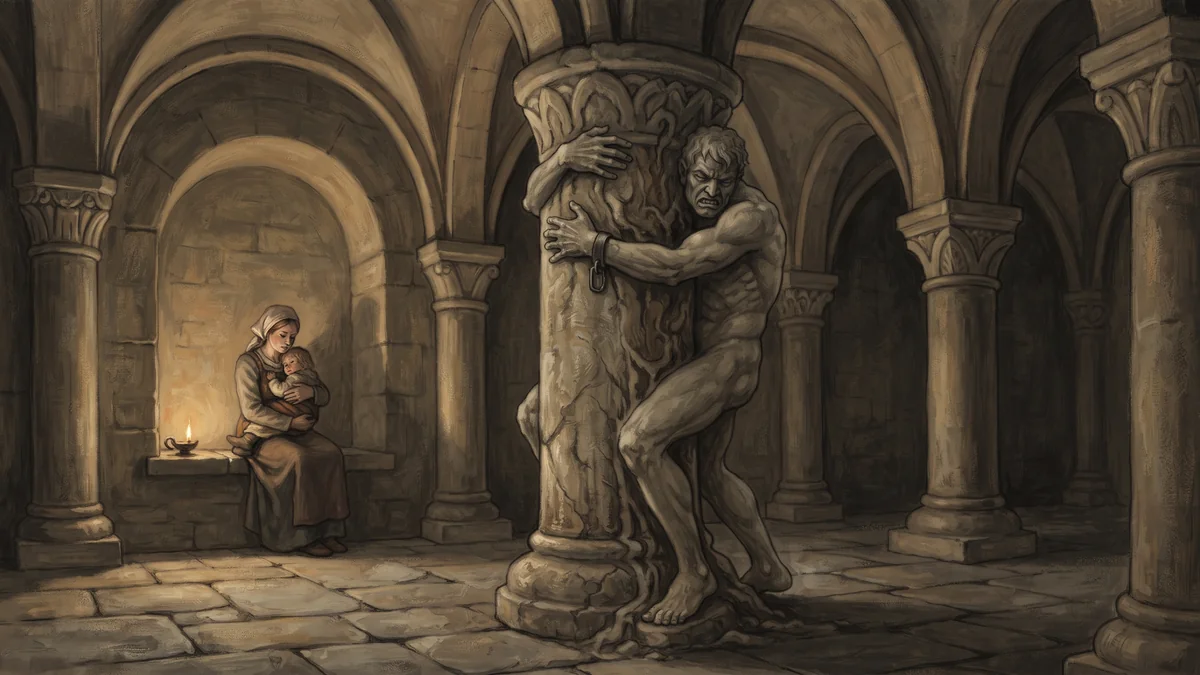
Lund Cathedral, in southern Sweden, hides a legend about who built it. In the crypt, near one of the columns, there is a stone figure that seems to hug the pillar. Tradition says it is a giant, Finn, who stayed there turned to rock after trying to bring down the church he himself had built.
The bargain
Saint Lars (Laurentius) wanted to raise a church in Lund. The giant Finn, who lived under the hill of Helgonabacken, offered to build it. As payment, he asked for the sun and the moon, or else the saint’s eyes. There was a way out: if the saint guessed the giant’s name before the work was finished, he would receive nothing.
The name
The saint tried names, such as Gunnar, Philip and Magnus, but none was right. The work advanced. When it was almost done, the saint, in despair, walked over the hill and heard a mother rocking her child. The song said that the father, Finn, would soon return with the sun and the moon, or with the saint’s eyes.
Lars cried: “Finn, Finn, lay the stone!” The giant, hearing the name, hurled the last stone, ran to the crypt and tried to pull down a column. He turned to rock right there.
The crypt figure
The stone figure, hugging a pillar, really exists. Art historians interpret it differently: as Samson (or Samson and Delilah), or as Boaz and Jachin, the columns of Solomon’s temple. The legend gave it a story of its own.
The sources
The first known mention is from 1593, by Erich Lassota von Steblau, who speaks of “giants punished by God”. The legend is first told in detail in 1654, by Jens Lauritzen Wolf. In 1750, Corylander already called it fictional.
The Kalundborg variant
In Kalundborg, in Denmark, the same legend is tied to Esbern Snare. The church has three and a half pillars, and the half is explained by the legend.
Lund Cathedral is dedicated to Saint Lawrence (Laurentius), which explains why the saint of the legend is called Lars, the Swedish form of that name. The legend also works as an explanation: it gives meaning to a figure in the crypt that, without it, would be only a stone sculpture hugging a pillar, and it gives the city a foundation story in which cunning beats strength.
To stack the cathedral’s stones before the giant wins, play The stones of the cathedral.
Sources.
- Kulturportal Lund, text on the legend of the giant Finn and Lund Cathedral
- Jens Lauritzen Wolf (1654) and Erich Lassota von Steblau (1593), the first written mentions
- Records of the Kalundborg variant, with Esbern Snare, and of the church with three and a half pillars