 MMXXVI
The Golden Horns of Gallehus: found in 1639 and 1734, melted down in 1802
Two gold horns of the early 5th century were found at Gallehus, in Jutland, in 1639 and 1734. One bore a sentence in runes. In 1802 a goldsmith stole and melted them, and today only drawings and copies remain.
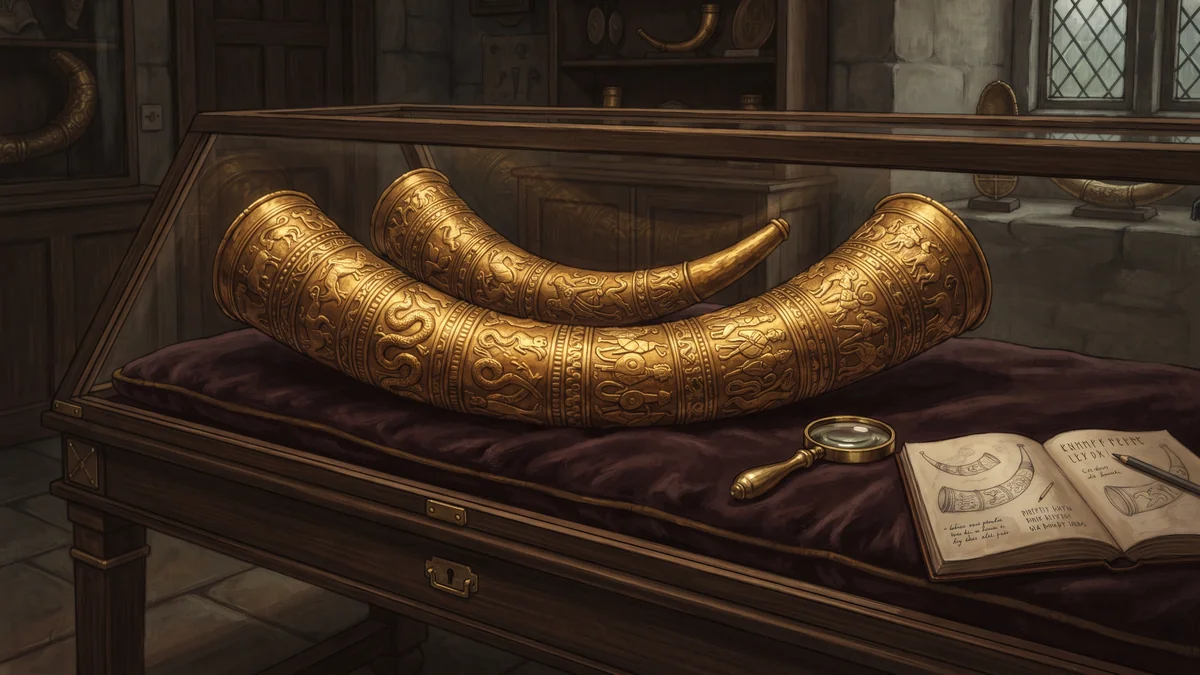
In 1639 and 1734, near Møgeltønder in Southern Jutland, two gold horns of the early 5th century were found. They were luxury objects, with figures of men, animals and serpents in relief, and one bore a sentence in runes. Today they no longer exist, because in 1802 they were stolen and melted down.
The two finds
The longer horn was found on 20 July 1639 by a peasant girl, Kirsten Svendsdatter, who saw something sticking out of the ground. She alerted King Christian IV, and the horn passed to the prince, who had it refitted as a drinking horn with a gold pommel at the narrow end (Wikipedia marks that claim as disputed). The shorter horn was found on 21 April 1734 by Erich Lassen, some 15 to 20 metres from the first. Both were kept in the Royal Chamber of Art at Christiansborg.
What they were like
Each horn was made of double gold sheet. The longer one, about 75.8 cm and 3.2 kg after restoration, had seven decorated segments, and the shorter, about 50 cm and 3.7 kg, had six, one of them a narrow band with the inscription. The figures combine human, animal and serpent forms, some interlaced. Since the drawings made before 1802 are imprecise, all interpretations of the images are speculative.
The sentence in runes
The inscription, in Elder Futhark, reads: ek hlewagastiz holtijaz horna tawido, “I, Hlewagastiz Holtijaz, made the horn”. It is among the oldest inscriptions of that alphabet with a full sentence and the oldest with a line of alliterative verse. Hlewagastiz may mean “fame guest”, and Holtijaz is usually read as a patronymic.
The theft
On 4 May 1802 the goldsmith Niels Heidenreich entered the storeroom with forged keys, took both horns and melted them down. The theft was discovered the next day. Heidenreich was arrested in April 1803, confessed and was sentenced to prison in June. The recovered gold was made into coins, not new horns.
In short
What exists today are copies made from drawings, Oehlenschläger’s poem and a runic sentence that, in a way, summed up a craftsman. To assemble the horn piece by piece, play The horn of Gallehus.
Sources.
- English Wikipedia, article "Golden Horns of Gallehus" (discovery, dimensions, inscription DR 12, theft of 1802)
- Ole Worm, De aureo cornu (1641), first preserved drawing
- Adam Oehlenschläger, poem "Guldhornene", about the horns