 MMXXVI
The Gundestrup cauldron: Iron Age silver found in a Danish peat bog
Peat cutters found in 1891, in Denmark, a dismantled silver cauldron with plates of figures in relief. It is not Norse: it came from far away, and who made it and why it was hidden are matters of hypothesis only.
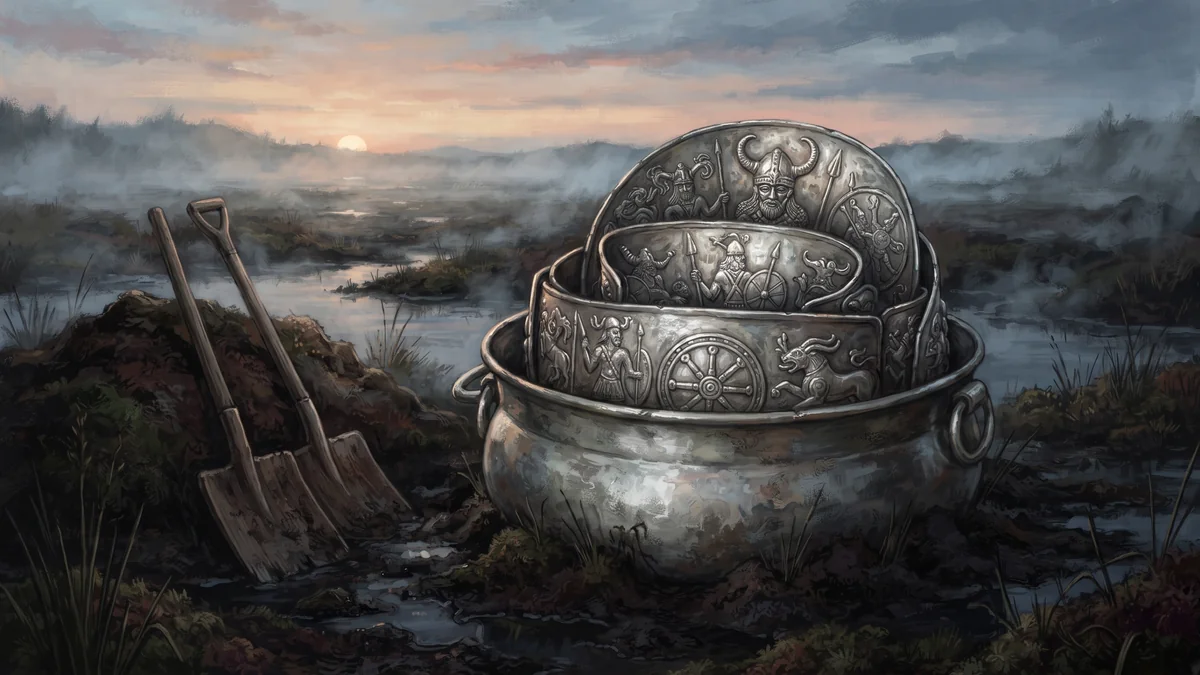
The Gundestrup cauldron is not a Norse object, which is why it deserves to be told properly. It was found in Denmark, but the images, the metal and the style point to other parts of Europe. It appears here because it stands at the centre of Danish archaeology.
The discovery
On 28 May 1891, peat cutters found it in the small bog of Rævemose, near the larger Borremose, close to Gundestrup in Himmerland. The finders received a large reward from the government and then quarrelled over how to divide it. The cauldron was dismantled, with the other pieces stacked inside the base. This suggests it was hidden deliberately. Plant studies showed that the land was dry when it was deposited and that peat grew over it later.
What it is
It measures 69 cm in diameter and 42 cm in height, and weighs almost 9 kg. Wikipedia calls it the largest known European Iron Age silver work. It is incomplete: a base plate, five inner plates, seven outer plates and two rim fragments survive. There is repoussé relief, gilding, glass eyes in the figures and tin solder.
The images
On the base plate there is a bull, with a female figure with a sword and dogs. On other plates appear a figure with antlers holding a torc and a horned serpent (often called Cernunnos), a female bust between wheels, elephants and griffins, a bull-sacrifice scene repeated three times, warriors with three carnyx players and a man dipped in a barrel, sometimes read as rebirth.
When and by whom
The dating runs from 200 BC to 300 AD, or, more narrowly, from 150 to 1 BC. Who made it is disputed: lead isotopes in the silver point to northern France and western Germany, the tin came from Cornwall and the glass probably from the eastern Mediterranean. Some propose Thracian craftsmen, others link it to the coinage of northwest Gaul. The Cimbri appear in a hypothesis about how it reached the north, but it is only a hypothesis.
In short
Wikipedia mentions no Norse connection. The cauldron is in the National Museum of Denmark in Copenhagen, with replicas in Ireland and France. To collect the plates before the peat covers them, play The Gundestrup plates.
Sources.
- English Wikipedia, article "Gundestrup cauldron" (discovery, dating, motifs, debate on origin)
- References cited by Wikipedia: Nielsen, Bergquist and Taylor, Olmsted, Hutton