 MMXXVI
The Gutasaga: the island of Gotland that sank by day and rose by night, Þieluar's fire and the three sons who divided it
The 13th-century Gutasaga says that the Swedish island of Gotland lay under water by day, that a man fixed it by lighting a fire and that his three grandsons divided the land. It also tells of the lot-drawing that sent part of the people away.
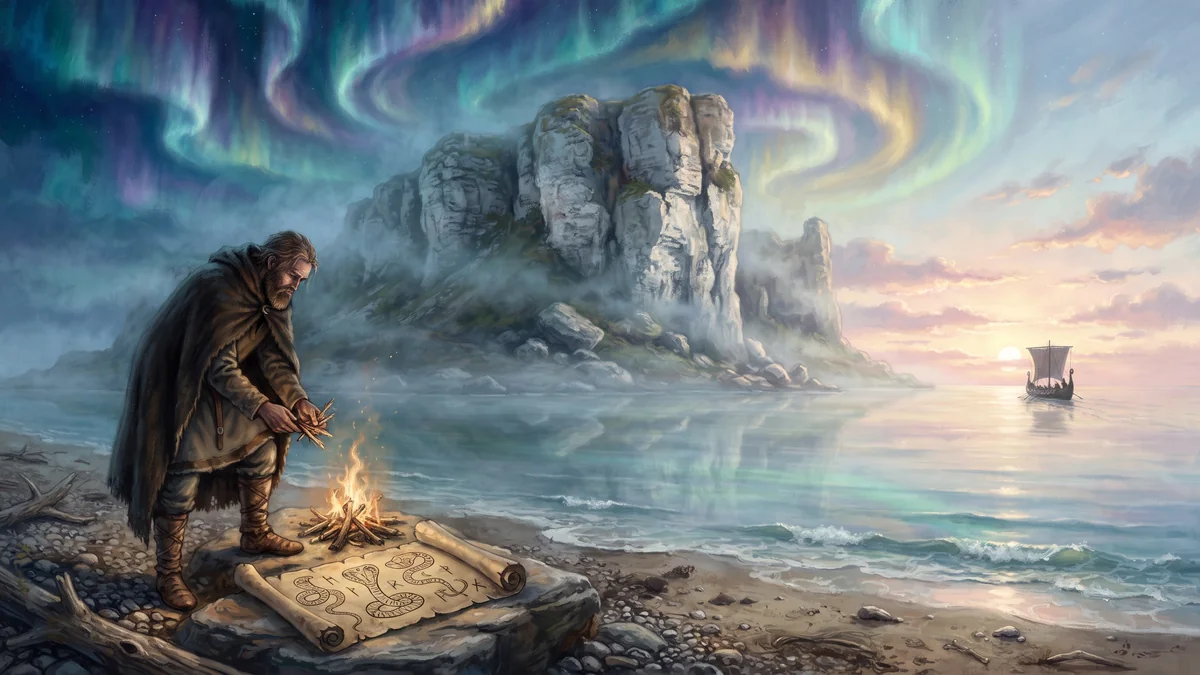
The Gutasaga is a 13th-century saga about the history of Gotland before Christianization. It survives in a single manuscript, Codex Holm. B 64, from about 1350, kept at the National Library of Sweden in Stockholm alongside the Gutalag, the island’s law code. It was written in Old Gutnish, a variety of Old Norse.
The island that sank
The opening is fairy-tale. A man called Þieluar, or Tjelvar, discovers the island, which lay under a spell: it sank by day and only rose to the surface at night. When Þieluar lit a fire on it, the spell broke, and the island stayed fixed above the sea. His son Hafþi married Hwitastierna.
Three snakes and three sons
Hwitastierna dreamed of three snakes coiled around her body. Hafþi read the dream as a sign of three sons and named them before they were born: Graipr, Guti and Gunfiaun. The three fathered the Gotlanders. The verses say that Guti would own the island, but the prose calls Graipr the eldest. The prose divides Gotland into three parts: Graipr took the north, Gute the middle and Gunnfjaun the south. That division held legally until 1747, and the Church’s three deaneries still reflect it.
The lot and the voyage
In time the island filled up. They drew lots, and one person in every three had to leave, taking movable goods but not land. The group went to Þorsburg, was driven out, moved to Fårö and then to an island near Estonia called Dagaiþi, where it built a fortress. It followed the river Dyna (Daugava) through Russia and reached Greece. The saga links this journey to the historical Goths.
The pact with the Swedish king
The second half deals with agreements with the king of Sweden and with the duties of king and bishop towards Gotland. Scholars read this as an assertion of the island’s independence. The name Awair Strabain appears as the man who arranged the agreement with the Swedish king.
By giving the island a discoverer, a dream, three founders and a written agreement with the king, the saga presents it as a people with a history of its own, which is why it is still read together with the law of the island.
To put each part of the saga in its place, play One passage, one part.
Sources.
- *Gutasaga*, 13th-century saga about Gotland, in the manuscript Codex Holm. B 64 (c. 1350), National Library of Sweden, together with the *Gutalag*
- Modern studies of the Gutasaga and of the Old Norse language of Gotland