 MMXXVI
The Kalmar Union: Erik of Pomerania's 1397 coronation and three kingdoms under one monarch
On 17 June 1397, Erik of Pomerania was crowned at Kalmar as king of Denmark, Sweden and Norway. The union, designed by Queen Margaret, lasted more than a century and ended bloodily.
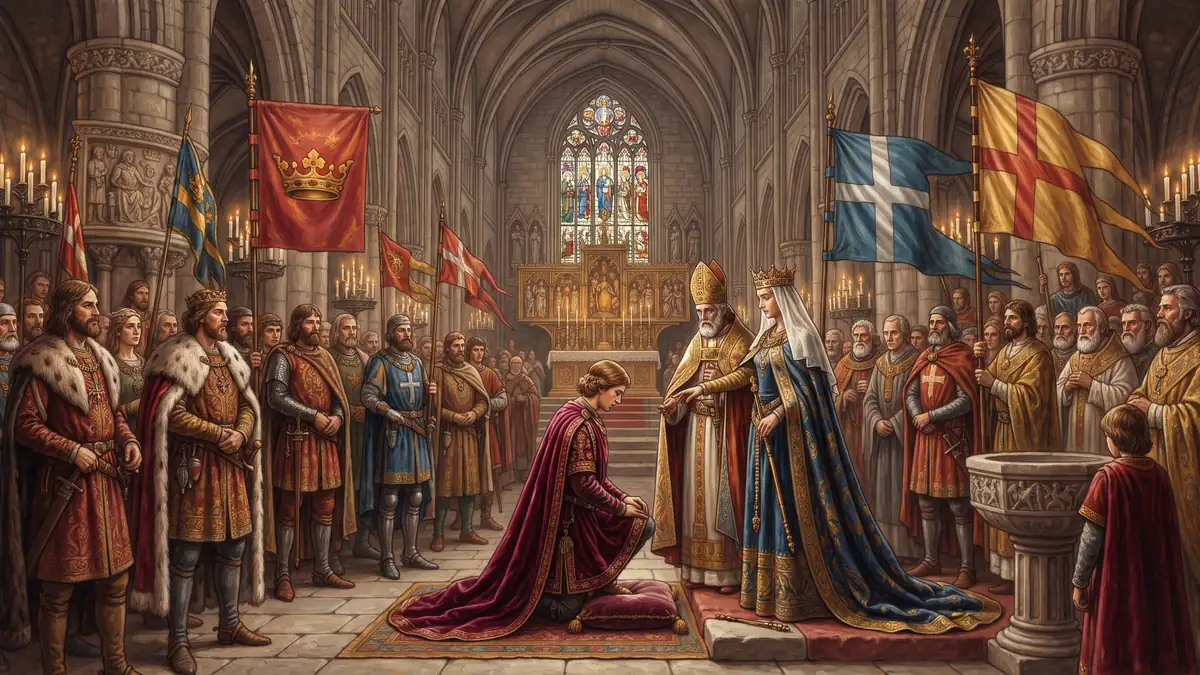
The Kalmar Union joined Denmark, Sweden (which then included much of present-day Finland) and Norway under one monarch. According to the sources, it was designed by Queen Margaret of Denmark, and each kingdom remained legally separate.
The coronation of 1397
Margaret adopted her great-nephew Erik of Pomerania in 1387. After she defeated King Albert in 1389, Erik was proclaimed king of Norway. In 1396 he was elected king of Denmark and Sweden, and the coronation at Kalmar, in Sweden, took place on 17 June 1397, the date the article gives as the start of the union.
Why they united
The article says Scandinavian aristocrats formed the union to counter the Hanseatic League. Denmark had lost the Danish-Hanseatic war of 1361 to 1370, and one aim was to block German expansion northward into the Baltic.
The end
In 1520, Christian II invaded Sweden, and Sten Sture the Younger died at the battle of Bogesund. In November that year, Sten Sture’s supporters were executed en masse in the Stockholm Bloodbath. Gustav Vasa, whose father, Erik Johansson, was executed, organized a rebellion in Dalarna, allied with Lübeck and conquered most of Sweden. On 6 June 1523 he was elected king, and Sweden left the union. Frederick I renounced his claim to Sweden in 1524, in the Treaty of Malmö.
What historians debate
The union ended “effectively” in 1523, but some structures lasted until 1536 or 1537, when Norway was declared a Danish province, though it kept its own laws. The article says it was not continuous and had several interruptions. The historian Sverre Bagge lists causes of the instability: the power of the national aristocracies, the uneven effect of foreign policy, geography, size, and Denmark’s difficulty in forcing Norway and Sweden to stay. The monarchs wanted a strong state, and the nobilities did not.
To stack the blocks of the crown of the three kingdoms, play The blocks of the three-realm crown.
Sources.
- Reference work in English, article "Kalmar Union"