 MMXXVI
The Kirkegrim: the Nordic church's guardian spirit, the lamb buried alive beneath the altar and the omen the gravedigger feared to see
In Scandinavia, folklore says the spirit of an animal buried alive in the foundations guards the church. It lives in the tower, walks at night, punishes scandals, and seeing it in the graveyard foretells a child's death.
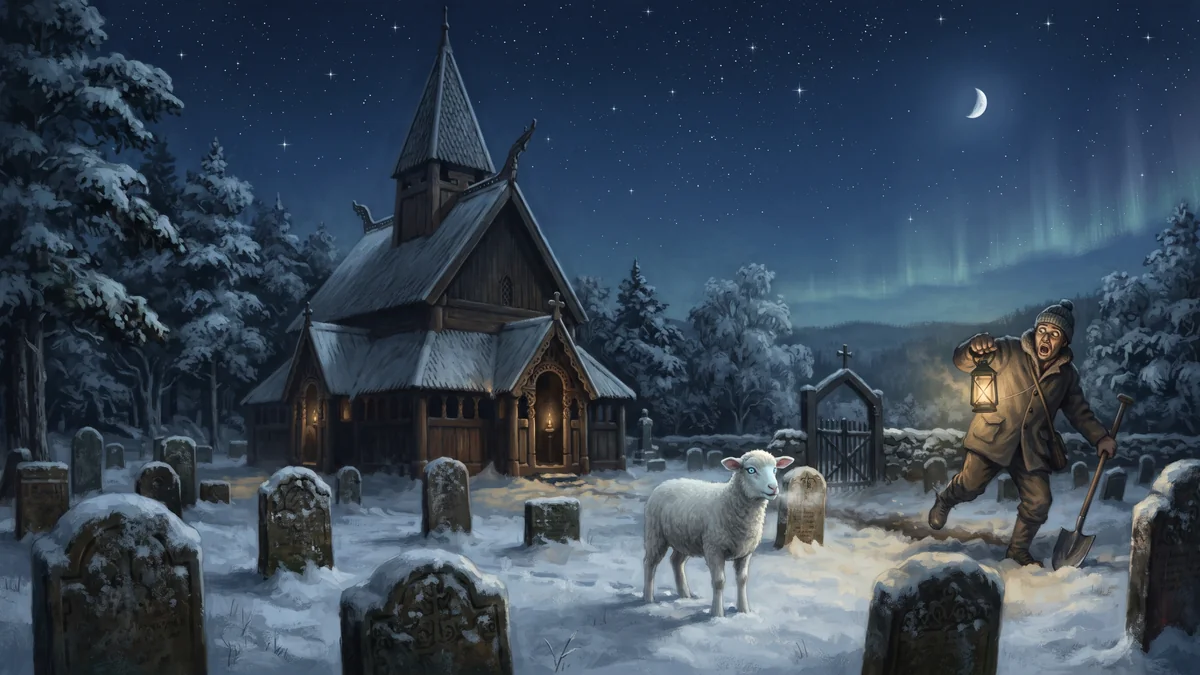
In many parts of Scandinavia, folklore says every church has a spirit that protects it. It is the ghost of an animal buried alive in the foundations, beside the first cornerstone, so that the building would stand firm. In Swedish it is the kyrkogrim. In Danish, the kirkegrim. In Finnish, the kirkonväki.
Where it is told
The belief appears mainly in Scania, Halland and Blekinge, in southern Sweden, and in Denmark. The buried animal varies: a lamb, a boar, a pig, a horse, according to Henderson. In many churches, it is said, the lamb lies under the altar.
What it does
The kirkegrim lives in the tower. At night, it walks the graveyard and around the building. It punishes scandals in the church and troubles anyone who does wrong inside. It is also the enemy of the årsgång, the Swedish ritual in which someone walks on New Year’s night to learn who will die in the coming year. The spirit hinders the walker.
The omen
The most feared sign is the lamb. If the church lamb is seen in the graveyard, especially by the gravedigger, it foretells the death of a child. In some versions it has three legs. At Kroskjoberg, a buried sow played the same part: whoever saw it expected a death.
What the lamb means
Scholars see here an old memory of foundation sacrifice, the practice of burying something alive beneath a building to make it firm. They also see a Christian rereading: the lamb stands for Christ as the cornerstone. The belief survives because it joins the two, the old and the new, in an animal nobody can see without fear.
To raise the church foundation stone by stone, under the lamb’s gaze, play The foundation of the church.
Sources.
- Henderson, Notes on the Folk-Lore of the Northern Counties of England and the Borders (1879), and Thorpe, Northern Mythology (1851)
- Craigie, Scandinavian Folk-Lore (1896); Briggs, An Encyclopedia of Fairies (1976); Thiselton-Dyer (1893); Kuusela (2016)