 MMXXVI
The Maine penny: an eleventh-century Norwegian penny found at a Native American site in the United States
In 1957, an amateur archaeologist said he found in Maine a silver penny of King Olaf Kyrre, of 1065–1080, at a Native American site. Is it genuine? How did it get there? See what is known and what is still disputed.
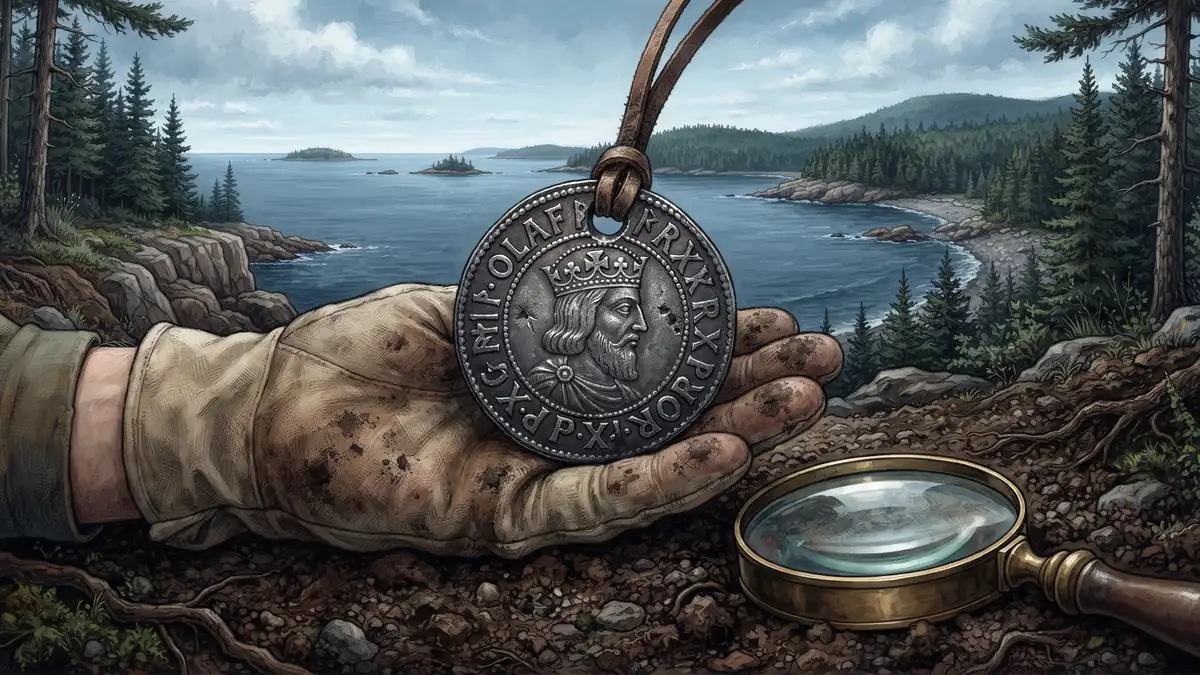
The Norse reached North America around the year 1000, and the only proven site is L’Anse aux Meadows, in Newfoundland. But there is a coin found much farther south, in the state of Maine, that has caused argument since 1957: the penny from the Goddard site.
The find
According to Wikipedia, the amateur Guy Mellgren said he found the coin on 18 August 1957 at the Goddard site, an old Native American settlement at Naskeag Point on Penobscot Bay, in Brooklin, Maine. The coin was donated to the Maine State Museum in 1974, together with about 30,000 objects from the site.
What the coin is
At first it was taken for a twelfth-century British penny. Then Kolbjørn Skaare, of the University of Oslo, determined that it was a Norwegian silver penny minted between 1065 and 1080, during the reign of Olaf Kyrre (1067–1093). The coin has a perforation, probably for a pendant, and that part has since corroded away.
The site
The Goddard site is dated to 1180–1235, within the period in which this type of coin circulated. Its inhabitants are generally considered ancestors of the Penobscot. The coin is the only Norse object found there, and a burin point of the Dorset culture was also recovered.
How did it get there?
The explanations compete:
- A Norse voyage or trade: the Maine State Museum favours a Norse presence, but says the most likely explanation is that Native people obtained the coin elsewhere, perhaps in Newfoundland, and traded it to the site.
- A coastal origin: supporters argue that Norse travellers went farther south than Newfoundland, or that the coin circulated locally.
- A hoax: similar coins were on the open market in 1957, so Mellgren could have planted the coin or been deceived by someone who did. No motive is clear.
The sceptics and Gullbekk
Robert Hoge, of the American Numismatic Society, said in 2006 that the coin “should probably be considered a hoax”. The anthropologist Edmund Carpenter’s assessment was “not proven”. The Norwegian numismatist Svein Gullbekk published in November 2017, in the Journal of the North Atlantic, a paper arguing that the coin is a genuine find.
What is firmly established
The coin is a Norwegian silver penny of the Olaf Kyrre period, as identified by Skaare. Mellgren said he found it at the Goddard site in 1957, and it was donated to the museum in 1974. The site dates to 1180–1235. The coin’s provenance is disputed and its archaeological significance is not clear. Wikipedia says the sources consulted do not resolve whether it is a genuine find, a hoax or a trade item.
In short
The Maine penny is a Norwegian penny of 1065–1080 found at a Native American site of 1180–1235. It may have arrived by a Norse voyage, by trade or by hoax, and the dispute goes on.
To find the pairs of coins, play The pairs of coins.
Sources.
- English Wikipedia, article "Maine penny" (discovery, identification, dating of the site and the competing views)
- Svein Gullbekk, article in the Journal of the North Atlantic (November 2017), cited on Wikipedia, arguing that the coin is a genuine find
- Kolbjørn Skaare (University of Oslo), identification of the coin, cited on Wikipedia