 MMXXVI
The minor goddesses of the Gylfaginning: Sjöfn, Lofn, Vár, Vör, Syn, Hlín, Snotra and Gná, the handmaids of Frigg who watched over loves, oaths and doors
In the Gylfaginning, Snorri lists the goddesses (ásynjur) beside Frigg and Freyja. Some get only one line: one watches over love, another over oaths, another over doors. See what the text says of each and what was lost.
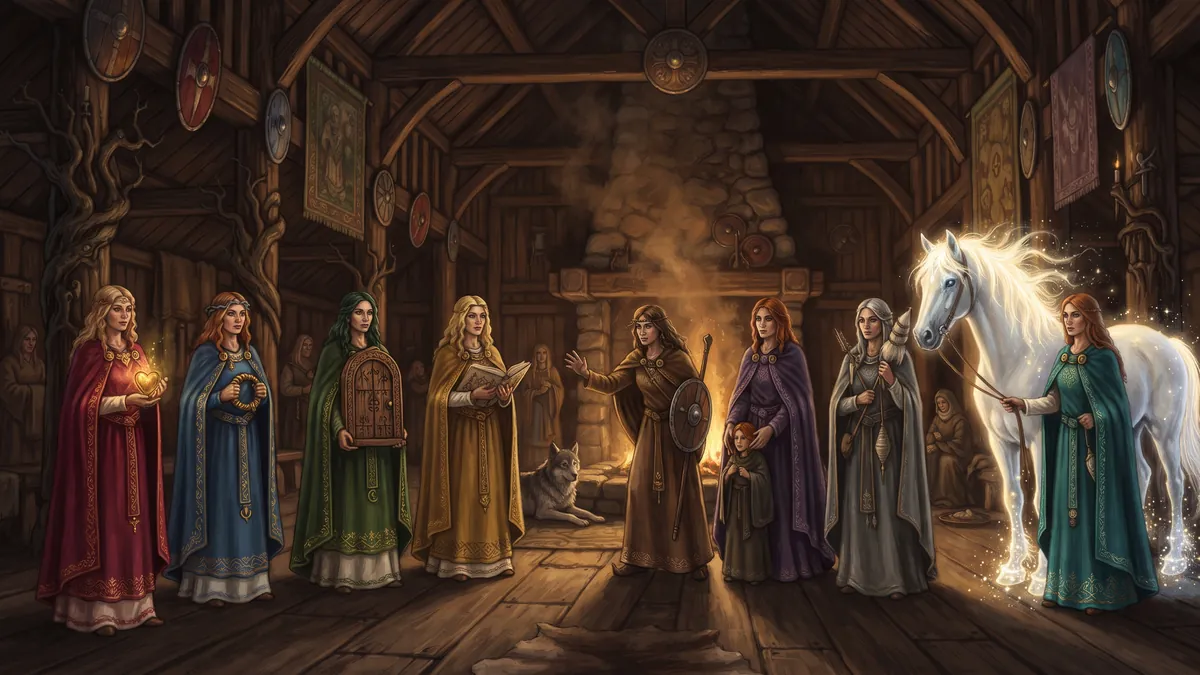
When people speak of Norse mythology, the names that come first are Odin, Thor and Loki. The goddesses appear less. In the Gylfaginning, Snorri Sturluson gives them a passage, after speaking of Frigg and Freyja, with a list of names and a short function for each. Many get one or two sentences. That is nearly all that survives.
Snorri’s list
What he says about each, in brief:
- Sjöfn takes care to turn the hearts of people, men and women, towards love.
- Lofn is kind and, with leave of the Allfather or of Frigg, unites lovers even where there are obstacles.
- Vár hears the oaths and promises made between men and women and punishes those who break them.
- Vör is so wise and perceptive that nothing can be hidden from her.
- Syn guards the door of the hall and shuts it against those who should not enter; she also guards denial in lawsuits, when something is denied.
- Hlín protects the people whom Frigg wants to save from some danger.
- Snotra is wise and well-mannered.
- Gná is Frigg’s messenger, whom she sends to various worlds. She has a horse, Hófvarpnir, which runs through air and over sea.
Sól and Bil also appear in the list, but Snorri describes them elsewhere.
What was lost
Almost nothing more is known of these names. There are no known poems, myths or cults of Sjöfn or Snotra, for example. So scholars debate whether many of these goddesses were cult figures, or whether some are only names representing aspects of Frigg. Snorri’s text is late, from about 1220, and written by a Christian, which also calls for caution.
The interest of the list
Even short, the list shows what the tradition valued: love, the given word, wisdom, the protection of the home and the message carried from afar. Vár and Syn recall how oaths and law counted in the Norse world.
One detail of the list stands out. Among the goddesses named, only Gná comes with an animal, the horse Hófvarpnir, and only she has a travelling function. The others look after people, doors and given words. It is a division of tasks reminiscent of a well-run household, in which each servant has her own duty, and perhaps that is why Snorri presents them as companions of Frigg.
To pop the oath rings without touching the hazards, play The oath rings.
Sources.
- Snorri Sturluson, Prose Edda, "Gylfaginning" (around 1220), the list of goddesses
- Anthony Faulkes (trans.), Edda, Snorri Sturluson (Everyman, 1987)
- Store norske leksikon, entry "norrøn religion"