 MMXXVI
The rune poems: how Old English, Norwegian and Icelandic sang the name of each letter
Three medieval poems give each rune a name and a stanza: the Old English one, with 29 runes, and the Norwegian and Icelandic, with 16. Fé, úr and þurs appear in all.
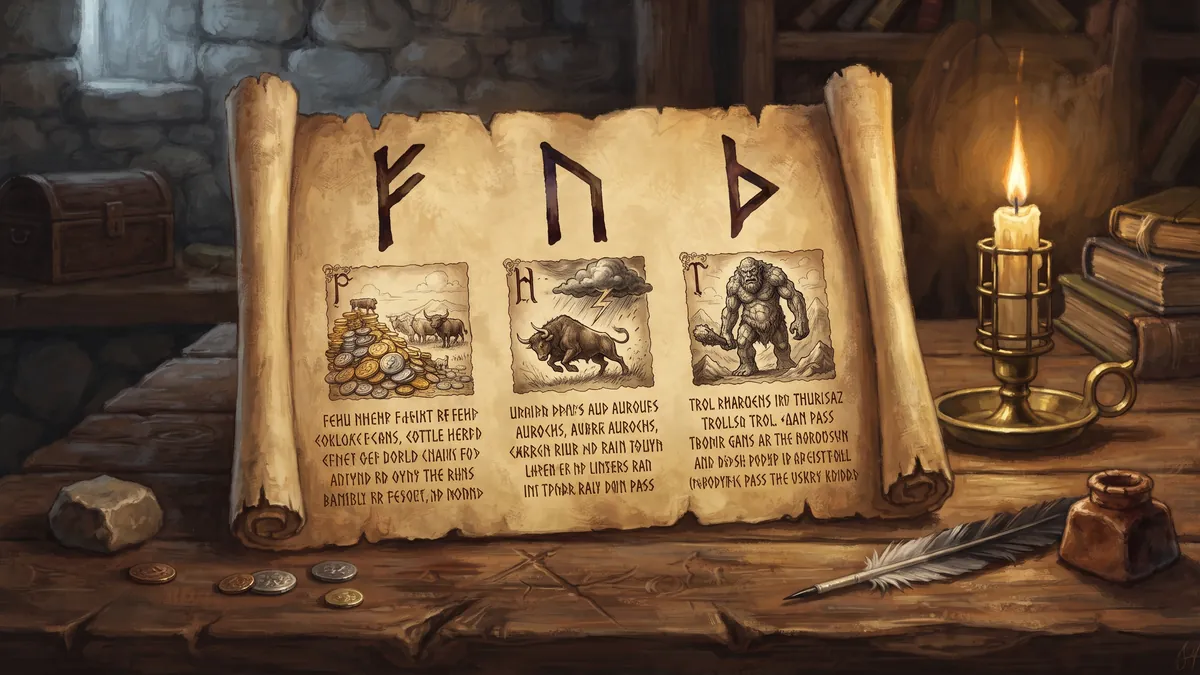
There are three medieval poems that give each rune a name and a short stanza: the Old English, the Norwegian and the Icelandic rune poems. They are among the few sources that say what the letters’ names meant to those who used them.
The Old English poem
The Old English poem was probably composed in the 7th century. It covers 29 Anglo-Saxon runes. The manuscript, Cotton Otho B.x, from the 10th century, burned in a fire at the Cotton library in 1731. George Hickes copied it in 1705, and his copy underlies all editions. Hickes printed it as prose, divided into 29 stanzas, with the runes engraved in the margin. Van Kirk Dobbie argues that this layout was probably not in the original. The poem has references to Anglo-Saxon pagan figures alongside Christian ones.
The Norwegian poem
The Norwegian poem survives only in a 17th-century copy of a 13th-century manuscript that has been lost. It covers the 16 runes of the Younger Futhark and is in skaldic metre. Each stanza opens with a line in the pattern “rune name + is + X”, followed by a rhyming line that gives more information about the subject.
The Icelandic poem
The Icelandic poem is in four manuscripts of the Arnamagnæan collection. The oldest, AM 687 d 4°, dates from around 1500 and is damaged in places, so some readings are guesswork. Another, AM 461 12°, dates from around 1550. The poem also covers the 16 runes of the Younger Futhark and is the most systematic of the three, compared to ljóðaháttr. The text is not standardized, and Olaus Verelius and Jón Ólafsson of Grunnavík recorded different versions, some shorter.
Three runes, three images
The Icelandic poem gives, for example, these readings: fé, wealth, is a source of discord among kinsmen. Úr, bad drizzle, is the lament of the clouds, the ruin of the hay harvest and the shepherd’s hatred. Þurs, the giant, troll or demon, is the torment of women and the dweller of cliffs.
In short
The rune poems show that the alphabet was also a small inventory of the world: money, rain, monsters. To see who is who, play Fé, Úr and Þurs.
Sources.
- English Wikipedia, article "Rune poem"
- Manuscript Cotton Otho B.x (10th century), copy by George Hickes (1705)
- Arnamagnæan manuscripts AM 687 d 4° (around 1500) and AM 461 12° (around 1550)