 MMXXVI
The Snoldelev stone: the reciter of Salhaugar and the three interlaced horns
The Snoldelev stone, from the 9th century, in Denmark, says it was raised by Gunnvaldr, son of Hróaldr, a þulr of Salhaugar. It bears three horns interlaced in a triangle, and scholars still discuss what they mean.
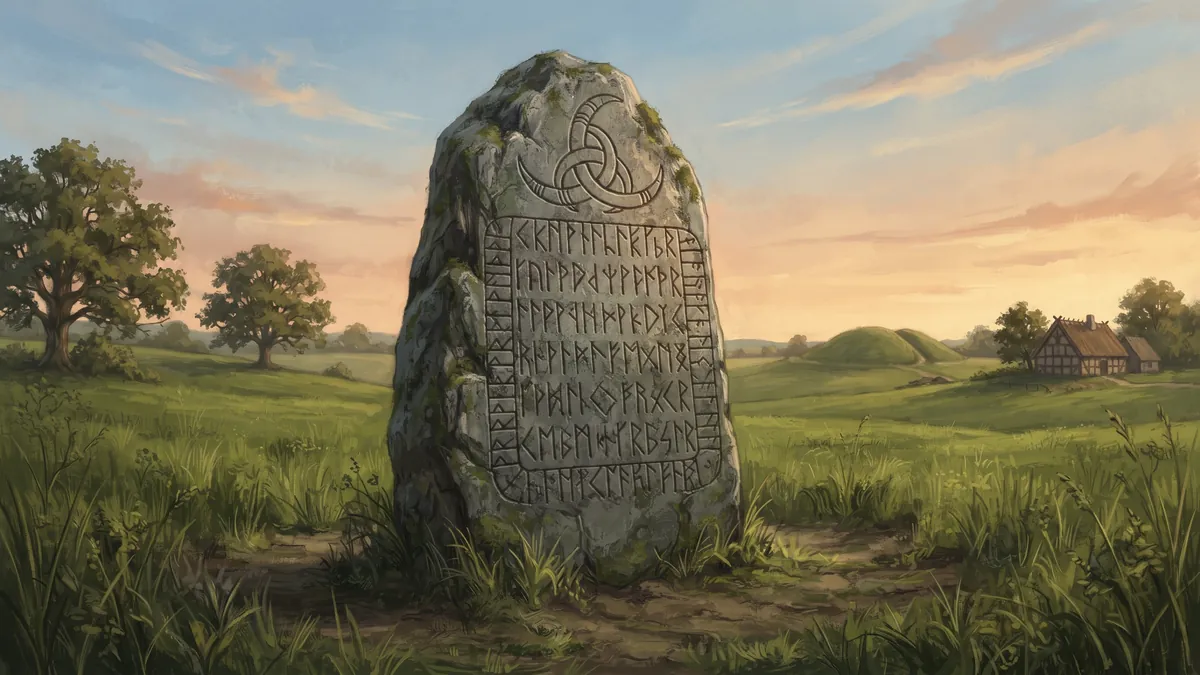
The Snoldelev stone, catalogued as DR 248, is a 9th-century runestone found at Snoldelev, in Ramsø, Denmark. It is 1.25 metres tall and is in the National Museum of Denmark in Copenhagen. The most curious thing about it is not the text, which is short, but the drawing: three interlaced horns.
The text
The inscription is in an early form of the Younger Futhark. It says, roughly: “Gunnvaldr’s stone, Hróaldr’s son, þulr of Salhaugar”. The name of the carver is not known. Salhaugar is identified with the village of Salløv, near where the stone stood, and Salhøgum joins sal, “hall”, and hörgar, “mounds”, that is, something like “hall mounds”, perhaps a place where official meetings were held.
What a þulr is
The word is linked to Old Norse þula, “litany”, and means something like “reciter”. The title may denote an office, perhaps a priest or a skald. The þulr of later texts was a sage tied to chieftains and kings. Rundata suggests “reciter”; other readings point to a religious or poetic role. The exact meaning remains uncertain.
The three horns
The stone has three horns scratched on it, possibly drinking horns, interlaced in a triangle. Wikipedia compares the figure to incomplete Borromean rings. A similar design appears on the Lillbjärs stone on Gotland, beside the valknut, but the relation between the two symbols is unknown. The Snoldelev stone also bears a swastika, an ancient symbol that predates its modern use.
An approximate date
The page gives two dates of discovery: around 1775, when farmers found it, and 1810, when it was recorded. It was handed to the Antiquities Commission in 1811.
In short
A small stone, a title nobody fully understands and three horns nobody can read. To stack the stone to the right height, play Gunnvaldr’s stone.
Sources.
- English Wikipedia, article "Snoldelev Stone" (discovery, inscription, translation, horn symbol)
- Rundata, inscription DR 248
- References cited by Wikipedia: Nielsen (1974), Birkmann (1995), Simek (2007), Peterson (2002), Sundqvist (2009)