 MMXXVI
The svartebok: the more than a hundred Norwegian spellbooks of 1480 to 1850, the 7-by-4.8 cm Vinjeboka found under a church floor and the magician Cyprianus
The svartebok, "black book", was a handwritten Norwegian book of spells. More than a hundred survive, from about 1480 to 1850, and most contain remedies and protections. The oldest fits in the palm of a hand.
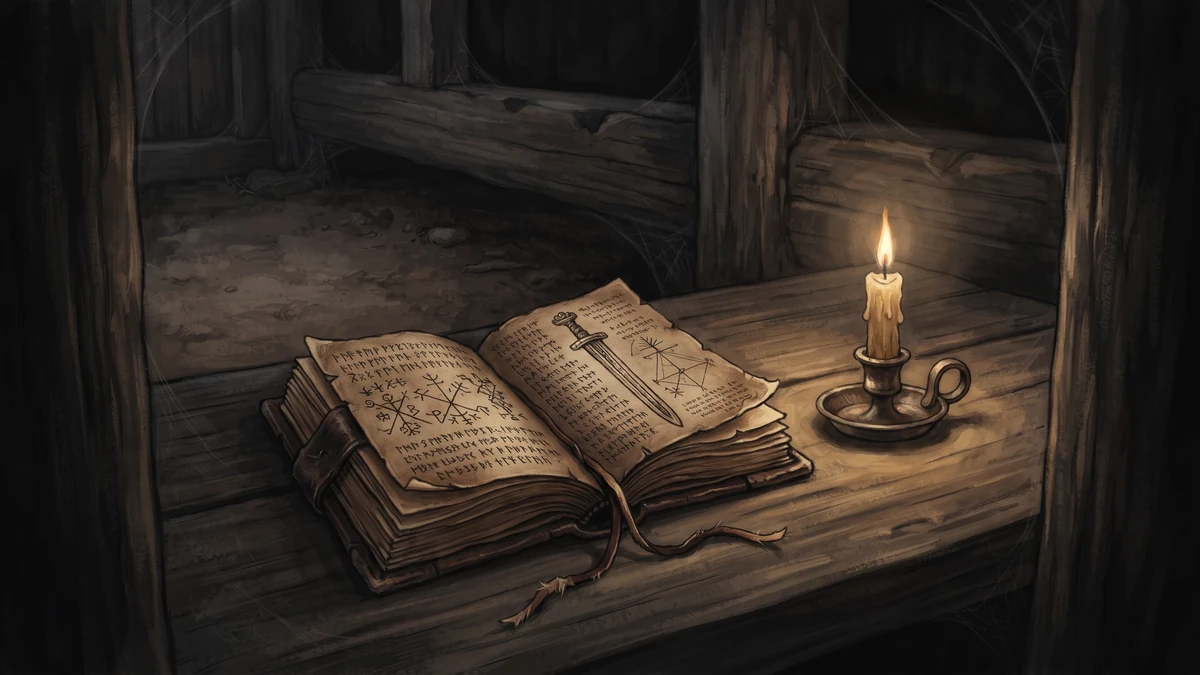
The svartebok, “black book”, was a book of witchcraft (trolldomsbok) with recipes and formulas for good and harmful magic. More than a hundred Norwegian examples survive, from about 1480 to 1850. Most are handwritten, but printed copies exist.
What was in them
Most of the recipes were of useful or protective magic: guarding against dangers, healing people and animals. Many healing recipes also included practical herbal remedies. What gave the books their name was the svartekunst, the harmful magic. Typical topics include:
- stopping bleeding and protecting against fire;
- relieving toothache and healing wounds;
- love magic and protection against witchcraft;
- finding thieves and stolen goods;
- contacting the dead, making a pact with the devil and harming others;
- abortifacients and luck at cards.
The content mixed Christianity, folk medicine and magic. Officially, religion and magic were kept apart; in practice the line was often blurred, and the blessing formulas had Christian parts.
The Vinjeboka
The oldest Norwegian black book that survives is the Vinjeboka, on paper from about 1480. It was found in 1796 under the floor of the Vinje stave church, when the church was demolished. It measures 7 by 4.8 cm and has about 108 pages, perhaps 112 at first. It contains spells, hymns and medical advice. Its best-known drawing is a sword, accompanied by a formula to dull an enemy’s blade, in the name of the Father, the Son and the Holy Spirit.
Cyprianus
The oldest books were often called “Cyprianus” or “the 6th and 7th Book of Moses”. The name comes from the legend of Cyprian of Antioch, a powerful magician whom folk belief held to be an author. In Scandinavian legends, the book stayed with its owner, resisted fire and water and, if thrown away, came back. If a servant read it in the owner’s absence, he summoned the devil, and the only escape was to give him an impossible task, such as emptying a fjord, until the owner returned.
Close to ordinary life
Around 1720, Norway had only five registered doctors and 28 surgeons, according to the historian Ole Georg Moseng. Many people turned to the priest or to a signekone, a folk healer. Black books rarely appear in witch trials and, when they do, they were confiscated as evidence.
To sort each formula into the right box, among healing, protection and dangerous magic, play One formula, one box.
Sources.
- Entry "svartebok" in Store norske leksikon on Norwegian spellbooks, Vinjeboka and Cyprianus
- Anton Christian Bang, Norske hexeformularer og magiske opskrifter (1901), the main edition of svartebok texts
- Studies of the Cyprianus and the black-book tradition in Scandinavia