 MMXXVI
The Tjängvide stone: the eight-legged horse and the ship of Gotland
The Tjängvide stone, found in 1844 on Gotland, shows an eight-legged horse with its rider above and a ship below. See what is in each part of the stone and why the rider has several readings.
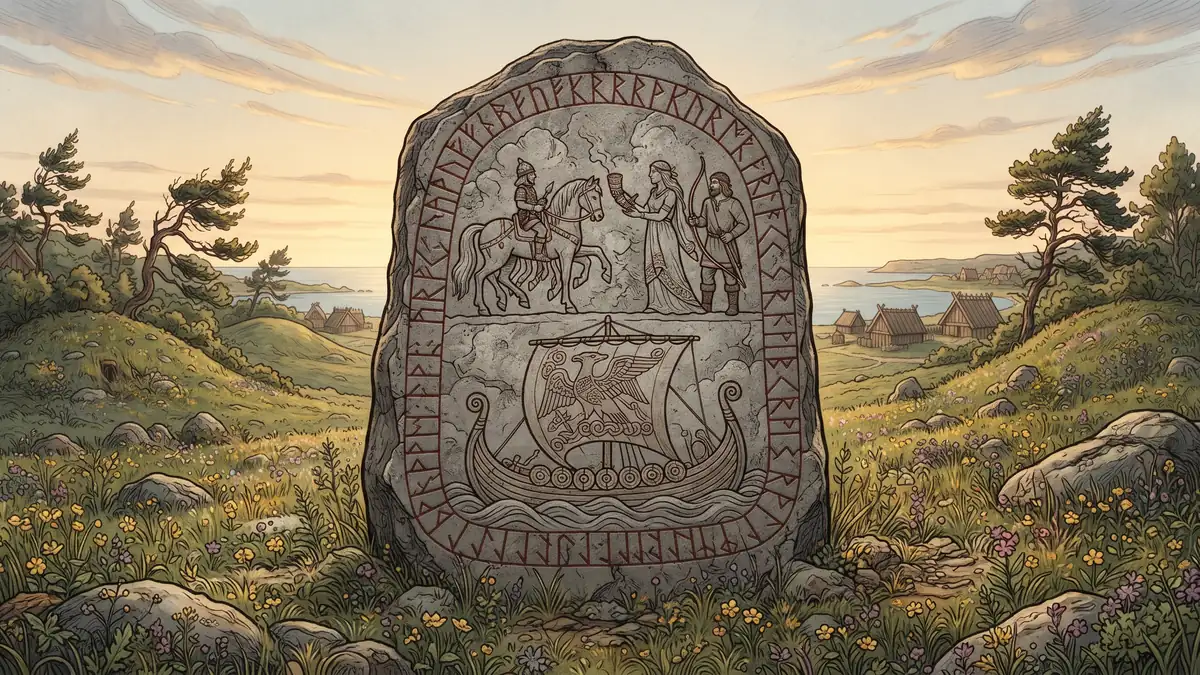
The Tjängvide stone (Rundata G 110) is a Viking Age image stone, dated to about 700–900 CE. It was found in 1844 on the Tjängvide farm, about three kilometres west of Ljugarn, on Gotland, in Sweden. It is in the Swedish Museum of National Antiquities, in Stockholm.
The stone
It is a slab of limestone 1.7 m high, 1.2 m wide and 0.3 m thick. The article says it is probably pagan, since no Christian elements have been found. A braided pattern, resembling valknuts, separates an upper field from a lower one.
Upper field
There is a large eight-legged horse. A small rider is offered a drinking horn by a woman, identified as a valkyrie. Behind her, a man with a bow may be a hunter, and the four-legged animal his dog.
Lower field
The lower field is almost entirely filled by a longship, with a high bow and stern. The sail is almost as wide as the ship is long.
The inscription
It is written in short-twig runes, without word separation. Several runes are lost in the left inscription, and perhaps half of the right. The Rundata reading, partly reconstructed, is usually rendered as: the stone was raised in memory of Hjôrulfr or Jórulfr, the speaker’s brother. The name Hiorulf means “sword wolf”.
The rider: several readings
The most common reading identifies the rider as Odin on Sleipnir, or as a dead man arriving at Valhalla on Odin’s horse. The museum uses the image as its logo. An alternative reading, based on the Völsunga saga, sees Sigurd on Grani and the woman as Brynhild or Grimhild, welcoming him to the Gjukungs’ court. Another possibility is that the eight legs indicate speed and the rider is a living man welcomed by his wife. It has also been argued that the shape of the stone is phallic, linking death and erotic symbolism, as on other Gotland stones.
What is uncertain
The inscription is incomplete, and its reading involves reconstruction and a choice between two forms of the name. The identity of the rider has several competing interpretations. The idea that the braided pattern resembles valknuts appears in the article marked as needing a citation.
In short
The Tjängvide stone has above an eight-legged horse, a rider, a woman with a horn and a hunter, below a ship with a wide sail and, along the edges, an inscription in memory of a brother. The most common reading sees Odin on Sleipnir, but there are others.
To match each detail to its part of the stone, play Each detail in its part.
Sources.
- English Wikipedia, article "Tjängvide image stone", with the description of the stone, the inscription and the interpretations