 MMXXVI
The Torslunda plates: four bronze dies from Öland and the dancing warrior in the horned headdress
In 1870, in a burial cairn on Öland in Sweden, four bronze dies were found that were used to stamp metal foils for Vendel-period helmets. See what each die shows and why some scholars see Odin and wolf-warriors in the scenes.
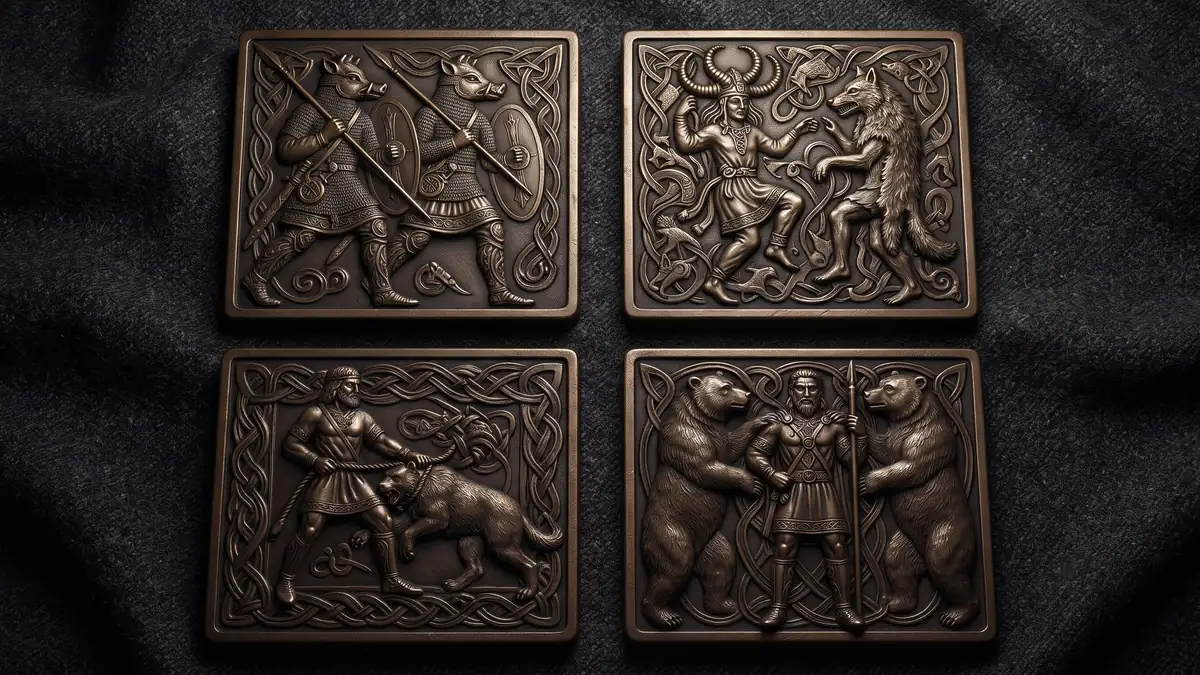
Many images we associate with the Vikings come from earlier times. Four bronze pieces found in Sweden, the Torslunda dies, show warriors, animals and figures that scholars connect with Germanic mythology.
The find
In early 1870, in a burial cairn in Torslunda parish, on the island of Öland in Sweden, four cast bronze dies were found. Wikipedia dates the pieces to the Vendel period, in the sixth and seventh centuries. The infobox gives the sixth to the eighth.
What they were for
The dies were not for display. They were made for mass production. Pressing a thin foil of metal against them produced identical foils, called pressblech, which decorated rich helmets such as those from Vendel, Valsgärde and Sutton Hoo.
What each die shows
The names are traditional labels, according to Wikipedia.
- Walking warriors with spears, wearing Germanic boar helmets.
- A dancing man with a horned head-dress and a man with a spear wearing a wolfskin.
- A man with an axe holding an animal on a rope.
- A man between bears.
How scholars read the scenes
The scenes are presumed to be traditional Germanic mythology. Two points stand out.
- The missing eye. The left figure on the dancing-man die is missing its right eye. A laser scan suggests the eye was deliberately struck out in the original used to make the mould. This recalls Odin, and so it is suggested that the figure is he.
- The wolf-man. The man beside him, in a wolfskin, is interpreted as a berserker, specifically an úlfhéðinn, a “wolf warrior”, perhaps representing wolf-warriors led by the god of frenzy.
Wikipedia presents these as interpretations, not facts.
Many foils, one die
Because each die could be pressed against thin metal as many times as wanted, the same scene could appear repeated on many helmets. This is why Wikipedia speaks of mass production and not display.
The dates
Wikipedia gives two datings: the text speaks of the Vendel period, sixth and seventh centuries, and the infobox of the sixth to the eighth. So it is more prudent to say “between the sixth and eighth centuries”.
Where they are
The dies are in the Swedish History Museum (Statens Historiska Museum).
In short
Four bronze dies show that Vendel-period helmets were decorated in series, with scenes of warriors, wolves and bears. Whether the dancing man is Odin and the other a wolf-warrior is a reading that scholars propose, not a certainty.
To train your observation with the details of the four dies, play The bronze foils.
Sources.
- English Wikipedia, article "Torslunda plates", with the description of the four dies, the dating and the interpretations
- Swedish History Museum (Statens Historiska Museum), where the dies are kept, cited in Wikipedia