 MMXXVI
The Vimose finds: the comb with the word harja and the oldest runes in Denmark
In the Vimose bog, on Funen, Denmark, objects with runes of the 2nd to 3rd century turned up, among them a comb with the word harja, held to be the oldest datable runic inscription known.
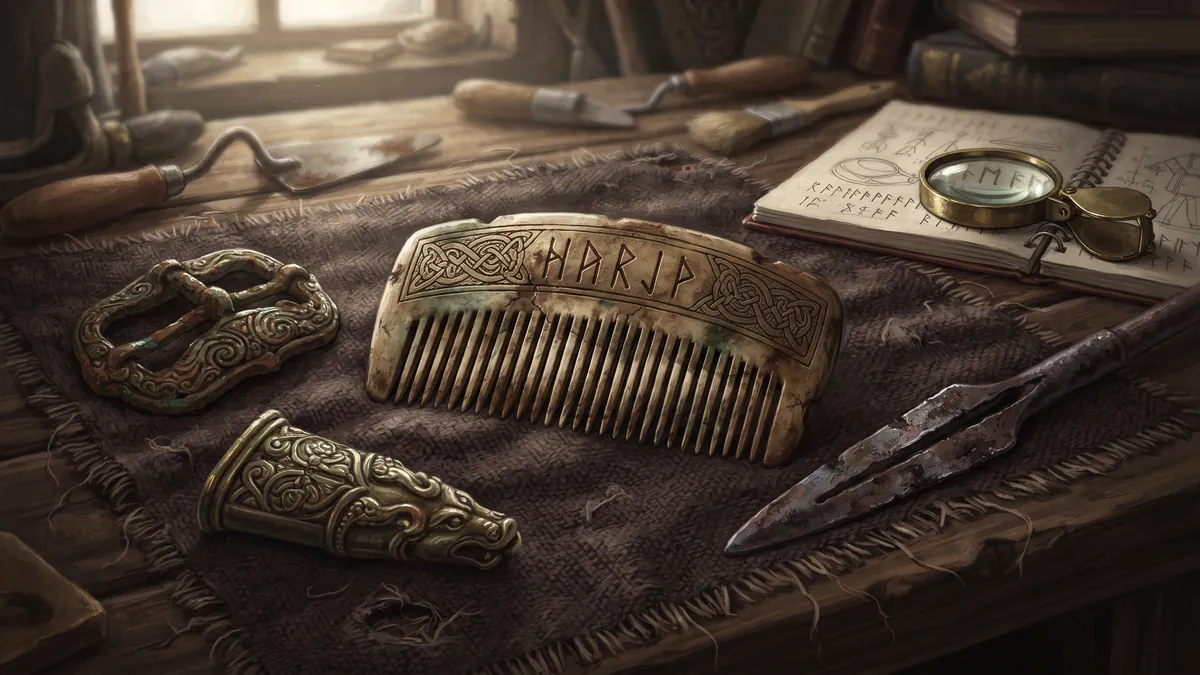
At Vimose, on the Danish island of Funen, objects were found with some of the oldest datable inscriptions in Elder Futhark, written in early Proto-Norse or late Proto-Germanic, between the 2nd and 3rd centuries, in the time of the Roman Empire. They are short words on everyday objects: a comb, a buckle, a chape, a plane.
The comb
The most famous is the comb, of about 160, considered the oldest datable runic inscription known. It says harja. The sources I consulted do not give the meaning, and the sense of the word is debated.
The buckle and the chape
The buckle, of about 200, bears aadagasu and laasauwija, with tentative readings such as ansuz-a(n)dag-a(n)su and la-a[n]sau-wija. A scabbard chape, of about 250, says mariha and [.]ala makija, which is possibly read “Mari, the famous one, is the sword of Alla”.
The plane, the plate and the spearhead
The wooden plane, of about 300, is damaged and begins talijo gisai oj. A sheath plate bears awgns, which perhaps means “son or descendant of Awa”. A spearhead bears [w]agni[ŋ]o.
Deposits in a bog
Vimose, like Illerup and Thorsberg, is a site of deposits in bogs, in which weapons and objects were thrown into the water. Elmar Seebold’s essay of 1994 deals with the linguistic interpretation of these archaic inscriptions.
In short
The runes of Vimose do not tell myths: they are names, perhaps of owners or makers, and words we cannot yet read. To find the runes on the comb, play The runes of the Vimose comb.
Sources.
- English Wikipedia, article "Vimose inscriptions" (list of objects, dates and readings)
- Elmar Seebold, 1994 essay on the linguistic interpretation of the archaic inscriptions (cited by Wikipedia)