 MMXXVI
Þorgerðr Hölgabrúðr: the goddess of the jarls of Hlaðir, her sister Irpa and the gold ring
Þorgerðr Hölgabrúðr and her sister Irpa appear in the Prose Edda, the Jómsvíkinga saga, Njáls saga and the Færeyinga saga. See what each source says, from the hail at Hjörungavágr to the gold ring stolen from the temple, and what scholars debate.
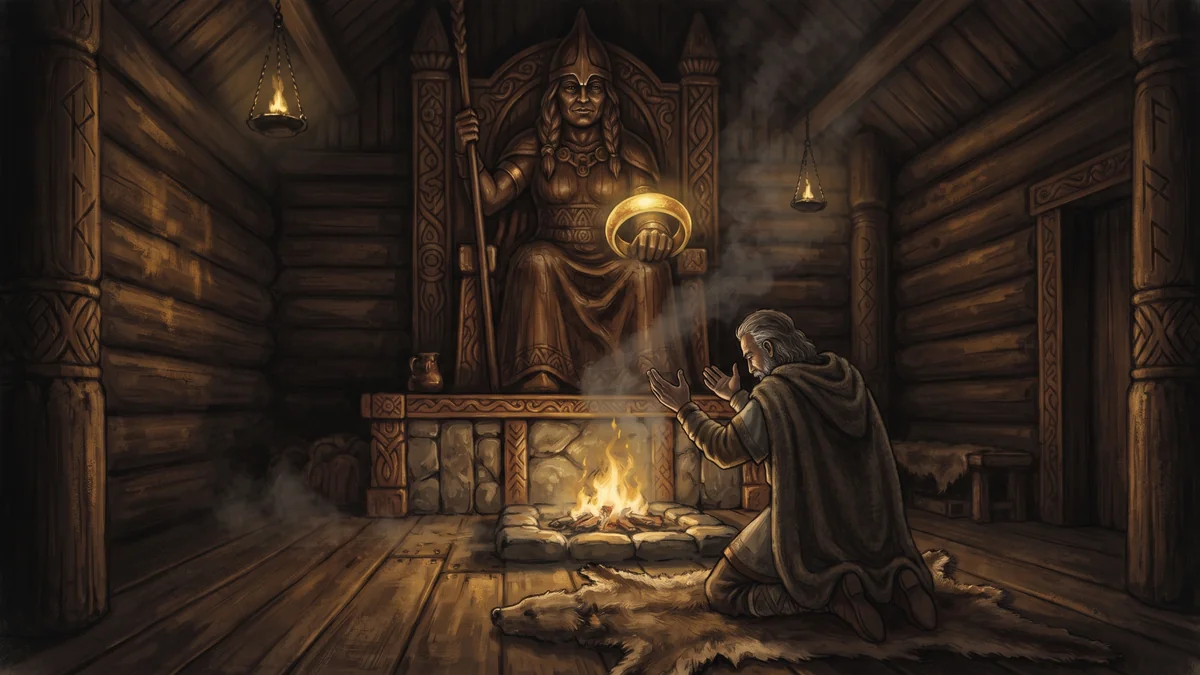
In the sagas, few names of female deities are as tied to one man as that of Þorgerðr Hölgabrúðr. She and her sister Irpa are the goddesses of Hákon Sigurðarson, the jarl of Hlaðir, and the carved image of Þorgerðr is one of the few “statues” of gods the sagas describe.
What the Prose Edda says
According to Skáldskaparmál (Faulkes edition, 1995), Hålogaland was named after king Hölgi, Þorgerðr’s father. Blót were made to him and to her, including money, and Hölgi’s mound was layered with gold and silver. Her name, “bride of Hölgi”, also appears in a list of troll-wives.
The hail at Hjörungavágr
The Jómsvíkinga saga (ch. 21) tells that, in the battle of Hjörungavágr, Hákon prayed to Þorgerðr on an island. The saga says she accepts the blót of Hákon’s young son. Then a warrior sees the goddess, and arrows fly from her fingertips and strike the Jomsvikings. Two women appear in a second squall, and the enemy leader Sigvaldi calls them “ogresses” and “trolls”. The hailstones, says the saga, weighed an ounce each.
The gold ring
In Njáls saga (ch. 87), Hrapp raids the temple of Hákon and Guðbrandr: from the seated image of Þorgerðr he takes a large gold ring and a linen hood, takes another gold ring from the image of Thor and another from the image of Irpa, and burns the temple. In the Færeyinga saga (ch. 23), Hákon asks “Thorgerd Shinebright” to loosen the ring she holds in her hand; it comes loose, and the jarl gives it to Sigmund. In Harðar saga (ch. 19), Grímkell burns her temple and dies at dinner that evening.
Irpa and the wooden man
Irpa appears in only four works, and her name may come from jarpr, “dark brown”. In the account of Þorleifr, the jarl honours the two sisters by asking for counsel for a revenge, and a driftwood figure with a human heart comes alive and kills Þorleifr in Iceland.
What scholars debate
Davidson sees them as guardian goddesses, comparable to the dísir and the valkyries, and points out that if Hölgi founded Hålogaland, her name would be “bride of Hölgi”: the wife of each ruler in turn. McKinnell proposes that Þorgerðr was the jarl’s partner and that Irpa would be a “dark” aspect, perhaps synonymous with Hel. Chadwick suggests the legends were confused with the history of Hákon’s wife Þóra, and that Lagertha in Saxo may be another aspect of Þorgerðr. Motz sees her as a giantess who received cult in her own right.
In short
Þorgerðr is a rare case where the same deity appears in poetry, in kings’ sagas and in Icelandic sagas, always tied to gold, storms and a chieftain. No one knows for sure whether she was a goddess, a deified ancestor or a figure of saga.
To train your aim with the rings and the hail, play Þorgerðr’s rings.
Sources.
- English Wikipedia, article "Þorgerðr Hölgabrúðr and Irpa", with the passages of Skáldskaparmál, Jómsvíkinga saga, Njáls saga, Færeyinga saga, Harðar saga and Þorleifs þáttr jarlsskálds
- Studies cited in the article: Hilda Ellis Davidson (1998), John McKinnell (2002, 2005), Nora Chadwick (1950) and Margaret Motz (1993)