 MMXXVI
Þorgils saga ok Hafliða: the quarrel between two Icelandic chieftains, the wedding at Reykjahólar in 1119 and the saga told at the table
Þorgils saga ok Hafliða, part of the Sturlunga saga, tells of a dispute between two Icelandic chieftains between 1117 and 1121 and describes a wedding where sagas were told. See what the text says and what scholars debate.
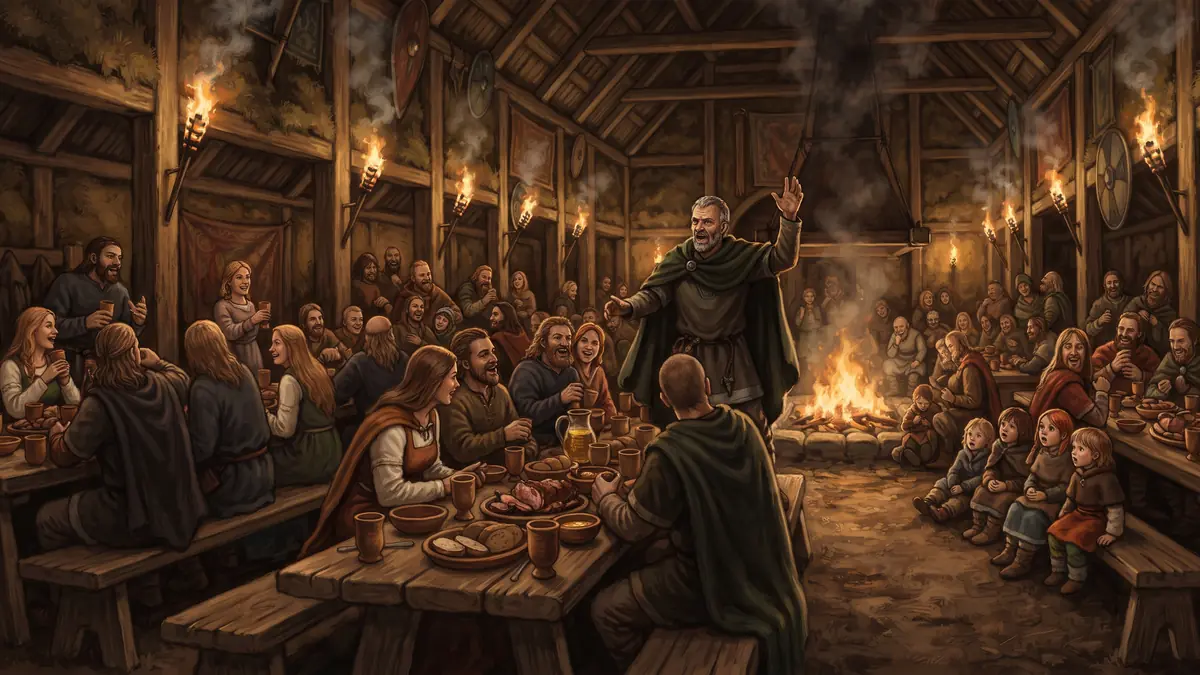
The Þorgils saga ok Hafliða is one of the sagas that make up the Sturlunga saga, and it is a “contemporary saga”: it deals with events relatively close to the time when it was written. It tells of the dispute between two Icelandic chieftains, Hafliði Másson and Þorgils Oddason, between 1117 and 1121. What people remember best, though, is a wedding where the guests amused themselves by listening to sagas.
Two chieftains and a quarrel
Hafliði Másson was a goði, a local chieftain, son of Már Húnröðarson, of Breiðabólstaður, in the north of Iceland. He died in 1130. It was at his house, in the winter of 1117–1118, that the wise men who put the country’s laws into writing met. According to the Íslendingabók, the lawspeaker, Bergþórr Hrafnsson, worked with Hafliði, and the following summer clerics read the text before the assembly, with no one objecting.
The saga says the dispute began with acts of Már, a relative of Hafliði. Deaths followed, and the Thing declared Þorgils an outlaw. In 1121, Þorgils confronted Hafliði at the Althing. In the end the two were reconciled on the initiative of Bishop Ketill. For this reason many scholars read the text as an example of how to settle a conflict without prolonging the vengeance.
The wedding at Reykjahólar
In chapter 10, the saga describes the wedding of Yngvildr Þórðardóttir, at Reykjahólar, in 1119. Among the entertainments, the farmer Hrólfr, of Skálmarnes, told a story about the viking Hröngviðr, King Óláfr Liðsmannakonungr, the breaking into the mound of the berserker Þráinn and the hero Hrómundr Gripsson, with many verses. The saga says Hrólfr composed it himself, and that King Sverrir liked this kind of “lying saga”.
This scene is precious because it shows orality in action. Instead of a text read in silence, we see a saga told aloud, to guests, at a feast. Researchers cite it when they discuss how the Icelandic sagas passed from the mouth to the parchment.
What is uncertain
The date of the saga is debated: the most common hypothesis puts it in the early thirteenth century, but dates from about 1180 to 1237 have been proposed. The text survives mainly in paper copies of the Sturlunga saga, made after the Middle Ages, and only the end is in an older parchment. The most cited critical edition is Ursula Brown’s, of 1952. As with every saga, names, dates and speeches should be read with caution.
To put in order the facts of the written law, the wedding and the dispute, play Hafliði’s facts.
Sources.
- Þorgils saga ok Hafliða, part of the Sturlunga saga (Icelandic text of the early thirteenth century)
- Ari Þorgilsson, Íslendingabók (account of the writing of the laws in the winter of 1117–1118)
- Ursula Brown (ed.), Þorgils saga ok Hafliða (Oxford University Press, 1952)