 MMXXVI
Þorleifs þáttr jarlsskálds: the Icelandic poet who made Jarl Hákon's hair fall out with a verse of insult and the wooden figure that killed him at the Alþingi
The Þorleifs þáttr jarlsskálds, in the Flateyjarbók, tells how Þorleifr Ásgeirsson, of Svarfaðardalur, loses his ship to Jarl Hákon, recites a verse of insult at his court and is killed, years later, by a figure sent by Hákon and his protective goddesses. See the tale and what the poetry preserved.
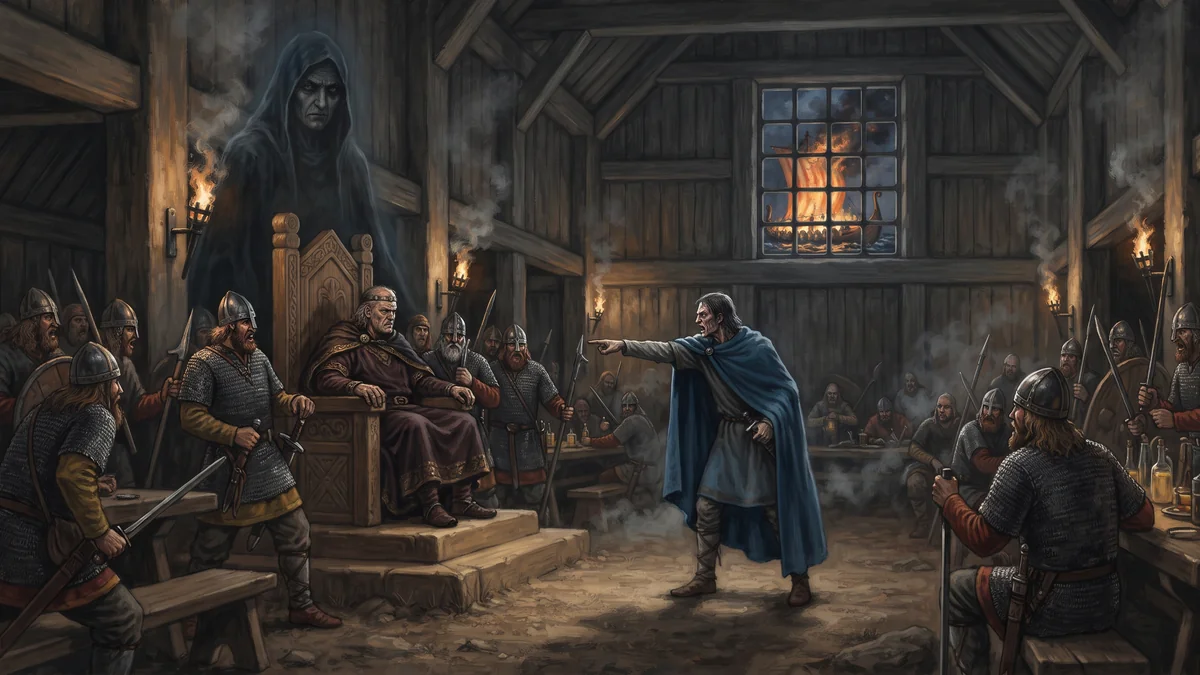
The Þorleifs þáttr jarlsskálds is one of the best-known tales of the Flateyjarbók and deals with a power that Norse literature took seriously: the verse of insult, the níð. Scholars place it in the late thirteenth or early fourteenth century, but the episode of the verse is older and already appears in the Latin life of King Óláfr Tryggvason written by Oddr Snorrason in the late twelfth century.
The young man from Brekka
Þorleifr is the son of Ásgeirr Rauðfeldarson, of Brekka, in Svarfaðardalur, in northern Iceland, and, according to the tale, the youngest of three brothers. As a young man, he goes to Norway and has a conflict with Jarl Hákon Sigurðarson over trading rights. Hákon burns his ship and kills the crew. Þorleifr flees to Denmark and becomes a courtier of King Sveinn Tjúguskegg, “Forkbeard”.
The verse that made the hair fall out
Years later, Þorleifr returns to Norway and recites a verse of insult at Hákon’s court, the Jarlsníð. According to the tale, the jarl’s hair falls out. Sveinn then gives him the name jarlsskáld, “the jarl’s poet”. Scholars take this verse as probably genuine. Hákon, a Norwegian magnate of great power and a supporter of the old cult, is the target.
The wooden figure
Þorleifr returns to Iceland and settles in Mýrdalur. Hákon, with the help of his protective goddesses Þorgerðr Hölgabrúðr and Irpa, sends a wooden figure that holds a man’s heart. The figure kills Þorleifr at the Alþingi, around the year 990, and he is buried at Þingvellir.
The shepherd and the mound
In the last chapter, a shepherd called Hallbjörn, an unsuccessful poet, sits on the mound where Þorleifr is buried. The dead man appears to him in a dream and teaches him the art of poetry. So the tale ends with a gift, and not with revenge.
What remains uncertain
The tale has many fantastic elements, and scholars think Þorleifr spent more time at Hákon’s court than the text indicates. Of Þorleifr’s work there remain the verse of insult, six loose stanzas of doubtful authorship, the refrain of a poem for Sveinn said to have forty stanzas and one and a half stanzas of a poem for Hákon.
To tap the boards with verses and avoid the wooden figures, play Þorleifr’s verses.
Sources.
- Þorleifs þáttr jarlsskálds, in the Flateyjarbók, in Óláfs saga Tryggvasonar en mesta (Old Norse text available at heimskringla.no)
- Kate Heslop, "Þorleifr jarlsskáld Ásgeirsson", in Diana Whaley (ed.), Poetry from the Kings' Sagas 1, Skaldic Poetry of the Scandinavian Middle Ages 1 (Turnhout: Brepols, 2012)
- Snorri Sturluson, Heimskringla, trans. Lee M. Hollander (University of Texas Press, 1964)