 MMXXVI
Þorrablót: the Icelandic midwinter feast, between the king Þorri of the sagas and the 19th-century party
Þorrablót has the name of a sacrifice to Þorri, but the modern feast began between the 19th and 20th centuries, with society dinners and cured food, and its pagan origin remains debated.
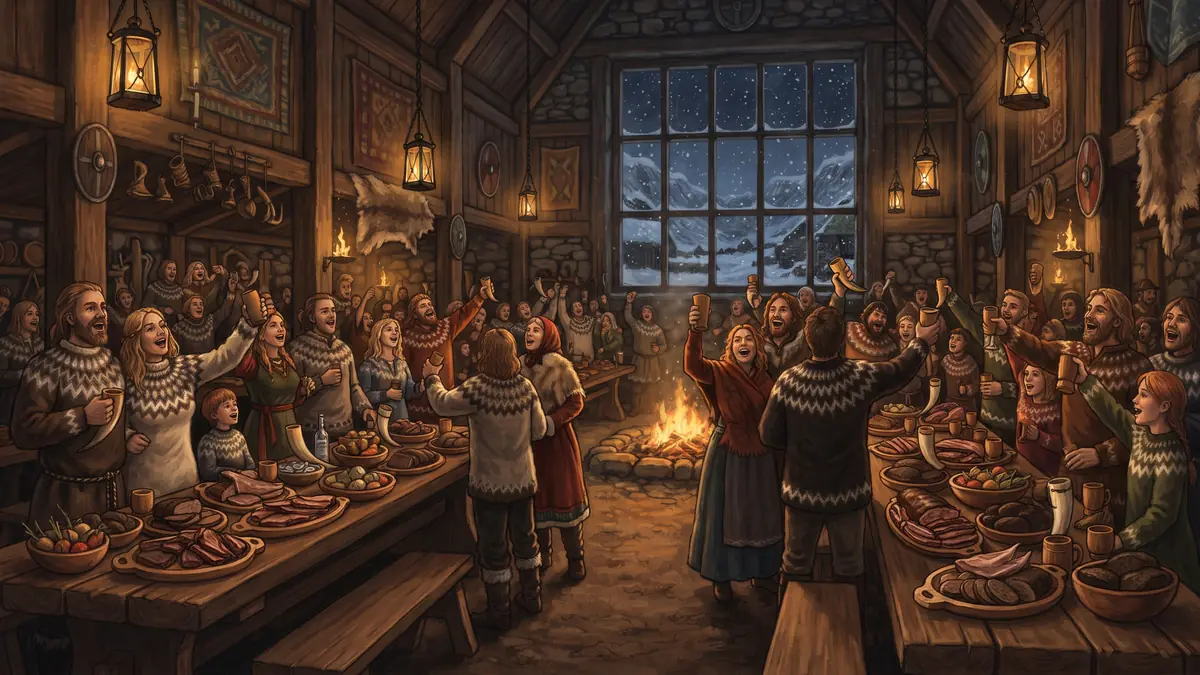
Þorrablót is a midwinter dinner of Iceland. The name joins Þorri, the month of the old Icelandic calendar, roughly from mid-January to mid-February, and blót, “sacrifice”. Today it is an evening of speeches, poems, singing and food, from small family dinners to large events with a stage and dancing, usually put on by societies.
King Þorri in the old sources
In the Orkneyinga saga, Þorri appears as an early king, described as a Finn, son of Snær, “snow”. It is the literary background of the name. In the text Hversu Noregr byggðist, in the Flateyjarbók, the Kvens, a people of the north, made an annual sacrifice to Þorri in midwinter. But the source does not say that this sacrifice was a continuous practice down to modern times.
The modern feast
Today’s feast comes from the 19th century, in the time of romantic nationalism, and is compared to Burns Night in Scotland. The first recorded modern Þorrablót was a secret event in 1867, held by a society in Reykjavík. In 1873 Icelandic students in Copenhagen held another, and in 1874 Akureyri held the first public one. By the early 20th century the feast was national, with dinners, speeches, songs and ballads. In 1954 the restaurateur Halldór Gröndal served traditional food at the restaurant Naustið during Þorrablót, which helped popularise the custom, and the term þorramatur appears in 1958.
The food
Þorramatur is made of preserved foods, such as meats and offal cured in sour whey, served on wooden trays, the bakkar, and sold in supermarkets and restaurants every January.
What is certain and what is debated
The 19th-century modern feast is well documented. The pagan origin is debated. The figure of Þorri appears in literary and medieval texts, and the link between Þorri and the god Þórr is only taken to be probable. 19th-century nationalists idealised the pre-Christian past, and the pagan framing may have been shaped by the feast itself.
In short
It is a feast old in name and young in form, mixing sagas, calendar and winter food. To catch the trays arriving at the table, play The trays of the feast.
Sources.
- Reference work in English, article "Þorrablót"
- Orkneyinga saga and Flateyjarbók (Hversu Noregr byggðist)
- Article on Þorrablót, Professor Iceland (Substack)