 MMXXVI
Þorsteins þáttr skelks: the tale of Þorsteinn who went to the privy at night, talked with a demon and earned the nickname "Shiver"
The Þorsteins þáttr skelks, in the Flateyjarbók, tells how a man at the court of King Óláfr Tryggvason disobeys the order not to go out alone at night and talks with a demon about who fares best and worst in hell. See the tale and why he became "Þorsteinn Skelkr".
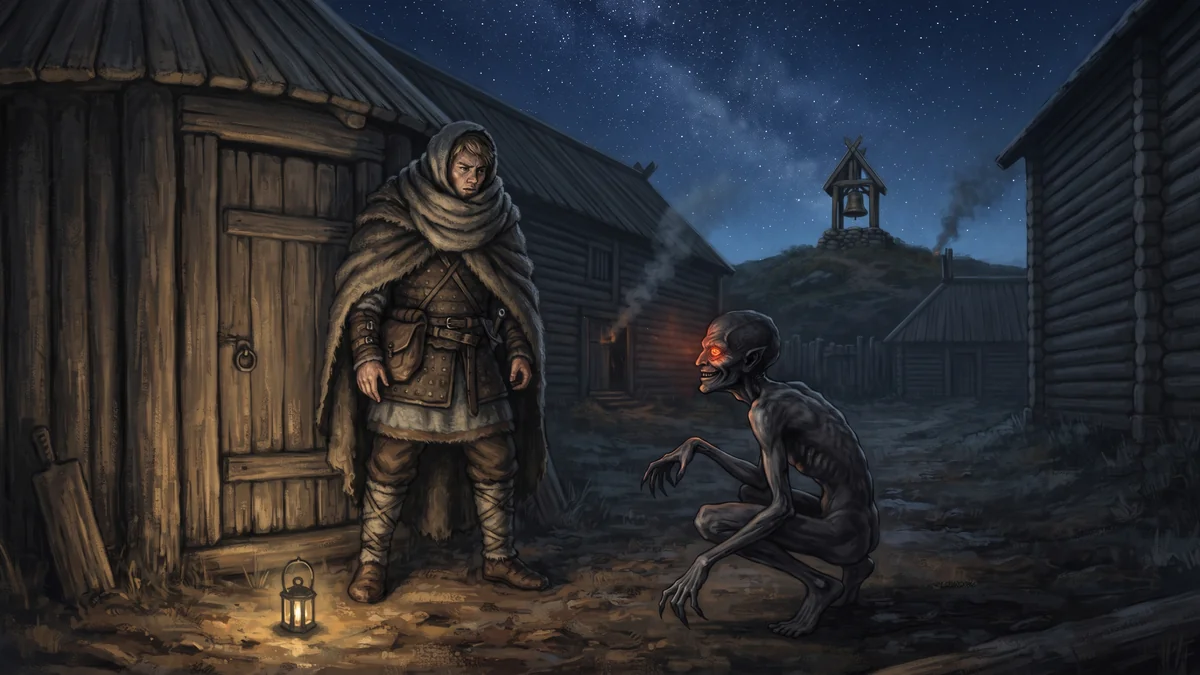
The Þorsteins þáttr skelks is part of the Flateyjarbók, in the section devoted to the Norwegian king Óláfr Tryggvason. It is a tale of courage with black humour: the hero shows no fear, and only the nickname keeps what he felt.
The king’s order
Þorsteinn Þorkelsson is one of the men at Óláfr’s court. The king orders that no one go alone to the privy during the night. Þorsteinn does not obey. He goes, and inside he meets a demon.
The conversation
Instead of fleeing, Þorsteinn talks with the creature and asks its name. It says it is Þorkell the Thin, who supposedly died in the battle against King Haraldr Hilditönn. Þorsteinn wants to know who fares best in hell, and the demon names Sigurðr Fáfnisbani, the dragon-slayer. Then he asks who fares worst, and the answer is Starkaðr the Old, who stands with his feet in the fire, face down, and cries louder than anyone else.
The cry
Þorsteinn asks the demon to imitate Starkaðr’s cry. The demon cries out. He asks again, and the cry comes stronger. He asks a third time. At each cry, Þorsteinn wraps more clothing around his head, and at the third he faints. At that moment a church bell rings, and the demon flees. The cry was meant to wake the others, and it worked: King Óláfr woke and had the bell rung.
The nickname
When asked whether he was afraid, Þorsteinn answers that he was not, although he shivered once. For that reason he comes to be called Þorsteinn Skelkr, “the Shiver”.
What remains uncertain
The Flateyjarbók is a compilation from the late fourteenth century, and the tale is set inside the saga of King Óláfr, which puts it at the service of a Christian theme: the bell and the king defeat the demon. The names cited come from other traditions. Starkaðr appears in the legendary sagas, and Sigurðr Fáfnisbani is the hero of the Völsung cycle. What a demon would have to say about them is the tale’s invention, and the tale can be read as a humorous comment on the courage of the old heroes. The date of composition is not secure.
To take each fact to the box of whoever said or did it, play Who said it, who did it.
Sources.
- Þorsteins þáttr skelks, in the Flateyjarbók, in Óláfs saga Tryggvasonar en mesta (fourteenth century)
- Ármann Jakobsson, "Enter the Dragon: Legendary Saga Courage and the Birth of the Hero" (Viking Society for Northern Research, 2010)
- Fernando Guerrero, Stranded in Miðgarðr: Draugar Folklore in Old Norse Sources (University of Oslo, 2003)