 MMXXVI
Þorsteins þáttr uxafóts: the boy exposed in the forest at Krossavík, the trolls of Heiðarskógr and the bull whose leg was torn off
The Þorsteins þáttr uxafóts tells how the son of a mute woman, left to die in the forest, grows up, defeats trolls in Norway in the service of King Óláfr Tryggvason and earns the nickname "Ox-Foot" by tearing the leg off a bull. See the plot and what remains uncertain.
The Þorsteins þáttr uxafóts mixes the story of a family from eastern Iceland with a troll-hunting adventure in Norway. It is a tale of a hero who is born rejected and proves himself before a king.
Ornný’s boy
At the start of the tale, the author recalls the founding of the Alþingi and the laws of Úlfljótr, and then takes us to Krossavík, where Þorkell Geitisson lives, strong and proud, with his sister Ornný, who weaves well but cannot speak. Ívarr, nicknamed Lómi, a proud merchant from the region of Hörðaland, winters there. Ornný serves him and becomes pregnant. Þorkell demands that Ívarr marry her, and he refuses and insults him. After a fight, Ívarr goes back to Norway.
Ornný gives birth to a big boy. Þorkell, furious, orders him exposed. The slave Freysteinn takes him to the forest and leaves him sheltered. On the fourth day, Krummr of Krumshóll finds him, takes him home and names him Þorsteinn. At seven, the boy is already strong, and he is accepted by the family once the truth comes out.
The mound and the trip to Norway
At ten, Þorsteinn sleeps near a great burial mound and, in a dream, enters it. A dead man called Bryniarr lives there, and his brother Oddr is hostile. Þorsteinn cuts off Oddr’s arm and fights the dwellers of the mound. Bryniarr gives him gold that, placed under the tongue, restores speech, and Þorsteinn’s mother begins to speak.
At twelve, he sails to Norway, with a ring from his mother to prove who he is. Ívarr denies paternity. Þorsteinn spends two winters with Styrkárr, at Gimsar.
The trolls of Heiðarskógr
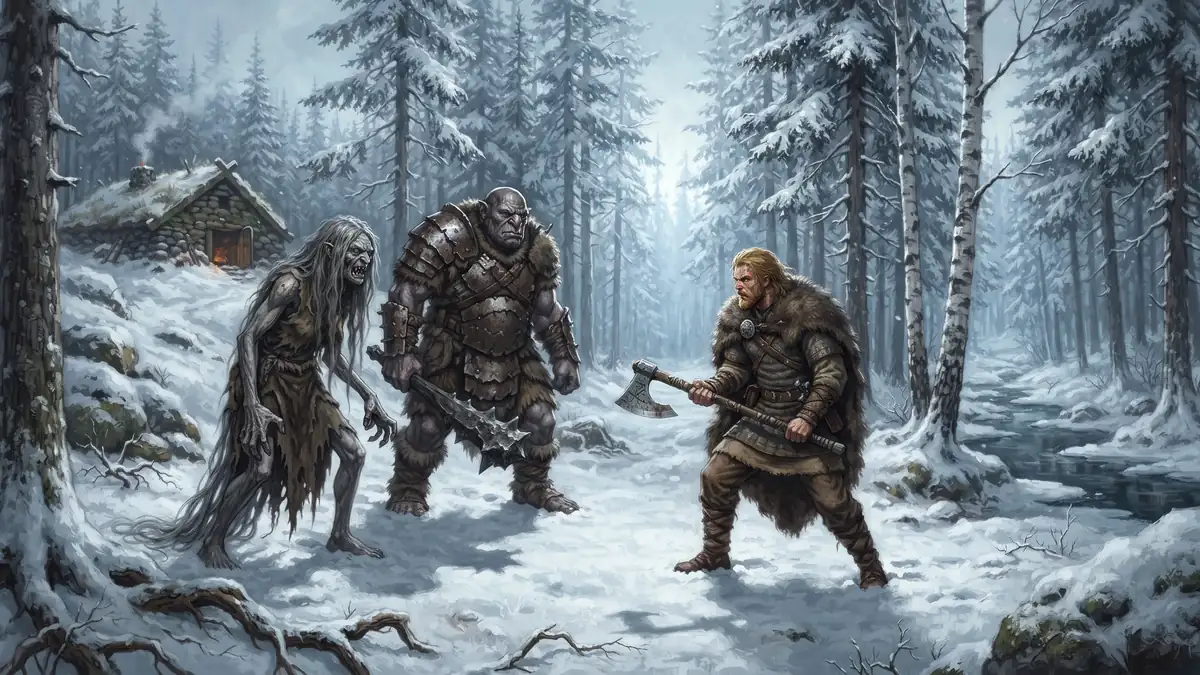
King Óláfr Tryggvason wants to clear the forest of Heiðarskógr of trolls. A landowner, Bryniulfr, goes with sixty men and nearly all die. Þorsteinn and Styrkárr go to the forest. In a house, he kills the old woman Kelling and then fights the troll Járnskjöldr, whom he kills but loses a leg. When the troll’s wife, Skjaldvör, attacks him, he promises to accept the king’s faith, a luminous figure appears and weakens her, and Styrkárr kills her. The two burn the bodies. Later the trolls return, and the two go again to the forest, defeat the rest and take the treasure.
The bull and the nickname
Ívarr admits paternity at a feast of the king, and both are baptised. A jealous man, Hárekr of Reyna, tells the king of Þorsteinn’s boasts. The king puts the young man before a fierce sacrificial bull. Þorsteinn grabs the hind leg and tears it off, and the animal dies. The king calls him Uxafótr, “Ox-Foot”, and gives him a ring. Þorsteinn marries Herdís, Styrkárr’s sister, and dies in the battle of Svöldr, on the Ormrinn langi.
What remains uncertain
The tale speaks of families of eastern Iceland, but the plot, with the exposed boy, the dream in the mound and the trolls, follows folktale patterns. The date of composition is not secure.
To withstand each blow of the forest trolls, play The trolls of Heiðarskógr.
Sources.
- Þorsteins þáttr uxafóts, preserved in the Flateyjarbók, in Óláfs saga Tryggvasonar en mesta (Old Norse text available at heimskringla.no)
- Ármann Jakobsson, "The life and death of the medieval Icelandic short story", Journal of English and Germanic Philology 112:3 (2013)