 MMXXVI
Tilberi: the Icelandic creature made from a stolen rib that sucks the milk of the neighbours' cows
In Icelandic folklore, the tilberi is a creature made by a woman from a dead person's rib and stolen wool, to suck the milk of other people's cows and ewes and vomit it into her butter churn.
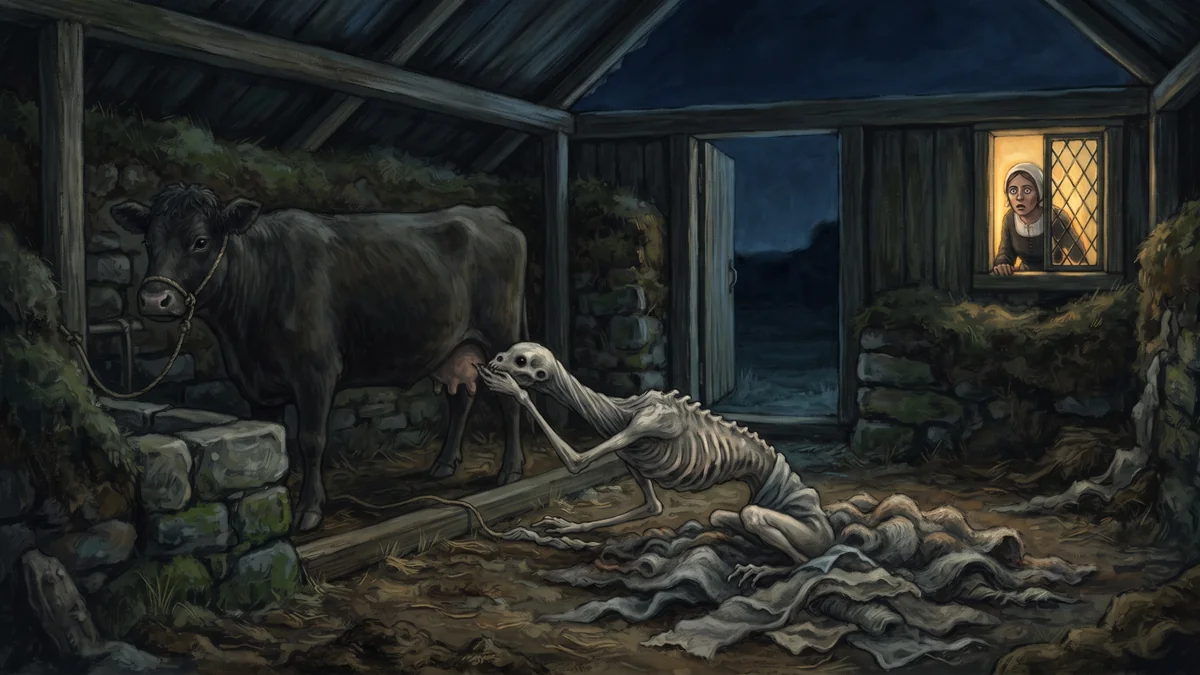
The tilberi, also called snakkur, “spindle”, is a creature of Icelandic folklore that, according to the legends, witches created to steal milk. Only women could create and own one. In the north of the country it was called tilberi, in the south and west snakkur, and in the east both names.
When it appears in writing
There is no written mention before the 17th century. A 17th-century writer says a witch was punished for having one in 1500, but that is a single secondhand report and remains uncertain.
How a tilberi is made
According to tradition, the woman steals a rib from a recently buried body, early on Whitsunday morning. She wraps the rib in grey wool, also stolen, and keeps the bundle between her breasts. On the next three Sundays, at communion, she spits the consecrated wine on it. Then she lets it suckle on the inside of her thigh, which leaves a wart. One variant says the wool must be taken from a widow’s sheep, soon after shearing.
What it does
The tilberi is sent to suck the milk of other people’s cows and ewes and returns through the dairy window, where it vomits the milk into its mistress’s butter churn. To reach the udder it climbs on her back and stretches itself, and in some versions it reaches both sides and drains two teats at once. Butter made from that milk falls apart or foams if someone makes the sign of the cross or the sign of the butterknot, the smjörhnútur. It can also steal wool and roll it into a large moving ball. And if it reaches the breast of a nursing mother, she risks being sucked to death.
How to get rid of it
Until the 19th century, animals were protected with the sign of the cross under the udder and over the rump, and a Psalter on the back. To destroy a tilberi, the creature is sent to the common pasture to gather lambs’ droppings from three pastures, or into three piles. Either it works itself to death, or it cannot stand the number three, and only a human bone remains. If it is chased, it runs to its mistress and hides under her skirt, and then her petticoat is sewn shut and the two are burned or drowned.
In short
It is a tale of stolen milk and suspicious neighbours, preserved in collections such as Jón Árnason’s. To defend the cows from every attack, with the right sign, play The sign of the cross in the cowshed.
Sources.
- Reference work in English, article "Tilberi"
- Jacqueline Simpson, "Icelandic Folktales and Legends" (1972)
- Jón Árnason, "Íslenzkar þjóðsögur og æfintýri" (1862-1864)
- Kvideland and Sehmsdorf, "Scandinavian Folk Belief and Legend" (1988)