 MMXXVI
Tordenskjold: the admiral from Trondheim who won at Dynekilen in 1716 and died in a duel at 30
Peter Wessel, called Tordenskiold, "thunder shield", attacked a Swedish supply fleet at Dynekilen in 1716 and forced Charles XII to lift the siege of Fredriksten. He died in a duel in 1720.
Peter Jansen Wessel was born on 28 October 1690 in Trondheim, Norway, then part of Denmark-Norway. According to the sources, he was the tenth child of the alderman Jan Wessel, and his brother Caspar von Wessel became a rear-admiral. He served in the Dano-Norwegian navy in the Great Northern War against Sweden and rose from second lieutenant to vice-admiral.
A rebellious boy
The article describes him as a wild, unruly boy who troubled his pious parents. In 1704 he stowed away on a ship bound for Copenhagen. There, at first, he failed to win a cadetship in the navy. The king’s chaplain, Peder Jespersen, helped him make voyages to the West Indies and then the East Indies, and eventually secured him the cadetship.
Rising in the navy
On 7 July 1711 he was appointed second lieutenant and served on the frigate Postillion, where Admiral Waldemar Løvendal became his friend. Soon after, Løvendal gave him command of the four-gun sloop Ormen. In June 1712 he took the 18-gun Løvendals Galej. On 29 September 1712 he took part in the destruction of Swedish transports at Rügen and was promoted to captain lieutenant. In 1714, after a fight of about two days with the 28-gun Swedish privateer Olbing Galley off Lindesnes, he was court-martialed and acquitted on 15 December. On 28 December he was made captain. On 24 April 1715 he captured, at Kolberg, the Swedish rear-admiral Hans Wachtmeister and the frigate Hvita Örn, which became his flagship, the Hvide Ørn.
The name
In 1716, King Frederick IV of Denmark-Norway ennobled him and gave him the name Tordenskiold, “thunder shield”. It is now often spelled Tordenskjold.
Dynekilen
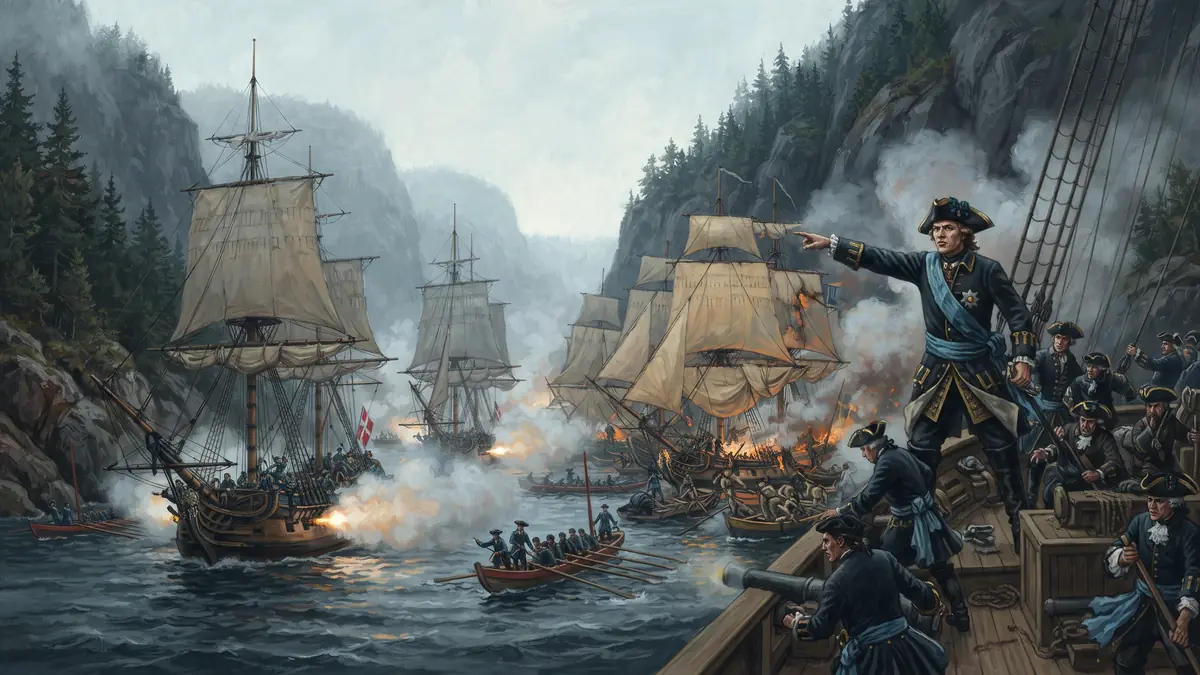
On 8 July 1716, in the Dynekil fjord, he attacked the Swedish transport fleet, which carried ammunition and military stores, with two frigates and five smaller ships. He captured or destroyed about 30 Swedish ships, with minor damage to his own force. The blow forced Charles XII, who was besieging the fortress of Fredrikshald (Fredriksten), to lift the siege and withdraw to Sweden. Afterwards Tordenskiold was promoted to post-captain and given command of the Kattegat squadron.
Gothenburg and Marstrand
In 1717 he was tasked with destroying the Swedish Gothenburg squadron, but succeeded only in part, because some officers were disloyal. In December 1718 he brought Frederick IV the news of Charles XII’s death and was made rear-admiral. In 1719 he captured the Swedish fortress of Carlsten at Marstrand. On 26 September 1719 he destroyed part of the Gothenburg squadron and captured the rest, and was promoted to vice-admiral.
A popular story says that, at Marstrand, he walked the enemy commander past his men, who moved from block to block to look more numerous. The source says this is a myth, not documented fact. From it comes the idiom “Tordenskjold’s soldiers”, used for someone who fills several roles.
The death
On 12 November 1720, aged 30, he died in a duel with the Livonian colonel Jakob Axel Staël von Holstein, on the Sehlwiese at Gleidingen, near Hildesheim. The quarrel began after he accused him of cheating at gambling. The source notes that the details of the duel are not well known. His body was taken to Holmen Church in Copenhagen and placed in a sarcophagus in 1819.
The memory
There are statues of him in Copenhagen (1876), Trondheim, Stavern, Oslo and Haakonsvern. Ships of the Danish and Norwegian navies have been named after him. A Danish make of matches carried his portrait from 1882, and the national anthems of Denmark (1778) and Norway (1864) both mention him. Many call him “the Mozart of naval warfare”.
To catch the barrels of ammunition in the ship’s hold and avoid the cannonballs, play The barrels of Dynekilen.
Sources.
- Reference work in English, article "Peter Wessel Tordenskjold"