 MMXXVI
Tristrams saga ok Ísöndar: how Brother Robert translated the story of Tristan and Iseult for King Hákon of Norway in 1226
The Tristrams saga ok Ísöndar is the Norwegian translation, attributed to Brother Robert and dated 1226, of Thomas of Britain's Tristan. See what he cut, what he added, how the story ends and why it opened the way for the chivalric sagas.
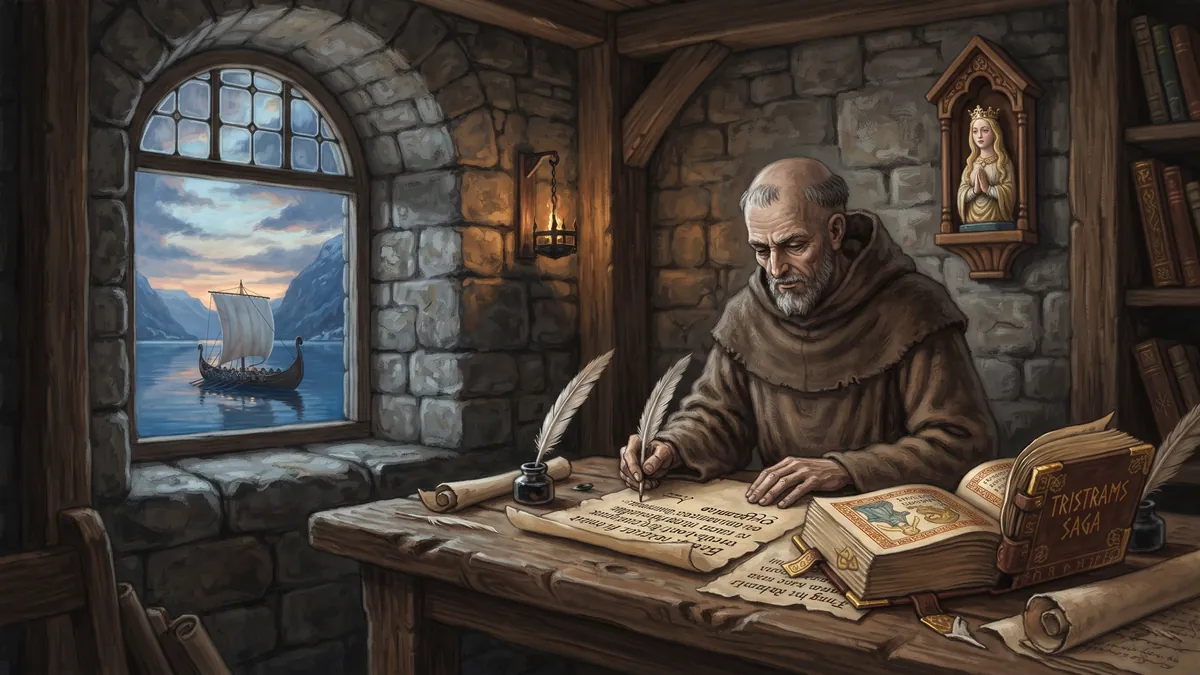
The Tristrams saga ok Ísöndar is the earliest dated chivalric saga, or riddarasaga. According to the introduction in a seventeenth-century manuscript, Brother Robert composed it in 1226 on the order of King Hákon Hákonarson of Norway. Most scholars accept that date, though not all. Little is known about Robert. He may have been a monk of Lyse Abbey near Bergen. The king’s marriage to Margrét Skúladóttir the previous year may have prompted the commission.
What he translated
The original is Tristan by Thomas of Britain, an Old French romance that survives only in fragments. The Norwegian version is abridged. Robert cut dialogues, the characters’ private thoughts, the narrator’s comments and many descriptions, so some passages are abrupt. He added explanations, details of interest to a Norwegian audience, alliterating word pairs and exaggerations in the plot. He also changed passages that seemed to him immoral or unorthodox.
The result shifts the tone. Thomas analyses emotion; Robert moves the story toward the worldview of the Norse sagas, in which the hero struggles against fate. His style uses many present participles, alliteration and wordplay, but avoids similes.
The ending
Banished from Cornwall, Tristram marries Ísodd of Brittany in the hope of forgetting Ísönd. He builds a shrine with a statue of her. Kardín, Ísodd’s brother, is his companion. Wounded, Tristram sends for Ísönd and arranges a signal: white sails if she comes. Ísodd lies and says the sails are black. Tristram dies, and Ísönd dies beside his body. The two are buried in the same churchyard.
Manuscripts and influence
The text rests on late copies: AM 543 in Copenhagen, on paper, from the last quarter of the seventeenth century, and ÍB 51 in Reykjavík, from about 1688. Two fifteenth-century vellum fragments, AM 567 and the Reeves Fragment in the Library of Congress, published in the 1960s, show that the original text differed markedly from the later Icelandic version, which condenses it further.
Some scholars saw its influence as revolutionary: it inspired the riddarasögur genre. Its themes appear in Laxdæla saga and Gunnlaugs saga. The vault with the statue of Ísönd appears in Rémundar saga keisarasonar and in Þiðreks saga, and the fifteenth-century ballad Tristrams kvæði derives from it. Critical opinion varies: Phillip M. Mitchell called it “of no high literary quality,” while David Ashurst praised its humane handling of the story.
A saga from 1226
It is worth remembering what the date means. In 1226 Norway had no translated romances yet, and the king wanted to bring the literature of the Continent to his court. The Tristrams saga is probably the first romance translated into Norse, and what followed, such as Ívens saga, Möttuls saga and Karlamagnús saga, took the same road.
To build Ísönd’s shrine block by block, play Ísönd’s shrine.
Sources.
- Marianne E. Kalinke (ed.), Norse Romance I: The Tristan Legend (Boydell & Brewer, D. S. Brewer, 1999)
- Geraldine Barnes, entry on the riddarasögur, in Medieval Scandinavia: An Encyclopedia (Garland, 1993)
- Marianne E. Kalinke and P. M. Mitchell, Bibliography of Old Norse-Icelandic Romances (Cornell University Press, 1985)