 MMXXVI
Uppåkra: the cult building rebuilt six times and the 200 gold foils
Near Lund, in Scania, Uppåkra was one of the great centres of the Nordic Iron Age. See what the excavation of the cult building found and what is still interpretation.
About five kilometres south of Lund, in Scania, southern Sweden, lies the village of Uppåkra. What lies under the field is one of the largest Iron Age and Viking Age towns on the Scandinavian peninsula. This text deals with what has been excavated and what is still reading.
An ancient centre
Uppåkra was founded in the last century BC and seems to have grown in the 5th century. It served as a religious and political centre for centuries, perhaps for much of the first millennium. The excavated area is about 40 hectares. The rulers of Uppåkra probably influenced most of West Scania, but this is described as likely. Uppåkra declined, and part of the population may have moved to Lund around 990, although the decline and the move are uncertain.
A metal-detector find
In 1934 the building of a farm near the church revealed a settlement from the Bronze to the Iron Age. Later, metal-detector surveys revealed almost 30,000 objects of gold, silver and bronze.
The cult building
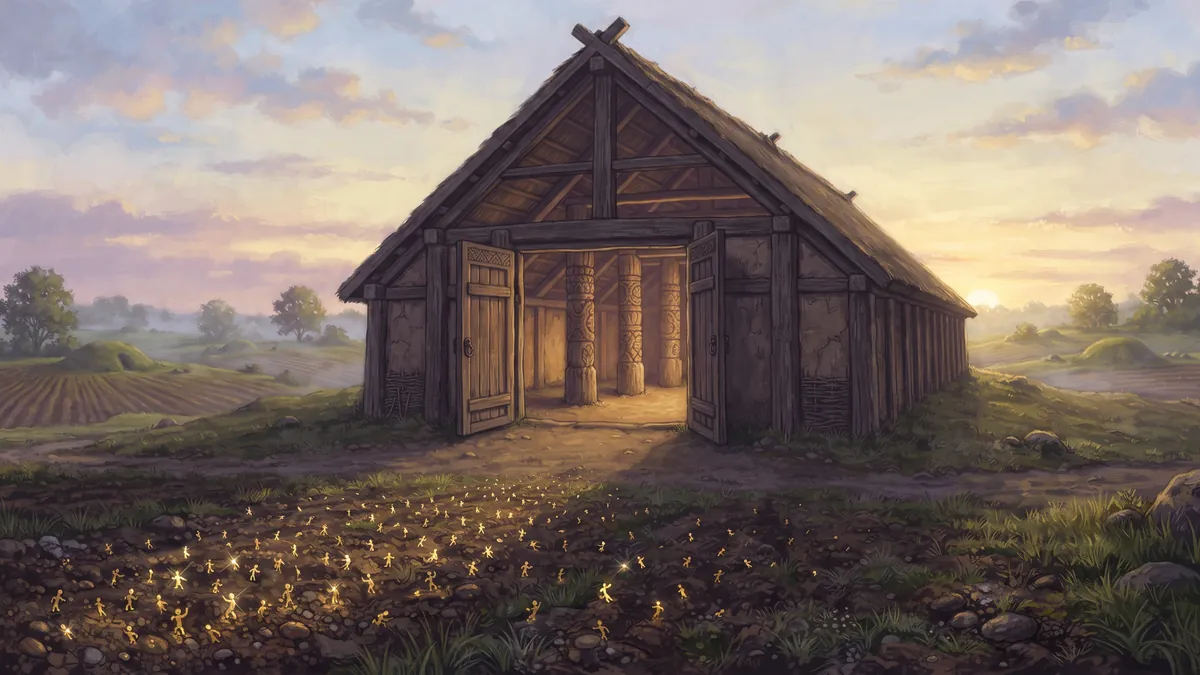
Excavated from 2000 to 2004, the building measures 13 by 6.5 metres and has three entrances. The walls were oak posts in trenches more than a metre deep, and four large central columns stood free of the walls. It was built in the 3rd century, on the site of an unusually large longhouse, and rebuilt six times on the same plan. The last version dates to the early Viking Age.
The gold foils
About 200 guldgubbar, small gold foils stamped with figures, were found in the wall trenches and postholes, more than at any other site in Sweden. Most show male figures, fewer show women, and some show couples. They resemble finds from Sorte Muld on Bornholm, and some were made from the same moulds. Their size suggests that they were offerings, probably linked to the erection of the building.
Other finds
Weapons, many deliberately broken, were found mostly north of the building, and spearpoints were the most numerous. A glass beaker with bronze and silver, from about the year 500, about 20 cm high and with bands of gold leaf showing humans, snakes and horses, was found near the hearth.
What is interpretation
Larsson (2007) argued that the building is “the first Scandinavian building for which the term ‘temple’ can be justly claimed”. Scholars call the building a hof, but the identification as a temple is described as possible, and the role of each entrance (men’s, women’s, priest’s) is a hypothesis. The two published reconstructions differ in the height of the walls.
In short
Uppåkra is a large, long-lived centre, with a cult building rebuilt six times and a collection of gold foils unique in Sweden. What exactly it served, and for whom, is a reading of the finds.
To sift the earth and find the gold foils among the stones, play The sieve of gold foils.
Sources.
- English Wikipedia, articles "Uppåkra" and "Uppåkra temple", for the excavation data
- Lars Larsson (2007), study of the ritual building at Uppåkra, cited in those articles