 MMXXVI
Vegvísir: the "way-finder" symbol from an Icelandic manuscript of 1860, not from the Viking Age
The Vegvísir is an Icelandic magical symbol, the "way-finder", recorded in the Huld manuscript of 1860 as protection in bad weather, and has no clear link to the Viking Age despite the nickname "Viking compass".
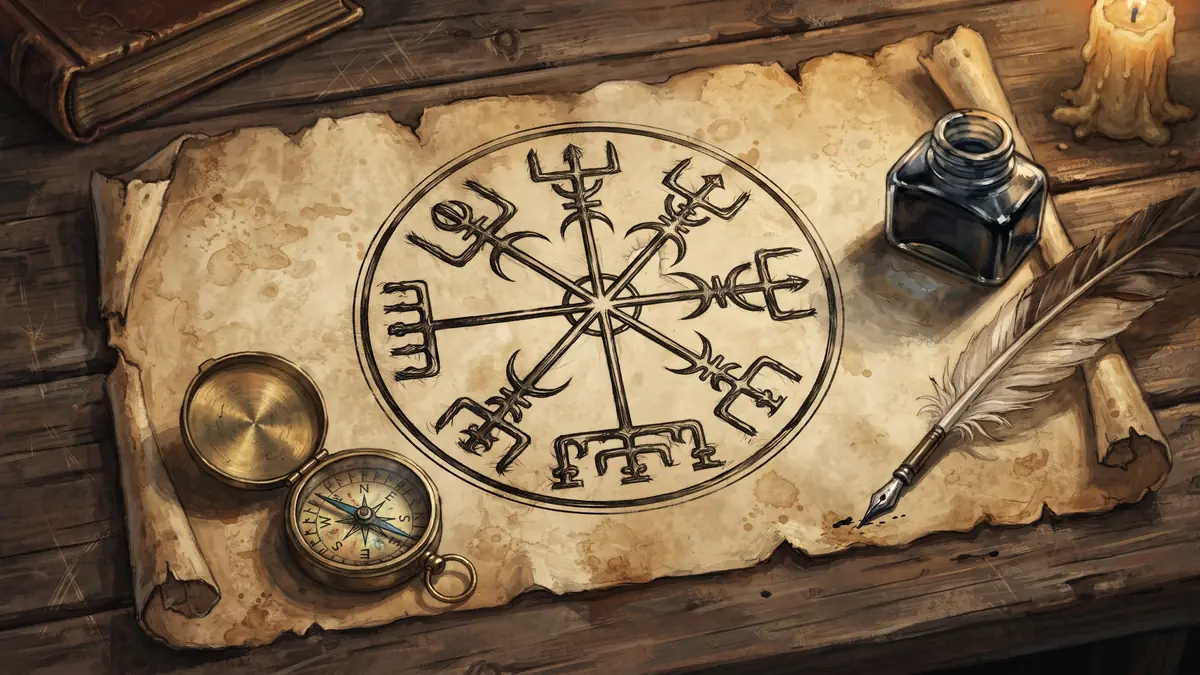
The Vegvísir is an Icelandic magical symbol, a galdrastafur, or “magical stave”, whose name means “way-finder”, from vegur, “way”, and vísir, from vísa, “to show”. It is much used today in jewellery and tattoos under the nickname “Viking compass”. The nickname is wrong.
Where it comes from
The oldest known record is the Huld manuscript, of 1860 (ÍB 383 4to), compiled by Geir Vigfússon in Akureyri. The Vegvísir is on page 60, and no earlier attestations are known. That means the image, as we know it, does not come from the Viking Age, which ended centuries before.
What the caption says
The leaf gives the name of the symbol and states that whoever carries it will not lose their way in storms or bad weather, “even when the way is not known”. It is a protection for travel, not an instrument of navigation.
The galdrastafir
The galdrastafir are signs with supposed magical effects, preserved in Icelandic grimoires such as the Galdrabók, from the 17th century onward. Other manuscripts cited on the source are the Huld itself, a 17th-century grimoire in Stockholm and manuscripts of the National Library in Reykjavík. There too are the Ægishjálmur, the “helm of terror”, linked to causing fear and protecting the warrior, and the Vegvísir, linked to bad weather.
What is certain and what is modern
What is certain is the manuscript of 1860, the caption and the use of magical signs in Icelandic grimoires. What is not certain, and the source does not support, is that this was used in the Viking Age or in navigation. The effects attributed to the signs are always supposed, never verified.
In short
It is a symbol of paper and ink, from a 19th-century Icelandic grimoire, with a promise of a safe road. To run through the storm without losing your bearings, play Through the storm.
Sources.
- Reference work in English, article "Vegvísir"
- Reference work in English, article "Icelandic magical staves"
- Huld manuscript (ÍB 383 4to), National Library of Iceland